


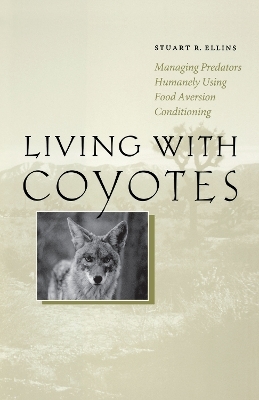
Living with Coyotes
Managing Predators Humanely Using Food Aversion Conditioning
Seiten
2005
University of Texas Press (Verlag)
978-0-292-71956-9 (ISBN)
University of Texas Press (Verlag)
978-0-292-71956-9 (ISBN)
A thoughtful, well-argued plea for using humane methods to manage North America's most adaptable animal predator.
The coyote may well be North America's most adaptable large predator. While humans have depleted or eliminated most other native predators, the coyote has defied all attempts to exterminate it, simultaneously expanding its range from coast to coast and from wilderness to urban areas. As a result, coyotes are becoming the focus of increasing controversy and emotion for people across the continent- from livestock growers who would like to eradicate coyotes to conservationists who would protect them at any cost.
In this thoughtful, well-argued, and timely book, Stuart Ellins makes the case that lethal methods of coyote management do not work and that people need to adopt a more humane way of coexisting with coyotes. Interweaving scientific data about coyote behavior and natural history with decades of field experience, he shows how endlessly adaptive coyotes are and how attempts to kill them off have only strengthened the species through natural selection. He then explains the process of taste aversion conditioning-which he has successfully employed-to stop coyotes from killing domestic livestock and pets. Writing frankly as an advocate of this effective and humane method of controlling coyotes, he asks, "Why are we mired in the use of archaic, inefficient, unsophisticated, and barbaric methods of wildlife management in this age of reason and high technology? This question must be addressed while there is still a wildlife to manage."
The coyote may well be North America's most adaptable large predator. While humans have depleted or eliminated most other native predators, the coyote has defied all attempts to exterminate it, simultaneously expanding its range from coast to coast and from wilderness to urban areas. As a result, coyotes are becoming the focus of increasing controversy and emotion for people across the continent- from livestock growers who would like to eradicate coyotes to conservationists who would protect them at any cost.
In this thoughtful, well-argued, and timely book, Stuart Ellins makes the case that lethal methods of coyote management do not work and that people need to adopt a more humane way of coexisting with coyotes. Interweaving scientific data about coyote behavior and natural history with decades of field experience, he shows how endlessly adaptive coyotes are and how attempts to kill them off have only strengthened the species through natural selection. He then explains the process of taste aversion conditioning-which he has successfully employed-to stop coyotes from killing domestic livestock and pets. Writing frankly as an advocate of this effective and humane method of controlling coyotes, he asks, "Why are we mired in the use of archaic, inefficient, unsophisticated, and barbaric methods of wildlife management in this age of reason and high technology? This question must be addressed while there is still a wildlife to manage."
Stuart R. Ellins is Professor Emeritus of Psychology at California State University, San Bernardino.
Preface
Chapter 1. Coyotes in My Pen
Chapter 2. Surviving the Onslaught
Chapter 3. A Balance of Power
Chapter 4. Surplus Killing
Chapter 5. An Opportunistic Scavenger: Coyote Feeding Habits
Chapter 6. Feeding the Pack: The Development of Dietary Preferences and Aversions
Chapter 7. To Eat or Not to Eat? Modification of Dietary Habits
Chapter 8. Conditioned Prey Aversions: Will They Work in the Real World?
Chapter 9. Predator Management: Sociology, Science, or Politics
Chapter 10. Current Status: The Application of Prey Aversion Conditioning
References
| Erscheint lt. Verlag | 1.10.2008 |
|---|---|
| Verlagsort | Austin, TX |
| Sprache | englisch |
| Maße | 140 x 216 mm |
| Gewicht | 454 g |
| Themenwelt | Sachbuch/Ratgeber ► Natur / Technik ► Naturführer |
| Naturwissenschaften ► Biologie ► Ökologie / Naturschutz | |
| Weitere Fachgebiete ► Land- / Forstwirtschaft / Fischerei | |
| ISBN-10 | 0-292-71956-6 / 0292719566 |
| ISBN-13 | 978-0-292-71956-9 / 9780292719569 |
| Zustand | Neuware |
| Informationen gemäß Produktsicherheitsverordnung (GPSR) | |
| Haben Sie eine Frage zum Produkt? |
Mehr entdecken
aus dem Bereich


aus dem Bereich
Buch | Hardcover (2019)
Quelle & Meyer (Verlag)
CHF 55,90


