


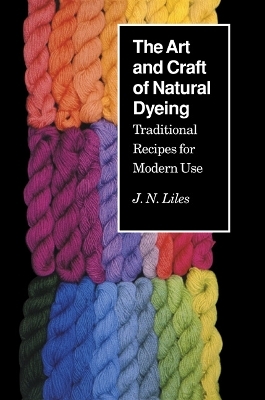
The Art and Craft of Natural Dyeing
Traditional Recipes for Modern Use
Seiten
1990
University of Tennessee Press (Verlag)
978-0-87049-670-7 (ISBN)
University of Tennessee Press (Verlag)
978-0-87049-670-7 (ISBN)
Consolidates the lore of the older dyers with the author’s own first-hand experience to produce both a history of natural dyes and a practical manual for using pre-synthetic era processes on all the natural fibres - cotton, linen, silk, and wool.
For several thousand years, all dyes were of animal, vegetable, or mineral origin, and many ancient civilizations possessed excellent dye technologies. The first synthetic dye was produced in 1856, and the use of traditional dyes declined rapidly thereafter. By 1915 few non-synthetics were used by industry or craftspeople. The craft revivals of the 1920s explored traditional methods of natural dyeing to some extent, particularly with wool, although the great eighteenth- and nineteenth-century dye manuals, which recorded the older processes, remained largely forgotten.
In The Art and Craft of Natural Dyeing, J. N. Liles consolidates the lore of the older dyers with his own first-hand experience to produce both a history of natural dyes and a practical manual for using pre–synthetic era processes on all the natural fibers--cotton, linen, silk, and wool. A general section on dyeing and mordanting and a glossary introduce the beginner to dye technology. In subsequent chapters, Liles summarizes the traditional dye methods available for each major color group. Scores of recipes provide detailed instructions on how to collect ingredients--flowers, weeds, insects, wood, minerals--prepare the dyevat, troubleshoot, and achieve specific shades.
The book will appeal not only to beginning and veteran dyers but to students of restorations and reconstruction as well as to craftspeople--spinners, quilters, weavers, knitters, and other textile artists--interested in natural dyes for their beauty and historical authenticity.
For several thousand years, all dyes were of animal, vegetable, or mineral origin, and many ancient civilizations possessed excellent dye technologies. The first synthetic dye was produced in 1856, and the use of traditional dyes declined rapidly thereafter. By 1915 few non-synthetics were used by industry or craftspeople. The craft revivals of the 1920s explored traditional methods of natural dyeing to some extent, particularly with wool, although the great eighteenth- and nineteenth-century dye manuals, which recorded the older processes, remained largely forgotten.
In The Art and Craft of Natural Dyeing, J. N. Liles consolidates the lore of the older dyers with his own first-hand experience to produce both a history of natural dyes and a practical manual for using pre–synthetic era processes on all the natural fibers--cotton, linen, silk, and wool. A general section on dyeing and mordanting and a glossary introduce the beginner to dye technology. In subsequent chapters, Liles summarizes the traditional dye methods available for each major color group. Scores of recipes provide detailed instructions on how to collect ingredients--flowers, weeds, insects, wood, minerals--prepare the dyevat, troubleshoot, and achieve specific shades.
The book will appeal not only to beginning and veteran dyers but to students of restorations and reconstruction as well as to craftspeople--spinners, quilters, weavers, knitters, and other textile artists--interested in natural dyes for their beauty and historical authenticity.
J. N. Liles is professor of zoology at the University of Tennessee, Knoxville. He has taught at Arrowmont School and other regional craft schools and has exhibited his work at the Arrowmont School, the Southern Highland Handicraft Guild Folk Art Center, and the Carol Reece Museum.
| Erscheint lt. Verlag | 30.11.1990 |
|---|---|
| Verlagsort | Chicago |
| Sprache | englisch |
| Maße | 153 x 233 mm |
| Gewicht | 379 g |
| Themenwelt | Sachbuch/Ratgeber ► Freizeit / Hobby ► Handarbeit / Textiles |
| Naturwissenschaften ► Chemie ► Technische Chemie | |
| Technik ► Umwelttechnik / Biotechnologie | |
| ISBN-10 | 0-87049-670-0 / 0870496700 |
| ISBN-13 | 978-0-87049-670-7 / 9780870496707 |
| Zustand | Neuware |
| Informationen gemäß Produktsicherheitsverordnung (GPSR) | |
| Haben Sie eine Frage zum Produkt? |
Mehr entdecken
aus dem Bereich



aus dem Bereich
Schnittmuster an die eigene Körperform anpassen
Buch | Hardcover (2025)
Edition Michael Fischer (Verlag)
CHF 34,90
Buch | Softcover (2024)
Edition Michael Fischer (Verlag)
CHF 24,90
dekorativer Christbaum-Schmuck von edel bis süß für ein zauberhaftes …
Buch | Softcover (2024)
Edition Michael Fischer (Verlag)
CHF 15,90


