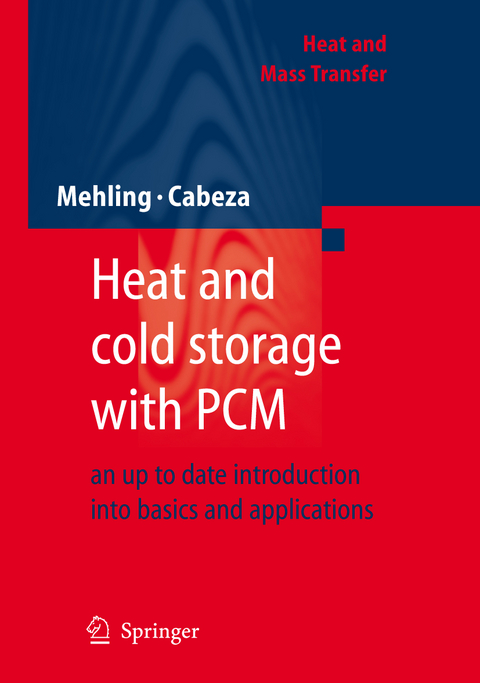
Heat and cold storage with PCM
Springer Berlin (Verlag)
978-3-540-68556-2 (ISBN)
The years 2006 and 2007 mark a dramatic change of peoples view regarding c- mate change and energy consumption. The new IPCC report makes clear that - mankind plays a dominant role on climate change due to CO emissions from en- 2 ergy consumption, and that a significant reduction in CO emissions is necessary 2 within decades. At the same time, the supply of fossil energy sources like coal, oil, and natural gas becomes less reliable. In spring 2008, the oil price rose beyond 100 $/barrel for the first time in history. It is commonly accepted today that we have to reduce the use of fossil fuels to cut down the dependency on the supply countries and to reduce CO emissions. The use of renewable energy sources and 2 increased energy efficiency are the main strategies to achieve this goal. In both strategies, heat and cold storage will play an important role. People use energy in different forms, as heat, as mechanical energy, and as light. With the discovery of fire, humankind was the first time able to supply heat and light when needed. About 2000 years ago, the Romans started to use ceramic tiles to store heat in under floor heating systems. Even when the fire was out, the room stayed warm. Since ancient times, people also know how to cool food with ice as cold storage.
Dr. Harald Mehling, born: 03.08.1966 Education: M.A. (SUNY Buffalo, USA), 1992; Diploma Physics, University of Würzburg (Germany), 1995; Ph.D., University of Würzburg (Germany), 1998 Since 1995 working at the Bavarian Center for applied Energy Research, since 1998 Group leader "Latent heat storage" Coordinator of the BMWA funded strategic project "Innovative PCM-technology" (budget about 6 Mio EUR, 1999-2004) Organizer of two workshops on latent heat storage Author or co-author of about 50 publications, with more than 20 reviewed Books contributions (4 chapters): Thermal energy storage for sustainable energy consumption - fundamentals, case studies and design; NATO Science series II. Mathematics, Physics and Chemistry - Vol. 234, Springer, 2007, ISBN 978-1-4020-5289-7 Editor: H.Ö.Paksoy
Basic thermodynamics of thermal energy storage.- Solid-liquid phase change materials.- Determination of physical and technical properties.- Heat transfer basics.- Design of latent heat storages.- Integration of active storages into systems.- Applications in transport and storage containers.- Applications for the human body.- Applications for heating and cooling in buildings.
| Erscheint lt. Verlag | 26.8.2008 |
|---|---|
| Reihe/Serie | Heat and Mass Transfer |
| Zusatzinfo | XVI, 308 p. 136 illus. |
| Verlagsort | Berlin |
| Sprache | englisch |
| Maße | 155 x 235 mm |
| Gewicht | 607 g |
| Themenwelt | Naturwissenschaften ► Chemie ► Technische Chemie |
| Technik | |
| Schlagworte | Applications • Cooling • Design • Energy Storage • Heat storage • heat transfer • Heat transfer basics • latent heat • Materials • PCM • phase change • thermodynamics • Wärmeübertragung • Wärmeübertragung |
| ISBN-10 | 3-540-68556-1 / 3540685561 |
| ISBN-13 | 978-3-540-68556-2 / 9783540685562 |
| Zustand | Neuware |
| Informationen gemäß Produktsicherheitsverordnung (GPSR) | |
| Haben Sie eine Frage zum Produkt? |
aus dem Bereich