Population Genetics
Wiley-Blackwell (Verlag)
978-1-4051-3277-0 (ISBN)
- Titel erscheint in neuer Auflage
- Artikel merken
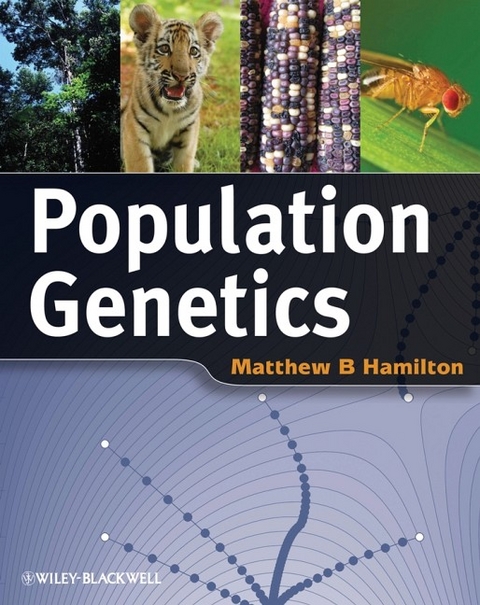
This book aims to make population genetics approachable, logical and easily understood. To achieve these goals, the book’s design emphasizes well explained introductions to key principles and predictions. These are augmented with case studies as well as illustrations along with introductions to classical hypotheses and debates. Pedagogical features in the text include:
Interact boxes that guide readers step-by-step through computer simulations using public domain software.
Math boxes that fully explain mathematical derivations.
Methods boxes that give insight into the use of actual genetic data.
Numerous Problem boxes are integrated into the text to reinforce concepts as they are encountered.
Dedicated website at www.wiley.com/go/hamiltongenetics
This text also offers a highly accessible introduction to coalescent theory, the major conceptual advance in population genetics of the last two decades.
Matthew B. Hamilton teaches population genetics, evolutionary processes, and similar undergraduate and graduate courses at Georgetown University. He conducts research on the processes that shape genetic variation within species using molecular genetic markers as well as predictive mathematical models.
Preface and acknowledgments xi
1 Thinking like a population geneticist 1
1.1 Expectations 1
Parameters and parameter estimates 2
Inductive and deductive reasoning 3
1.2 Theory and assumptions 4
1.3 Simulation 6
Interact box 1.1 The textbook website 7
Chapter 1 review 8
Further reading 8
2 Genotype frequencies 9
2.1 Mendel’s model of particulate genetics 9
2.2 Hardy–Weinberg expected genotype frequencies 13
Interact box 2.1 Genotype frequencies 14
2.3 Why does Hardy–Weinberg work? 17
2.4 Applications of Hardy–Weinberg 19
Forensic DNA profiling 19
Problem box 2.1 The expected genotype frequency for a DNA profile 22
Testing for Hardy–Weinberg 22
Box 2.1 DNA profiling 22
Interact box 2.2 χ2 test 26
Assuming Hardy–Weinberg to test alternative models of inheritance 26
Problem box 2.2 Proving allele frequencies are obtained from expected genotype frequencies 27
Problem box 2.3 Inheritance for corn kernel phenotypes 28
2.5 The fixation index and heterozygosity 28
Interact box 2.3 Assortative mating
and genotype frequencies 29
Box 2.2 Protein locus or allozyme genotyping 32
2.6 Mating among relatives 33
Impacts of inbreeding on genotype and allele frequencies 33
Inbreeding coefficient and autozygosity in a pedigree 34
Phenotypic consequences of inbreeding 37
The many meanings of inbreeding 40
2.7 Gametic disequilibrium 41
Interact box 2.4 Decay of gametic disequilibrium and a χ2 test 44
Physical linkage 45
Natural selection 46
Interact box 2.5 Gametic disequilibrium under both recombination and natural selection 46
Mutation 47
Mixing of diverged populations 47
Mating system 48
Chance 48
Interact box 2.6 Estimating genotypic disequilibrium 49
Chapter 2 review 50
Further reading 50
Problem box answers 51
3 Genetic drift and effective population size 53
3.1 The effects of sampling lead to genetic drift 53
Interact box 3.1 Genetic drift 58
3.2 Models of genetic drift 58
The binomial probability distribution 58
Problem box 3.1 Applying the binomial formula 60
Math box 3.1 Variance of a binomial variable 62
Markov chains 62
Interact box 3.2 Genetic drift simulated with a Markov chain model 65
Problem box 3.2 Constructing a transition probability matrix 66
The diffusion approximation of genetic drift 67
3.3 Effective population size 73
Problem box 3.3 Estimating Ne from information about N 77
3.4 Parallelism between drift and inbreeding 78
3.5 Estimating effective population size 80
Interact box 3.3 Heterozygosity,and inbreeding over time in finite populations 81
Different types of effective population size 82
Problem box 3.4 Estimating Ne from observed heterozygosity over time 85
Breeding effective population size 85
Effective population sizes of different genomes 87
3.6 Gene genealogies and the coalescent model 87
Math box 3.2 Approximating the probability of a coalescent event with the exponential distribution 93
Interact box 3.4 Build your own coalescent genealogies 94
3.7 Effective population size in the coalescent model 96
Interact box 3.5 Simulating gene genealogies in populations with different effective sizes 97
Coalescent genealogies and population bottlenecks 98
Coalescent genealogies in growing and shrinking populations 99
Interact box 3.6 Coalescent genealogies in populations with changing size 101
Chapter 3 review 101
Further reading 102
Problem box answers 103
4 Population structure and gene flow 105
4.1 Genetic populations 105
Method box 4.1 Are allele frequencies random or clumped in two dimensions? 110
4.2 Direct measures of gene flow 111
Problem box 4.1 Calculate the probability of a random haplotype match and the exclusion probability 117
Interact box 4.1 Average exclusion probability for a locus 117
4.3 Fixation indices to measure the pattern of population subdivision 118
Problem box 4.2 Compute FIS FST,and FIT 122
Method box 4.2 Estimating fixation indices 124
4.4 Population subdivision and the Wahlund effect 124
Interact box 4.2 Simulating the Wahlund effect 127
Problem box 4.3 Account for population structure in a DNA-profile match probability 130
4.5 Models of population structure 131
Continent-island model 131
Interact box 4.3 Continent-island model of gene flow 134
Two-island model 134
Infinite island model 135
Interact box 4.4 Two-island model of gene flow 136
Math box 4.1 The expected value of FST in the infinite island model 138
Problem box 4.4 Expected levels of FST for Y-chromosome and organelle loci 139
Interact box 4.5 Finite island model of gene flow 139
Stepping-stone and metapopulation models 141
4.6 The impact of population structure on genealogical branching 142
Combining coalescent and migration events 143
The average length of a genealogy with migration 144
Interact box 4.6 Coalescent events in two demes 145
Math box 4.2 Solving two equations with two unknowns for average coalescence times 148
Chapter 4 review 149
Further reading 150
Problem box answers 151
5 Mutation 154
5.1 The source of all genetic variation 154
5.2 The fate of a new mutation 160
Chance a mutation is lost due to Mendelian segregation 160
Fate of a new mutation in a finite population 162
Interact box 5.1 Frequency of neutral mutations in a finite population 163
Geometric model of mutations fixed by natural selection 164
Muller’s Ratchet and the fixation of deleterious mutations 166
Interact box 5.2 Muller’s Ratchet 168
5.3 Mutation models 168
Mutation models for discrete alleles 169
Interact box 5.3 RST and FST as examples of the consequences of different mutation models 172
Mutation models for DNA sequences 172
5.4 The influence of mutation on allele frequency and autozygosity 173
Math box 5.1 Equilibrium allele frequency with two-way mutation 176
Interact box 5.4 Simulating irreversible and bi-directional mutation 177
5.5 The coalescent model with mutation 178
Interact box 5.5 Build your own coalescent genealogies with mutation 181
Chapter 5 review 183
Further reading 183
6 Fundamentals of natural selection 185
6.1 Natural selection 185
Natural selection with clonal reproduction 185
Problem box 6.1 Relative fitness of HIV genotypes 189
Natural selection with sexual reproduction 189
6.2 General results for natural selection on a diallelic locus 193
Math box 6.1 The change in allele frequency each generation under natural selection 194
Selection against a recessive phenotype 195
Selection against a dominant phenotype 196
General dominance 197
Heterozygote disadvantage 198
Heterozygote advantage 198
The strength of natural selection 199
Math box 6.2 Equilibrium allele frequency with overdominance 200
6.3 How natural selection works to increase average fitness 200
Average fitness and rate of change in allele frequency 201
Problem box 6.2 Mean fitness and change in allele frequency 203
The fundamental theorem of natural selection 203
Interact box 6.1 Natural selection on one locus with two alleles 203
Chapter 6 review 206
Further reading 206
Problem box answers 206
7 Further models of natural selection 208
7.1 Viability selection with three alleles or two loci 208
Natural selection on one locus with three alleles 209
Problem box 7.1 Marginal fitness and Δp for the Hb C allele 211
Interact box 7.1 Natural selection on one locus with three or more alleles 211
Natural selection on two diallelic loci 212
7.2 Alternative models of natural selection 216
Natural selection via different levels of fecundity 216
Natural selection with frequency-dependent fitness 218
Natural selection with density-dependent fitness 219
Math box 7.1 The change in allele frequency with frequency-dependent selection 219
Interact box 7.2 Frequency-dependent natural selection 220
Interact box 7.3 Density-dependent natural selection 222
7.3 Combining natural selection with other processes 222
Natural selection and genetic drift acting simultaneously 222
Interact box 7.4 The balance of natural selection and genetic drift at a diallelic locus 224
The balance between natural selection and mutation 225
Interact box 7.5 Natural selection and mutation 226
7.4 Natural selection in genealogical branching models 226
Directional selection and the ancestral selection graph 227
Problem box 7.2 Resolving possible selection events on an ancestral selection graph 230
Genealogies and balancing selection 230
Interact box 7.6 Coalescent genealogies with directional selection 231
Chapter 7 review 232
Further reading 233
Problem box answers 234
8 Molecular evolution 235
8.1 The neutral theory 235
Polymorphism 236
Divergence 237
Nearly neutral theory 240
Interact box 8.1 The relative strengths of genetic drift and natural selection 241
8.2 Measures of divergence and polymorphism 241
Box 8.1 DNA sequencing 242
DNA divergence between species 242
DNA sequence divergence and saturation 243
DNA polymorphism 248
8.3 DNA sequence divergence and the molecular clock 250
Interact box 8.2 Estimating π and S from DNA sequence data 251
Dating events with the molecular clock 252
Problem box 8.1 Estimating divergence times with the molecular clock 254
8.4 Testing the molecular clock hypothesis and explanations for rate variation in molecular evolution 255
The molecular clock and rate variation 255
Ancestral polymorphism and Poisson process molecular clock 257
Math box 8.1 The dispersion index with ancestral polymorphism and divergence 259
Relative rate tests of the molecular clock 260
Patterns and causes of rate heterogeneity 261
8.5 Testing the neutral theory null model of DNA sequence evolution 265
HKA test of neutral theory expectations for DNA sequence evolution 265
MK test 267
Tajima’s D 269
Problem box 8.2 Computing Tajima’s D from DNA sequence data 271
Mismatch distributions 272
Interact box 8.3 Mismatch distributions for neutral genealogies in stable growing or shrinking populations 274
8.6 Molecular evolution of loci that are not independent 274
Genetic hitch-hiking due to background or balancing selection 278
Gametic disequilibrium and rates of divergence 278
Chapter 8 review 279
Further reading 280
Problem box answers 281
9 Quantitative trait variation and evolution 283
9.1 Quantitative traits 283
Problem box 9.1 Phenotypic distribution produced by Mendelian inheritance of three diallelic loci 285
Components of phenotypic variation 286
Components of genotypic variation (VG) 288
Inheritance of additive (VA) dominance (VD) and epistasis (VI) genotypic variation 291
Genotype-by-environment interaction (VG×E) 292
Additional sources of phenotypic variance 295
Math box 9.1 Summing two variances 296
9.2 Evolutionary change in quantitative traits 297
Heritability 297
Changes in quantitative trait mean and variance due to natural selection 299
Estimating heritability by parent–offspring regression 302
Interact box 9.1 Estimating heritability with parent–offspring regression 303
Response to selection on correlated traits 304
Interact box 9.2 Response to natural selection on two correlated traits 306
Long-term response to selection 307
Interact box 9.3 Response to selection and the number of loci that cause quantitative trait variation 309
Neutral evolution of quantitative traits 313
Interact box 9.4 Effective population size and genotypic variation in a neutral quantitative trait 314
9.3 Quantitative trait loci (QTL) 315
QTL mapping with single marker loci 316
Problem box 9.2 Compute the effect and dominance coefficient of a QTL 321
QTL mapping with multiple marker loci 322
Problem box 9.3 Derive the expected marker-class means for a backcross mating design 324
Limitations of QTL mapping studies 325
Biological significance of QTL mapping 326
Interact box 9.5 Effect sizes and response to selection at QTLs 328
Chapter 9 review 330
Further reading 330
Problem box answers 331
10 The Mendelian basis of quantitative trait variation 334
10.1 The connection between particulate inheritance and quantitative trait variation 334
Scale of genotypic values 334
Problem box 10.1 Compute values on the genotypic scale of measurement for IGF1 in dogs 335
10.2 Mean genotypic value in a population 336
10.3 Average effect of an allele 337
Math box 10.1 The average effect of the A1 allele 339
Problem box 10.2 Compute the allele average effect of the IGF1 A2 allele in dogs 341
10.4 Breeding value and dominance deviation 341
Interact box 10.1 Average effects breeding values and dominance deviations 345
Dominance deviation 345
10.5 Components of total genotypic variance 348
Interact box 10.2 Components of total genotypic variance VG 350
Math box 10.2 Deriving the total genotypic variance VG 350
10.6 Genotypic resemblance between relatives 351
Chapter 10 review 354
Further reading 354
Problem box answers 355
11 Historical and synthetic topics 356
11.1 Historical controversies in population genetics 356
The classical and balance hypotheses 356
How to explain levels of allozyme polymorphism 358
Genetic load 359
Math box 11.1 Mean fitness in a population at equilibrium for balancing selection 362
The selectionist/neutralist debates 363
11.2 Shifting balance theory 366
Allele combinations and the fitness surface 366
Wright’s view of allele-frequency distributions 368
Evolutionary scenarios imagined by Wright 369
Critique and controversy over shifting balance 372
Chapter 11 review 374
Further reading 374
Appendix 376
Statistical uncertainty 376
Problem box A.1 Estimating the variance 378
Interact box A.1 The central limit theorem 379
Covariance and correlation 380
Further reading 382
Problem box answers 382
References 383
Index 396
Color plates appear in between pages 114 –115
| Erscheint lt. Verlag | 20.3.2009 |
|---|---|
| Verlagsort | Hoboken |
| Sprache | englisch |
| Maße | 224 x 277 mm |
| Gewicht | 1565 g |
| Themenwelt | Naturwissenschaften ► Biologie ► Evolution |
| Naturwissenschaften ► Biologie ► Genetik / Molekularbiologie | |
| Naturwissenschaften ► Biologie ► Ökologie / Naturschutz | |
| ISBN-10 | 1-4051-3277-9 / 1405132779 |
| ISBN-13 | 978-1-4051-3277-0 / 9781405132770 |
| Zustand | Neuware |
| Informationen gemäß Produktsicherheitsverordnung (GPSR) | |
| Haben Sie eine Frage zum Produkt? |
aus dem Bereich