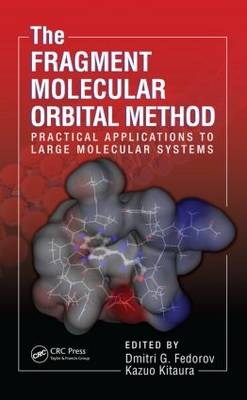
The Fragment Molecular Orbital Method
Crc Press Inc (Verlag)
978-1-4200-7848-0 (ISBN)
- Titel ist leider vergriffen;
keine Neuauflage - Artikel merken
Answering the need to facilitate quantum-chemical calculations of systems with thousands of atoms, Kazuo Kitaura and his coworkers developed the Fragment Molecular Orbital (FMO) method in 1999. Today, the FMO method can be applied to the study of whole proteins and protein–ligand interactions, and is extremely effective in calculating the properties of biological systems and molecular clusters.
Providing a unique and accessible approach, The Fragment Molecular Orbital Method: Practical Applications to Large Molecular Systems is for those researchers eager to obtain useful information from electronic structure calculations of large systems, and for those who wish to know what can be elucidated with the calculations at present and in the near future. The text emphasizes the practical aspects, with as little mathematical detail as possible and in language that is easy to understand.
The free modeling software Facio, in which FMO-related functions are implemented, is provided on the accompanying CD-ROM, which also provides input file samples, usage hints, annotated output from typical calculations, easy-to-follow tutorial material, and AppliGuide movies that show the sequence of mouse operations for data processing.
The book encourages readers to perform their own calculations — describing the features of the freely available FMO programs (GAMESS and ABINIT-MP) and reviewing many successful applications of the FMO method to practical problems. Filled with practical advice from the inventors of the method and from world-renowned contributors, this reference provides general scientists with the foundation required to use FMO computational methods in a wide range of biomolecular applications, including drug design, protein–ligand binding, enzyme reactivity, and light-driven processes.
Developers interested in extending FMO capabilities or in advancing their own methods will find sufficient information a
Dmitri Fedorov, Kazuo Kitaura
Introduction. Theoretical Background of the Fragment Molecular Orbital (Fmo) Method and Its Implementation in GAMES. Developments of FMO Methodology and Graphical User Interface in ABINIT-MP. Excited States of Photoactive Proteins by Configuration Interaction Studies. The Fragment Molecular Orbital–Based Time-Dependent Density Functional Theory for Excited States in Large Systems. FMO-MD: An Ab Initio-Based Molecular Dynamics of Large Systems. Application of the FMO Method to Specific Molecular Recognition of Biomacromolecules. Detailed Electronic Structure Studies Revealing the Nature of Protein–Ligand Binding. How Does the FMO Method Help in Studying Viruses and Their Binding to Receptors? FMO as a Tool for Structure-Based Drug Design. Modeling a Protein Environment in an Enzymatic Catalysis: A Case Study of the Chorismate Mutase Reaction. Index.
| Erscheint lt. Verlag | 18.5.2009 |
|---|---|
| Zusatzinfo | color insert - 20 figures total |
| Verlagsort | Bosa Roca |
| Sprache | englisch |
| Maße | 156 x 234 mm |
| Gewicht | 567 g |
| Themenwelt | Naturwissenschaften ► Biologie |
| Naturwissenschaften ► Chemie ► Physikalische Chemie | |
| Naturwissenschaften ► Physik / Astronomie ► Angewandte Physik | |
| Naturwissenschaften ► Physik / Astronomie ► Atom- / Kern- / Molekularphysik | |
| ISBN-10 | 1-4200-7848-8 / 1420078488 |
| ISBN-13 | 978-1-4200-7848-0 / 9781420078480 |
| Zustand | Neuware |
| Informationen gemäß Produktsicherheitsverordnung (GPSR) | |
| Haben Sie eine Frage zum Produkt? |
aus dem Bereich