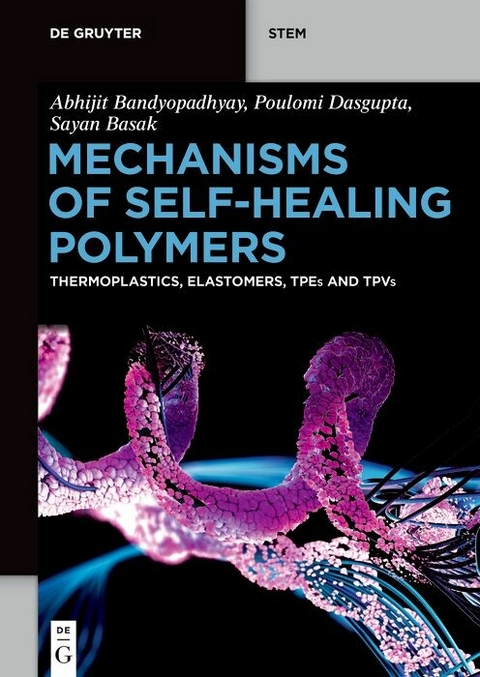
Mechanisms of Self-Healing Polymers (eBook)
219 Seiten
Walter de Gruyter GmbH & Co.KG (Verlag)
978-3-11-158371-6 (ISBN)
Self-healing synthetic materials have the ability to repair damage on their own, restoring functionality and significantly extending the lifespan, energy efficiency, safety, and environmental impact of synthetic materials. These materials can mimic self-repair mechanisms in biological materials and regain their original functionalities, ensuring prolonged durability. Methods for repairing mechanically damaged polymeric materials include using photo-activated healing agents, reversible covalent bonds, cycloaddition reactions, metal-ligand complexes, and dynamic non-covalent bonding. The initial chapter of the book lays the introduction by offering a fundamental overview of self-healing materials. It encompasses a spectrum of smart materials, from self-healing polymers to self-healing ceramics. The next section introduces the mechanisms that endow these materials with their remarkable properties. It explores various self-healing strategies, underlying chemistries, and stimulus responsiveness crucial for achieving these self-repairing abilities. The book then focuses on the processing aspect of these materials, detailing diverse fabrication methods used for developing these intelligent polymers, both in laboratory settings and at an industrial scale. The next section centers on self-healing elastomers, encompassing thermoplastic elastomers and thermoplastic vulcanizates. It not only provides an overview but delves into the synthesis, structure-property relationships, and applications of these elastomers molded as self-healing materials. The book concludes with potential applications of these smart materials. It is structured around specific properties such as mechanical or rheological characteristics, showcasing how these traits inspire the practical application of self-healing elastomers.
| Erscheint lt. Verlag | 1.12.2025 |
|---|---|
| Sprache | englisch |
| Themenwelt | Naturwissenschaften ► Chemie |
| Wirtschaft | |
| ISBN-10 | 3-11-158371-6 / 3111583716 |
| ISBN-13 | 978-3-11-158371-6 / 9783111583716 |
| Informationen gemäß Produktsicherheitsverordnung (GPSR) | |
| Haben Sie eine Frage zum Produkt? |
 PDF (Wasserzeichen)
Größe: 12,3 MB
DRM: Digitales Wasserzeichen
Dieses eBook enthält ein digitales Wasserzeichen und ist damit für Sie personalisiert. Bei einer missbräuchlichen Weitergabe des eBooks an Dritte ist eine Rückverfolgung an die Quelle möglich.
Dateiformat: PDF (Portable Document Format)
Mit einem festen Seitenlayout eignet sich die PDF besonders für Fachbücher mit Spalten, Tabellen und Abbildungen. Eine PDF kann auf fast allen Geräten angezeigt werden, ist aber für kleine Displays (Smartphone, eReader) nur eingeschränkt geeignet.
Systemvoraussetzungen:
PC/Mac: Mit einem PC oder Mac können Sie dieses eBook lesen. Sie benötigen dafür einen PDF-Viewer - z.B. den Adobe Reader oder Adobe Digital Editions.
eReader: Dieses eBook kann mit (fast) allen eBook-Readern gelesen werden. Mit dem amazon-Kindle ist es aber nicht kompatibel.
Smartphone/Tablet: Egal ob Apple oder Android, dieses eBook können Sie lesen. Sie benötigen dafür einen PDF-Viewer - z.B. die kostenlose Adobe Digital Editions-App.
Buying eBooks from abroad
For tax law reasons we can sell eBooks just within Germany and Switzerland. Regrettably we cannot fulfill eBook-orders from other countries.
aus dem Bereich