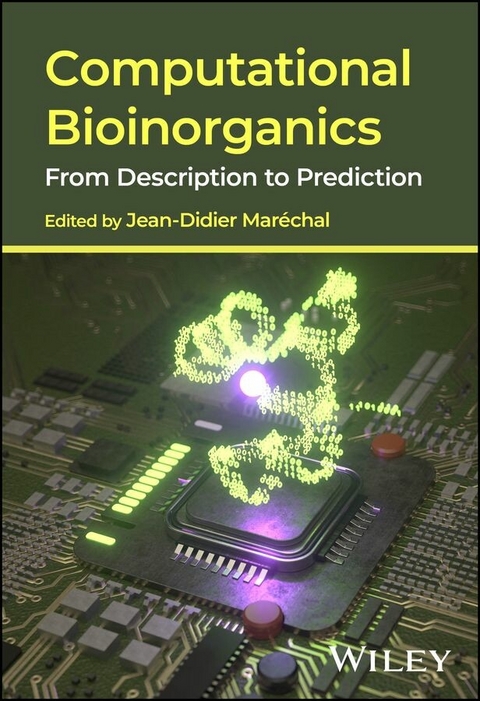
Computational Bioinorganics (eBook)
343 Seiten
Wiley (Verlag)
978-1-119-41524-4 (ISBN)

An in-depth overview of what computation can do in bioinorganic chemistry, written for experimentalists and theoreticians
The last decades have shown the emergence of numerous exiting fields in bioinorganic chemistry, such as the design of de novo metalloenzymes, the discovery of new bioactive metallodrugs, or the characterization of molecular mechanisms by which living organisms acquire their metal. In parallel, the computational chemistry community has been working hard on optimizing its framework to deal with biometallic systems; a phenomenon magnified by the increase of computational power and the advent of AI approaches.
Computational Bioinorganics: From Description to Prediction provides an updated view on the current state-of-the-art of the field. The book first intends to clarify how computational and experimental researchers in bioinorganic chemistry can now collaborate under this new computational paradigm. It then follows with a series of chapters that cover a wide range of computational approaches, strategies, and applications. Contributions from a team of experts in computational chemistry expose methods that range from structural bioinformatics, quantum chemistry, large-scale molecular dynamics or multi-scale strategies. They illustrate how these tools can be applied to a wide variety of topics such as the modeling of metal-mediated folding processes, the computer-aided design of metalloenzymes, spectroscopic analysis, the prediction of metal binding sites in proteins or the characterization of the interaction of metallodrugs with biomolecules.
Edited by a recognized leader in the field, Computational Bioinorganics: From Description to Prediction is an essential resource for academic and industrial researchers working in the fields of bioinorganic chemistry, coordination chemistry, biochemistry, computational chemistry, biophysics, bioinformatics, and protein engineering.
Jean-Didier Maréchal is a Full Professor of Physical Chemistry at the Universitat Autònoma de Barcelona (Autonomous University of Barcelona), Spain. An expert in modeling bioinorganic systems, Professor Maréchal's research focuses on computational bioinorganics applied to topics such as the design of artificial metalloenzymes, metallopeptides, and metallodrugs, as well as uncovering the molecular mechanisms that sustain metal homeostasis in humans and pathogens.
Chapter 1
What Could Bring Theory to Modern Bioinorganics: A Conversation?
Gerard Roelfes1 and Jean-Didier Maréchal2
1 Biomolecular Chemistry and Catalysis, Stratingh Institute for Chemistry, University of Groningen, Groningen, The Netherlands
2 Insilichem, Departament de Química, Universitat Autònoma de Barcelona, Bellaterra, Spain
In this exercise, Gerard Roelfes plays the part of the experimental bioinorganic chemist and Jean-Didier Maréchal, the part of the computational one.
Jean-Didier Maréchal (question [Q]): My entire scientific life has been dedicated to metals in biological systems, and I feel like an expert bioinorganic chemist. But what has struck me the most during the more than 20 years I spent on the subject is the increase in the number of fields in which bioinorganics is involved! From your perspective, what characterizes nowadays the fields of application of bioinorganics?
Gerard Roelfes (answer [A]): Indeed, the field of bioinorganic chemistry has evolved a lot over the past decades. When I started in this field (many years ago…….), a significant focus was on structural and functional models for metalloproteins and enzymes. The models were small molecule compounds that were used to study the spectroscopic properties of these coordination complexes, to discover the spectroscopic signatures of reactive intermediates (for example, metal oxo, superoxide, and peroxo complexes), and to study their reactivity, and in this way, learn about mechanism. While this is still a significant focus of attention, the field’s center of gravity has switched more to the biological systems themselves. This is, among others, due to the developments in spectroscopy, which make it possible to study biological systems directly without using model complexes. Also, the developments in biochemistry and molecular biology over the past decades have made it possible, even for nonexperts, to create proteins with any desired mutation, handle cell cultures, etc. So, bioinorganic chemistry is now being studied in more complex environments.
Gerard Roelfes (Q): I observe that molecular modeling is becoming increasingly relevant in molecular sciences. Let’s consider bioinorganic chemistry. However, I feel that the focus still often is on simplified complexes (to reduce computation effort?) and idealized conditions (e.g. gas phase), which may not translate very well to the (biological) system of interest. Why do we still focus on systems of small dimensions?
Jean-Didier Maréchal (A): You are right; little could be argued regarding the increase in the application of molecular modeling in molecular sciences. From small systems to solids, nanoparticles, or polymers, molecular modeling is now widely used in fields ranging from interstellar chemistry to atmospheric phenomena, homogeneous and heterogeneous catalysis, and biochemical processes. The Nobel Prizes in Chemistry awarded in 2013 to Levitt, Warshell, and Karplus and, more recently, in 2024 to Baker, Hassabis, and Jumper are clear examples of the rise of molecular modeling in chemistry and biology. However, molecular modeling is a generic term that covers many methods and answering that question obliges to discuss essential aspects of molecular modeling, especially in calculating energy and exploring conformational space.
Regarding energy calculation, methods can be classified depending on their physical models. Two prominent families exist: quantum mechanics (QM) and molecular mechanics (MM). On one side, QM methods consider the quantum nature of the system, and their primary interest in many chemistry fields lays on their ability to evaluate the electronic properties of the systems explicitly. On the other side, MM methods are based on classical physics and do not explicitly consider the electrons as separated entities but rather incorporate them, together with the nuclei, in atomic potentials. In this kind of method, the cohesion of the molecular structure and its energetic behavior are provided by a network of parametric functions that reproduce bonded (e.g. covalent) and nonbonded (e.g. electrostatic) interactions between atoms. The ensemble of functions that defines the system is called the force field.
There is a wide range of methods in the QM and MM realms. But your question regarding small systems mostly refers to QM models used for biomimetic models or truncated parts of a metalloprotein. The use of this strategy lays on two fundamental aspects QM methods offer: the accuracy in representing the metals’ electronic properties on one side and a high computational cost on the other. QM approaches, like post-Hartree-Fock or functional density theories (DFT), are the most indicated to study any phenomenon that implies electronic processes like catalysis, red-ox, changes in the coordination sphere, and many kinds of spectroscopies. Those processes are the focus of interest in many studies in bioinorganics and are fundamentally driven by the first coordination sphere. Unfortunately, QM calculations are computationally too expensive to be performed on a complete protein, and the dimension of the system must be reduced. The most critical aspect of these modeling exercises is to correctly ascertain the dimensional model so that the protein’s principal features are well reproduced despite reducing the number of atoms involved. For a metalloenzyme, for example, we tend to model its active site by including the first coordination sphere and incorporating as many residues of the second coordination sphere as possible.
Another reason that often conditions the use of QM over MM is that dealing with the electronic properties of the metal are challenging for MM methods. Parametrization of the force field functions, one of the critical steps in the way, is generally more complex in those cases than for organic molecules, and only described one unique coordination state at a time. Yet, molecular modeling studies are increasingly escaping the scope of small-dimension truncated models. For example, QM/MM calculations are an option when we look at reactivity. In those approaches, you can deal with the whole protein system, including the protein region that needs accurate electronic representation to be handled in the QM part and the rest of the system to be incorporated in the MM one. However, these types of calculations remain limited in terms of geometric exploration.
Gerard Roelfes (Q): This would explain why QM and small models have been so prominent in bioinorganic chemistry. However, I would like to get a better sense of what modeling can do and the challenges of the field, especially regarding the “real” dimensions. What are the limits regarding size and conditions?
Jean-Didier Maréchal (A): Well, when it comes to dealing with systems of large dimensions, modeling requires MM approaches. This drastically reduces the cost of calculating the energy by several orders of magnitude regarding QM; therefore, MM methods allow for the work of systems of large dimensions like proteins and DNA, and they can even be solvated in solvents or bound to membranes. The difference in computational cost between QM and MM methods is not limited to the size of the systems (number of atoms), but also the number of conformations could be explored (sampling). QM methods allow sampling that rarely explores phenomena higher than the scale fs or ps. In a chemical context, a typical application would characterize a reaction’s transition state and the systems’ local rearrangement. On the other side, MM methods enable calculations on a comprehensive set of conformations far wider than QM affords. Allied with the power of current computational architectures, this means that MM techniques can simulate events occurring at the microsecond timescale and in some cases milliseconds. This enables the study of stability and dynamical properties like folding, conformational changes, or even binding between partners.
As a last pointer, there are many ways to explore the conformational landscape, and their application depends on the focus of attention and the cost of calculating the energy. Calculations can focus on identifying global minima (e.g., minimization schemes or genetic algorithms), providing sampling that offers a vast statistical ensemble with thermodynamical meaning (e.g. Monte Carlo), or also generating the trajectory of the system’s molecular motions, even at a long-time scale (e.g. molecular dynamics).
As you can see, molecular modeling encompasses numerous methodologies applicable to small models and accurate electronic descriptions, large systems and massive conformational sampling, and everything in the middle. In this landscape, modelers can overcome the limitations of each separate method by combining them in integrative pipelines. For example, pure QM methods on small models of the active site of a metalloenzyme can be used to investigate the core of the catalytic properties of an enzyme, QM/MM the impact of residues in the binding site in this process, and large-scale molecular dynamics the stability of the enzyme-substrate complex. This multiscale philosophy enables pushing the frontiers of molecular modeling in bioinorganics.
Gerard Roelfes (Q): Still, I feel that certain metals are more frequently studied than others. Which metals are “easy” and which are challenging, and why?
Jean-Didier Maréchal (A): It is a question difficult to answer. That depends. In a way, when we talk about the “easiness” of the modeling regarding the nature of the...
| Erscheint lt. Verlag | 13.1.2026 |
|---|---|
| Sprache | englisch |
| Themenwelt | Naturwissenschaften ► Chemie ► Anorganische Chemie |
| Schlagworte | computational bioinorganics • computational bioinorganics advances • computational bioinorganics applications • computational bioinorganics artificial metalloenzymes • computational bioinorganics biosensors • computational bioinorganics metallodrugs |
| ISBN-10 | 1-119-41524-1 / 1119415241 |
| ISBN-13 | 978-1-119-41524-4 / 9781119415244 |
| Informationen gemäß Produktsicherheitsverordnung (GPSR) | |
| Haben Sie eine Frage zum Produkt? |
 EPUB (Adobe DRM)
Kopierschutz: Adobe-DRM
Adobe-DRM ist ein Kopierschutz, der das eBook vor Mißbrauch schützen soll. Dabei wird das eBook bereits beim Download auf Ihre persönliche Adobe-ID autorisiert. Lesen können Sie das eBook dann nur auf den Geräten, welche ebenfalls auf Ihre Adobe-ID registriert sind.
Details zum Adobe-DRM
Dateiformat: EPUB (Electronic Publication)
EPUB ist ein offener Standard für eBooks und eignet sich besonders zur Darstellung von Belletristik und Sachbüchern. Der Fließtext wird dynamisch an die Display- und Schriftgröße angepasst. Auch für mobile Lesegeräte ist EPUB daher gut geeignet.
Systemvoraussetzungen:
PC/Mac: Mit einem PC oder Mac können Sie dieses eBook lesen. Sie benötigen eine
eReader: Dieses eBook kann mit (fast) allen eBook-Readern gelesen werden. Mit dem amazon-Kindle ist es aber nicht kompatibel.
Smartphone/Tablet: Egal ob Apple oder Android, dieses eBook können Sie lesen. Sie benötigen eine
Geräteliste und zusätzliche Hinweise
Buying eBooks from abroad
For tax law reasons we can sell eBooks just within Germany and Switzerland. Regrettably we cannot fulfill eBook-orders from other countries.
aus dem Bereich