


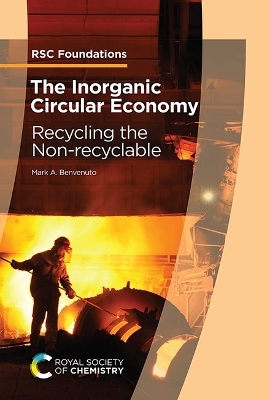
The Inorganic Circular Economy
Recycling the Non-recyclable
Seiten
2026
Royal Society of Chemistry (Verlag)
978-1-83767-519-7 (ISBN)
Royal Society of Chemistry (Verlag)
978-1-83767-519-7 (ISBN)
- Noch nicht erschienen (ca. Juni 2026)
- Versandkostenfrei
- Auch auf Rechnung
- Artikel merken
Discover which inorganic materials can be recycled, which could be recyclable in the future and which may never be recyclable.
Modern technologies rely heavily on a number of inorganic elements. From the lithium in your laptop battery to the helium that cools hospital MRI machines inorganic materials are crucial to many parts of life. The supply of these materials that we can extract from the environment is finite and many of them present an environmental hazard when concentrated in landfill waste. Recycling is therefore key to being able to continue to sustainably use these elements.
Examining in detail the many materials that can be classified as inorganic, and for which recycling is either non-existent or only in its infancy this book will help you to understand whether such materials can be re-used in some way, and how we might make advances into the recycling, re-use, and possible repurposing of any such materials or objects. Throughout, the discussion of how or if these materials can be recycled is balanced with economic and practical considerations.
Modern technologies rely heavily on a number of inorganic elements. From the lithium in your laptop battery to the helium that cools hospital MRI machines inorganic materials are crucial to many parts of life. The supply of these materials that we can extract from the environment is finite and many of them present an environmental hazard when concentrated in landfill waste. Recycling is therefore key to being able to continue to sustainably use these elements.
Examining in detail the many materials that can be classified as inorganic, and for which recycling is either non-existent or only in its infancy this book will help you to understand whether such materials can be re-used in some way, and how we might make advances into the recycling, re-use, and possible repurposing of any such materials or objects. Throughout, the discussion of how or if these materials can be recycled is balanced with economic and practical considerations.
Mark Benvenuto received his undergraduate degree from the Virginia Military Institute, and after four years as a lieutenant in the United States Army, his PhD in inorganic chemistry from the University of Virginia. After a 2-year post-doctoral fellowship at the Pennsylvania State University, he joined the faculty at the University of Detroit Mercy, where he has now been for 30 years. He teaches a course on industrial chemistry whenever it is offered, and has authored several books on the subject.
Introduction
Alkali Metals and Alkaline Earth Metals
Early Transition Metals
Mid-transition Metals
Late Transition Metals
Post-transition Elements
Lanthanides
Actinides
Helium
Directions for the Future
| Erscheint lt. Verlag | 19.6.2026 |
|---|---|
| Reihe/Serie | RSC Foundations ; Volume 5 |
| Verlagsort | Cambridge |
| Sprache | englisch |
| Maße | 156 x 234 mm |
| Themenwelt | Naturwissenschaften ► Biologie ► Ökologie / Naturschutz |
| Naturwissenschaften ► Chemie ► Anorganische Chemie | |
| ISBN-10 | 1-83767-519-8 / 1837675198 |
| ISBN-13 | 978-1-83767-519-7 / 9781837675197 |
| Zustand | Neuware |
| Informationen gemäß Produktsicherheitsverordnung (GPSR) | |
| Haben Sie eine Frage zum Produkt? |
Mehr entdecken
aus dem Bereich


aus dem Bereich
Methoden – Lösungen – Anwendungen
Buch | Hardcover (2025)
Hanser (Verlag)
CHF 69,95


