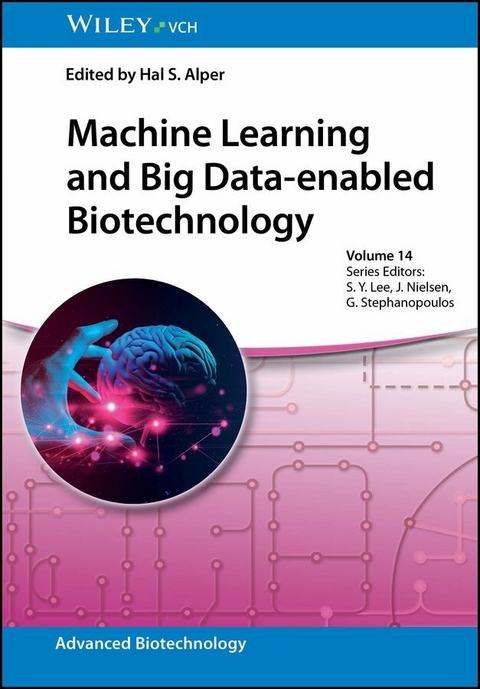
Machine Learning and Big Data-enabled Biotechnology (eBook)
435 Seiten
Wiley-VCH (Verlag)
978-3-527-85052-5 (ISBN)
Enables researchers and engineers to gain insights into the capabilities of machine learning approaches to power applications in their fields
Machine Learning and Big Data-enabled Biotechnology discusses how machine learning and big data can be used in biotechnology for a wide breadth of topics, providing tools essential to support efforts in process control, reactor performance evaluation, and research target identification.
Topics explored in Machine Learning and Big Data-enabled Biotechnology include:
- Deep learning approaches for synthetic biology part design and automated approaches for GSM development from DNA sequences
- De novo protein structure and design tools, pathway discovery and retrobiosynthesis, enzyme functional classifications, and proteomics machine learning approaches
- Metabolomics big data approaches, metabolic production, strain engineering, flux design, and use of generative AI and natural language processing for cell models
- Automated function and learning in biofoundries and strain designs
- Machine learning predictions of phenotype and bioreactor performance
Machine Learning and Big Data-enabled Biotechnology earns a well-deserved spot on the bookshelves of reaction, process, catalytic, and environmental engineers seeking to explore the vast opportunities presented by rapidly developing technologies.
Dr. Hal S. Alper is the Cockrell Family Regents Chair in Engineering #1 at The University of Texas at Austin in the McKetta Department of Chemical Engineering. His research focuses on applying and extending the approaches of metabolic engineering, synthetic biology, systems biology, and protein engineering.
| Erscheint lt. Verlag | 9.1.2026 |
|---|---|
| Reihe/Serie | Advanced Biotechnology |
| Sprache | englisch |
| Themenwelt | Naturwissenschaften ► Chemie |
| Schlagworte | biofoundries • bioreactor • cell models • De novo protein structure • enzyme functional classifications • flux design • GSM development • Metabolomics • pathway discovery • Proteomics • retrobiosynthesis • Strain Engineering • Synthetic biology |
| ISBN-10 | 3-527-85052-X / 352785052X |
| ISBN-13 | 978-3-527-85052-5 / 9783527850525 |
| Informationen gemäß Produktsicherheitsverordnung (GPSR) | |
| Haben Sie eine Frage zum Produkt? |
 PDF (Adobe DRM)
Kopierschutz: Adobe-DRM
Adobe-DRM ist ein Kopierschutz, der das eBook vor Mißbrauch schützen soll. Dabei wird das eBook bereits beim Download auf Ihre persönliche Adobe-ID autorisiert. Lesen können Sie das eBook dann nur auf den Geräten, welche ebenfalls auf Ihre Adobe-ID registriert sind.
Details zum Adobe-DRM
Dateiformat: PDF (Portable Document Format)
Mit einem festen Seitenlayout eignet sich die PDF besonders für Fachbücher mit Spalten, Tabellen und Abbildungen. Eine PDF kann auf fast allen Geräten angezeigt werden, ist aber für kleine Displays (Smartphone, eReader) nur eingeschränkt geeignet.
Systemvoraussetzungen:
PC/Mac: Mit einem PC oder Mac können Sie dieses eBook lesen. Sie benötigen eine
eReader: Dieses eBook kann mit (fast) allen eBook-Readern gelesen werden. Mit dem amazon-Kindle ist es aber nicht kompatibel.
Smartphone/Tablet: Egal ob Apple oder Android, dieses eBook können Sie lesen. Sie benötigen eine
Geräteliste und zusätzliche Hinweise
Buying eBooks from abroad
For tax law reasons we can sell eBooks just within Germany and Switzerland. Regrettably we cannot fulfill eBook-orders from other countries.
aus dem Bereich