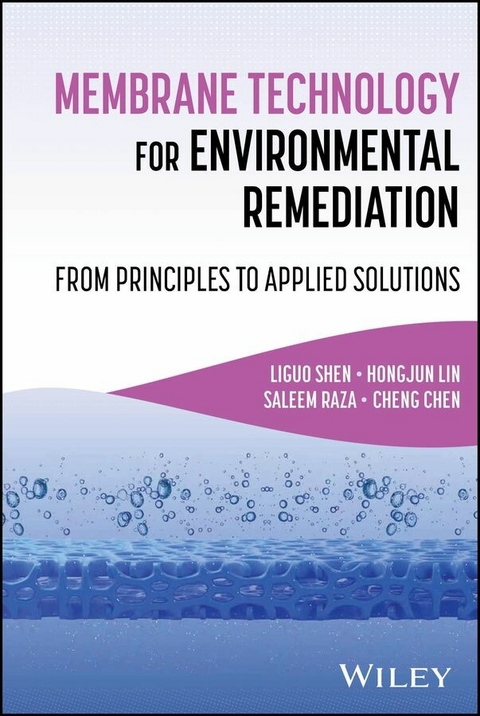
Membrane Technology for Environmental Remediation (eBook)
360 Seiten
Wiley (Verlag)
978-1-394-38821-9 (ISBN)
A definitive, practice-ready guide that unifies advanced membranes, nanomaterials, and smart control to solve real environmental problems at scale
Membrane Technology for Environmental Remediation: From Principles to Applied Solutions distills state-of-the-art membrane science into actionable engineering and maps the path from materials and mechanisms to field deployment. The text explores the core challenges of water scarcity, persistent pollution, and sustainable resource recovery, showing how to design, optimize, and operate systems that deliver measurable remediation outcomes.
Covering synthesis and characterization, transport and selectivity, and the engineering of multi-functional membranes, the book integrates catalytic, stimuli-responsive, and conductive architectures with AI-enabled operational intelligence. It connects fundamentals to applications - RO/UF/NF, bioreactors, anti-fouling strategies, and circular-economy recovery - culminating in design playbooks for robust, scalable treatment. Readers will find a rigorous survey of the landscape and a clear line of sight to implementation, as well as up-to-date discussions of:
- End-to-end system design: From material selection and fabrication to module integration, process control, and performance validation across drinking water, industrial effluents, and resource recovery
- Function-integrated membranes: Catalytic layers for in-situ degradation, stimuli-responsive surfaces for adaptive selectivity, and conductive matrices leveraging electrochemical oxidation/reduction for fouling control
- Optimization under constraints: Practical guidance to balance permeability, selectivity, stability, and lifecycle cost while addressing global water scarcity and compliance targets
- AI and smart operations: Data-driven monitoring, fouling prediction, and adaptive control strategies that enhance uptime, energy efficiency, and overall treatment reliability
Perfect for environmental scientists, chemical and environmental engineers, nanotechnology specialists, and water treatment professionals, Membrane Technology for Environmental Remediation will also benefit policymakers and advanced students seeking a rigorous, application-oriented reference.
Prof. Liguo Shen received his Ph.D. degree from University of Chinese Academy of Sciences(Joint Ph.D. of Max Planck Institute, Germany) in 2014. He is a professor in the College of Geography and Environmental Sciences of Zhejiang Normal University. His research interests are membrane bioreactor (MBR), membrane modification, and membrane separation technology for water treatment. He has published more than 200 SCI papers, including over 20 highly cited papers and 10 hot papers, which have been cited more than 11000 times, with an h-index of 66. He's a recipient of the IAAM Advanced Materials Laureate, the Ministry of Education Prize in Natural Sciences, the Zhejiang Province Natural Science Award, and the Outstanding Young Scientist Award of the Province.
Prof. Hongjun Lin is the Dean of the College of Geography and Environmental Sciences at Zhejiang Normal University. He obtained his Ph.D. degree from the Shanghai Institute of Applied Physics of the Chinese Academy of Sciences. His research interests are membrane separation technology, catalysis and mechanism research. He has published over 480 SCI papers with over 30000 citations, and has an h-index of 97.
Saleem Raza, PhD earned his doctorate from the Beijing University of Chemical Technology. He is an Associate Professor at Zhejiang Normal University. His research interests include advanced nanomaterials, membranes, and photocatalysis for environmental and energy applications. He has authored numerous articles contributing to sustainable water treatment and renewable energy technologies. He has published over 100 papers, with an h-index of 31.
Cheng Chen, PhD earned his doctorate from Zhejiang University in 2021. He is now an Associate Professor at Zhejiang Normal University. He is engaged in the design and preparation of smart-responsive membrane materials, multifunctional membrane separation coupling technology and nanofiltration membrane separation and mass transfer mechanism. He has published over 91 papers, with an h-index of 34.
1
Overview of Membrane Separation Technology
1.1 Introduction
Membrane separation technology has become a foundational component in contemporary environmental and industrial applications, providing highly adaptable and efficient methods for purification, filtration, and resource recovery. Fundamentally, a membrane functions as a selective barrier, permitting the passage of specific molecules or particles while blocking others, based on differences in size, charge, or chemical affinity. This selective nature underpins its broad applicability across diverse sectors, including seawater desalination, wastewater treatment, gas purification, and food and beverage processing. By tailoring membrane properties to target specific contaminants or compounds, processes can be optimized for greater efficiency and sustainability. A comprehensive understanding of the principles governing membrane behaviour and the mechanism of separation is crucial for advancing membrane technologies and unlocking their full potential in solving global environmental and industrial challenges.
To appreciate the scope and impact of membrane technology, it is important first to define what constitutes a membrane and the various separation processes it facilitates. Membrane systems are generally characterized by their structural materials, pore sizes, and transport mechanisms, which together determine their performance and suitability for different tasks. Over time, membranes have been engineered to meet increasingly demanding environmental and industrial needs, evolving from simple natural films to sophisticated synthetic materials with tailored functionalities.
The historical development of membrane science reveals a dynamic interplay between fundamental research and technological innovation. Early investigations laid the theoretical foundation by elucidating transport phenomena and selectivity criteria, while subsequent decades saw the advent of synthetic membranes designed for enhanced performance. Advances in polymer chemistry, fabrication techniques, and material science have driven diversification in membrane types, expanding their application horizon. Today, cutting‐edge innovations continue to push the boundaries, promising more energy‐efficient, selective, and sustainable membrane processes.
Wang et al. [1] introduced cellulose nanomaterials (CNMs)–based membranes, derived from sustainable and renewable resources, which hold significant promise for environmental applications owing to their nanoscale dimensions, large surface area, biodegradability, biocompatibility, and renewability. To fully harness this potential, a deeper understanding of the relationship between the tunable properties of CNMs and the targeted substances is essential for the rational design and fabrication of CNM‐based membranes. This review summarizes recent progress in employing CNM membranes for environmental remediation, particularly in clean air, water treatment, and green energy production. It critically evaluates the key parameters influencing CNM membrane performance (Fig. 1.1), explores their interactions with pollutants, molecules, and ions, and explains their selective transport mechanisms across different separation processes. Finally, the challenges and future research directions for CNM membranes are discussed.
Figure 1.1 Cellulose nanomaterials (CNMs) based membranes for water remediation [1] / with permission of Elsevier.
This chapter provides a comprehensive overview of membrane separation technology, starting with foundational definitions and classifications of various membrane processes. It then surveys the historical trajectory of membrane discovery, highlighting key milestones in both natural and synthetic membrane development. Finally, the chapter explores contemporary advancements and outlines future prospects in the field. Through this structured framework, readers will gain a broad, yet detailed, understanding of the principles governing membrane technology and its critical role in environmental remediation.
1.2 Definition of Membrane and Membrane Separation Processes
Embarking on a journey into the microscopic world reveals a realm teeming with complex molecular structures, where membranes serve as the guardians of life's fundamental processes. Membrane technology has emerged as a crucial tool in environmental remediation, addressing the urgent need to remove pollutants from water, air, and soil [2]. Membranes act as semipermeable permeable barriers, allowing selective passage of substances while blocking contaminants [3]. There are various types of membranes, including microfiltration (MF), ultrafiltration (UF), nanofiltration (NF), and reverse osmosis (RO), each designed to target specific contaminants based on pore size and material composition [4]. MF membranes, for example, are effective for removing suspended solids and bacteria, while RO membranes are utilized for desalination and removing dissolved salts. Additionally, specialized membranes like gas separation and pervaporation membranes cater to air purification and liquid mixture separation, respectively [5].
The chemical makeup and structural composition of membranes play a crucial role in defining their performance and suitability for various applications. Polymeric membranes, commonly crafted from materials like polysulfone (PS) and polyvinylidene fluoride (PVDF), are particularly valued for their adaptability and straightforward manufacturing processes [6]. Ceramic membranes, composed of materials like alumina and zirconia, offer superior thermal and chemical stability, making them suitable for harsh environments. Composite membranes combine organic and inorganic materials, providing enhanced mechanical strength and selective permeability [7]. Surface modifications—such as hydrophilization and the application of antifouling coatings—enhance membrane performance by boosting water permeability and minimizing the risk of fouling. In the field of environmental remediation, membrane technology finds widespread use across multiple industries. In water treatment, for example, membranes are employed in key processes like desalination and the removal of heavy metals and harmful microorganisms, utilizing different types of membranes including reverse osmosis (RO), nanofiltration (NF), ultrafiltration (UF), and microfiltration (MF) [8]. Air purification employs gas separation membranes to eliminate volatile organic compounds (VOCs) and particulate matter. For soil remediation, membranes help treat contaminated groundwater through permeable reactive barriers. Industrial effluent treatment also benefits from membrane technology, particularly in industries like pharmaceuticals and textiles, where UF, NF, and RO membranes are employed to effectively treat wastewater [9].
Over the years, substantial advancements have been achieved in the fabrication and commercialization of polyvinylidene fluoride (PVDF) membranes through the thermally induced phase separation (TIPS) method. These efforts have led to impressive success at both the laboratory and industrial scales, particularly for microfiltration (MF) and ultrafiltration (UF) applications in water treatment, highlighting the method’s reliability, scalability, and effectiveness in addressing critical water purification needs. Tang et al. [10] present a thorough and insightful review of the fabrication, advancement, and industrial application of PVDF microporous membranes produced using the thermally induced phase separation (TIPS) method over the past several decades (Fig. 2.1). The discussion begins with an in‐depth analysis of PVDF as a membrane material, explaining its widespread use and the criteria for selecting appropriate polymer raw materials for membrane production. The article then explores, from a historical standpoint, the two main preparation techniques for PVDF microporous membranes, with particular emphasis on the benefits of the TIPS approach. Furthermore, the study offers a comprehensive examination of the rapid progress in PVDF membrane fabrication and modification. It outlines how to optimize and enhance polymeric microporous membranes via TIPS by addressing thermodynamic formulation design, experimental kinetic studies, dynamic analysis of the membrane formation process using modelling and simulation, and hydrophilic surface modification, all within the context of industrial scalability and practical application. Subsequently, the article reviews the current state of production and application among global commercial PVDF membrane manufacturers, identifying key challenges that must be overcome to achieve large‐scale fabrication and widespread use of PVDF membranes for MF/UF applications using the TIPS method. In response to these critical issues encountered during membrane deployment, the authors introduce several emerging and advanced techniques based on TIPS, suggesting potential pathways toward successful commercialization. The paper concludes with a summary of findings and a discussion of remaining challenges. Overall, it offers fresh perspectives on the fabrication and industrialization of polymeric membranes via TIPS, viewed through both technological advancement and practical application lenses (Fig. 1.2).
Looking ahead, innovations in membrane technology promise even more effective solutions for environmental challenges. Advanced materials, such as graphene‐based membranes and metal–organic frameworks (MOFs), are being developed for their high...
| Erscheint lt. Verlag | 7.1.2026 |
|---|---|
| Sprache | englisch |
| Themenwelt | Naturwissenschaften ► Chemie |
| Schlagworte | catalytic membranes • circular economy • conductive membranes • fouling resistance • Membrane bioreactors • nanomaterials • pollution control • resource recovery • Smart Membranes • stimuli-responsive membranes • Wastewater Treatment • Water purification |
| ISBN-10 | 1-394-38821-7 / 1394388217 |
| ISBN-13 | 978-1-394-38821-9 / 9781394388219 |
| Informationen gemäß Produktsicherheitsverordnung (GPSR) | |
| Haben Sie eine Frage zum Produkt? |
 EPUB (Adobe DRM)
Kopierschutz: Adobe-DRM
Adobe-DRM ist ein Kopierschutz, der das eBook vor Mißbrauch schützen soll. Dabei wird das eBook bereits beim Download auf Ihre persönliche Adobe-ID autorisiert. Lesen können Sie das eBook dann nur auf den Geräten, welche ebenfalls auf Ihre Adobe-ID registriert sind.
Details zum Adobe-DRM
Dateiformat: EPUB (Electronic Publication)
EPUB ist ein offener Standard für eBooks und eignet sich besonders zur Darstellung von Belletristik und Sachbüchern. Der Fließtext wird dynamisch an die Display- und Schriftgröße angepasst. Auch für mobile Lesegeräte ist EPUB daher gut geeignet.
Systemvoraussetzungen:
PC/Mac: Mit einem PC oder Mac können Sie dieses eBook lesen. Sie benötigen eine
eReader: Dieses eBook kann mit (fast) allen eBook-Readern gelesen werden. Mit dem amazon-Kindle ist es aber nicht kompatibel.
Smartphone/Tablet: Egal ob Apple oder Android, dieses eBook können Sie lesen. Sie benötigen eine
Geräteliste und zusätzliche Hinweise
Buying eBooks from abroad
For tax law reasons we can sell eBooks just within Germany and Switzerland. Regrettably we cannot fulfill eBook-orders from other countries.
aus dem Bereich