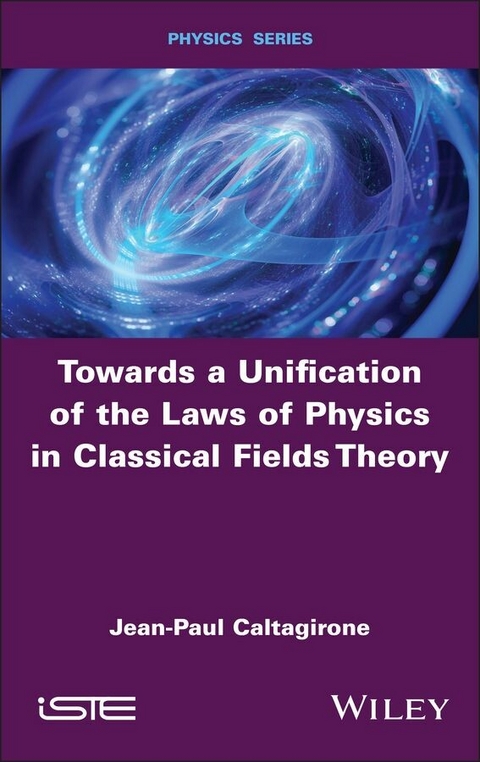
Towards a Unification of the Laws of Physics in Classical Fields Theory (eBook)
419 Seiten
Wiley-Iste (Verlag)
978-1-394-43504-3 (ISBN)
The unification of the laws of physics - a legitimate and long-standing aspiration - is undertaken here using the framework of discrete mechanics. Towards a Unification of the Laws of Physics in Classical Fields Theory extends these concepts to classical field physics.
This book examines and revisits the fundamental principles of physics to derive a unified law of motion capable of modeling the phenomena observed, which are currently described by disparate laws. The global reference frames of classical mechanics and relativity are abandoned: space is defined from a one-dimensional local reference frame, and time is considered discrete. Applying the principle of parsimony to the derivation of this single law leads to the rejection of many concepts from classical mechanics and relativity, retaining only proper acceleration as the sole absolute quantity.
The construction of this unified law of motion paves the way for a rational resolution of phenomena relating to mechanics, special and general relativity, electromagnetism and, more broadly, physics as a whole
Jean-Paul Caltagirone is Professor Emeritus at the National Polytechnic Institute of the University of Bordeaux, France. His research focuses on the conservation of acceleration in the field of mechanics, the basis of discrete mechanics, which has now been extended to all classical field physics.
1
Objections and Rebuttals of Current Laws
1.1. Discussion on the general concepts
1.1.1. Choosing a three-dimensional space
As we perceive it, space is three dimensional. To define the position x of a point in this space, classical Newtonian or relativistic mechanics introduced the notion of a Galilean or inertial frame of reference within which any point particle not submitted to a force moves following a translational motion with uniform velocity. This frame of reference is defined by a coordinate system denoted by in three dimensions spanned by the three orthonormal unit vectors . The theory of relativity introduces another space dimension based on the product between celerity of light and time ; the whole then forms what is called space-time.
The concept discussed now relates to the dimension with which a physical phenomenon can be interpreted. Despite the three-dimensional space being an accepted notion, the dimension of a fixed physical phenomenon can be the subject of further reflection. For example, the propagation of a compression wave has, in essence, a single direction; this phenomenon is extended to any type of longitudinal wave, swell, acoustic wave propagation or light. The velocity of the wavefront is called longitudinal celerity, whose symbol cl is different for each of the mentioned phenomena. This characteristic is strictly independent of the velocity of transport of the material medium or particle; it is an intrinsic property of the medium, the sea, the air or the vacuum. When the source of acoustic waves emits in all directions of the space, it is referred to as isotropic, but the phenomenon basically remains in a single direction in the space. When two plane waves enter the same area of the space, they form two-dimensional interference fringes. The same phenomenon is observed for shock waves, for example, in the wake of nozzles to form fixed structures called Mach disks. In all the examples, the phenomenon of longitudinal wave propagation has a single direction; it does not need to be modeled in a three-dimensional space. Extending this principle to other dimensions of space is a cause and effect approach; the reason for this is that the velocity in the direction of the wave cannot exceed the celerity of the medium.
The second type of wave is transverse, and it is defined by the celerity ct; these waves are generated by a motion orthogonal to the direction of propagation. They are also associated with only one direction, that of orthogonal propagation to the plane of motion that gives rise to them. They are said to be polarizable because propagation in a fixed direction can be generated by any directional movement in the orthogonal plane under consideration. They can be observed in the ground during seismic phenomena, in elastic solids or in space in the form of gravitational waves. Although these waves are generated in a two-dimensional plane, the propagation is still in a single spatial dimension. Thereby, independently of the waves being longitudinal or transverse, only the common direction of these waves must be considered to model them.
Why is such emphasis given to the dimension of three-dimensional space when the phenomena of propagation have only one direction? It is the very foundation behind modeling the phenomena of physics that is addressed through this question. The fact that the frame of reference of classical and relativistic mechanics is no longer employed leads to a decisive change in the way physics is understood. The consequences of such a choice are considerable because the frame of reference is attached to the very existence of the concept of continuous medium, to that of differentiation at a single point, to integration and, in general, to mathematical analysis.
1.1.2. Galileo’s law of free-falling bodies
The free fall of a body under the influence of the Earth’s gravity, which dates back to the 17th century, is a law devised by Galileo. It expresses the equivalence between mass associated with gravity, called “gravitational mass”, and inertia related to mass or “inertial mass.”
1.1.3. Uniform rotation, a Galilean motion
In classical mechanics, and namely the theory of relativity, constant-velocity rotation is an accelerated motion. The principle of inertia or Newton’s first law states that if a body is in rectilinear translational motion at a constant velocity V0 it continues to follow it as long as no force is applied to it. This uniform translational motion leads to the notion of inertial frame of reference. A frame of reference that is not in rectilinear and uniform translational motion with respect to a Galilean frame of reference is a non-inertial frame of reference. Therefore, all accelerated motion corresponds to non-inertial reference frames. Most of the time, the motion of rotating bodies is considered to be accelerated because they are subject to centrifugal acceleration. In fact, the Galilean and inertial frames of reference refer to the same concept, namely, that of the principle of inertia and Newton’s first law. The definition of the Galilean frame of reference is very restrictive because it only addresses the motion of uniform translation; it is written as:
For the acceleration to be zero, the motion has to be steady, ∂V/dt = 0, and the sum of the inertia terms also zero. In continuum mechanics, the inertial term is written equivalently in different manners:
where is the Lamb vector. In the case of a uniform motion with velocity V0 on a straight trajectory, it is easy to show that the inertial term is equally zero, and the condition [1.1] is indeed verified.
Let us examine why a rotational motion at a constant velocity induces a fictitious force in the Navier–Stokes equation. Given the angular velocity Ω, the local velocity is thus equal to Vrot = Ω × r and only a rotation about the Oz axis is taken into consideration here such that ω = Ω · ez. In cylindrical coordinates, the only component of the non-zero Navier–Stokes equation is the one following coordinate r. Since mechanical equilibrium is not certain within the context of an inertial frame of reference, the acceleration is expressed in a rotating frame of reference where the centrifugal acceleration, −Ω × Ω × r, enables us to write:
where the two terms on the left-hand side of relation [1.3] represent inertia in the context of a Galilean frame of reference and the term on the right-hand side corresponds to a fictitious centrifugal force. All other terms, especially viscous terms, are a priori zero.
The necessary presence of this fictitious centrifugal force to establish mechanical equilibrium is to be attributed to the formulation of the equations of mechanics in a global Cartesian frame of reference. To establish that a vector equation or a vector is zero, all three of its components must be zero simultaneously. We should first observe that the equilibrium translated by relation [1.3] is borne only by terms following er. The first term is the gradient of |V|2/2 and the term of the second member is also the gradient of a centrifugal potential ω2 r2/2. Therefrom, the Lamb vector can only be a gradient of a function of r identical to the other two terms. This perspective of the mechanical equilibrium of a uniform rotational motion is questionable. Indeed, no constraint applies in the orthoradial direction eθ, while basic common sense makes us believe that an acceleration following θ contributes to ensuring mechanical equilibrium.
The origin of the fictitious forces within the Navier–Stokes equation is due to the form of the perceived acceleration that reveals three fictitious accelerations: (i) the centrifugal acceleration, (ii) the Coriolis acceleration and (iii) the Euler acceleration corresponding to that of the rotating coordinate system. Nonetheless, the problem of a uniform rotational motion must not be assimilated to the problem of changing the frame of reference where a velocity field is added to the local celerity of the material medium in order to obtain solutions more easily. Nor should the dynamic actions to be carried out to obtain a fixed motion be mistaken for the motion itself that emerges from a purely kinematic understanding. There is no legitimate reason to consider that uniform rotational motion, with zero divergence and constant curl, is a non-inertial problem. A particle on its circular path carries on its motion without involving other accelerations or forces that are specifically related to a change in direction or velocity.
In fact, the assumptions that have shaped modern mechanics are the basis of choices that sometimes prove to be questionable and maintain the status quo about how space and time should be perceived [POI 17]. This is in particular the notion of a global reference frame in a three-dimensional space denoted by . Newton and Leibniz introduced differential and integral calculus, which are perfectly justified concepts in mathematics, as is analysis itself. In physics, laws can deviate from the basic concepts of mathematics; this is the case for vector addition, which...
| Erscheint lt. Verlag | 6.1.2026 |
|---|---|
| Reihe/Serie | ISTE Invoiced |
| Sprache | englisch |
| Themenwelt | Naturwissenschaften ► Physik / Astronomie ► Allgemeines / Lexika |
| Schlagworte | classical field physics • Discrete Mechanics • electromagnetism • General relativity • Laws of Physics • unified law of motion |
| ISBN-10 | 1-394-43504-5 / 1394435045 |
| ISBN-13 | 978-1-394-43504-3 / 9781394435043 |
| Informationen gemäß Produktsicherheitsverordnung (GPSR) | |
| Haben Sie eine Frage zum Produkt? |
 EPUB (Adobe DRM)
Kopierschutz: Adobe-DRM
Adobe-DRM ist ein Kopierschutz, der das eBook vor Mißbrauch schützen soll. Dabei wird das eBook bereits beim Download auf Ihre persönliche Adobe-ID autorisiert. Lesen können Sie das eBook dann nur auf den Geräten, welche ebenfalls auf Ihre Adobe-ID registriert sind.
Details zum Adobe-DRM
Dateiformat: EPUB (Electronic Publication)
EPUB ist ein offener Standard für eBooks und eignet sich besonders zur Darstellung von Belletristik und Sachbüchern. Der Fließtext wird dynamisch an die Display- und Schriftgröße angepasst. Auch für mobile Lesegeräte ist EPUB daher gut geeignet.
Systemvoraussetzungen:
PC/Mac: Mit einem PC oder Mac können Sie dieses eBook lesen. Sie benötigen eine
eReader: Dieses eBook kann mit (fast) allen eBook-Readern gelesen werden. Mit dem amazon-Kindle ist es aber nicht kompatibel.
Smartphone/Tablet: Egal ob Apple oder Android, dieses eBook können Sie lesen. Sie benötigen eine
Geräteliste und zusätzliche Hinweise
Buying eBooks from abroad
For tax law reasons we can sell eBooks just within Germany and Switzerland. Regrettably we cannot fulfill eBook-orders from other countries.
aus dem Bereich