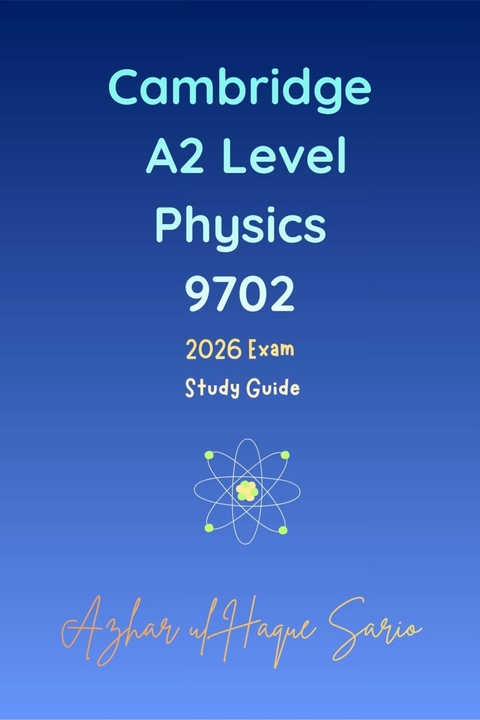
Cambridge A2 Level Physics 9702 (eBook)
228 Seiten
Azhar Sario Hungary (Verlag)
978-3-384-79447-5 (ISBN)
Unlock the secrets of the universe and ace your 2026 exams with a guide that actually speaks your language.
This book is your personal portal into the advanced world of A-Level Physics. It covers every major topic you need for the 9702 syllabus. You will explore the mechanics of circular motion. You will understand how gravity guides the Artemis II mission. You will dive into the chaotic dance of ideal gases. You will master the strict accounting of thermodynamics. The book explains the rhythm of oscillations. It reveals the invisible architecture of electric fields. You will learn how capacitors are changing electric vehicles. You will see how magnetic fields steer autonomous cars. The text breaks down alternating currents. It demystifies the quantum particles of light. You will calculate the energy of nuclear fusion. You will see inside the body with medical physics. You will map the expanding cosmos. Each chapter is packed with clear math. The diagrams are easy to follow. The examples are real. The definitions are precise. You will learn to think like a physicist. It is designed for the 2026 student.
This guide stands apart because it refuses to be boring or outdated. While other textbooks are stuck in the past, this book connects rigorous Cambridge standards to the cutting-edge technology of 2026. You won't just memorize abstract equations; you will see how they apply to AI data centers, quantum computing, and structural supercapacitors. It bridges the gap between dry theory and the vibrant, electrified world you live in today. The author replaces confusing jargon with intuitive analogies, turning complex problems into solvable puzzles. It treats you like a future engineer, not just a test-taker. This is not just a study guide; it is a roadmap to understanding the 'source code' of physical reality.
Disclaimer: This book is an independent publication by Azhar ul Haque Sario. It is not affiliated with, endorsed by, or connected to Cambridge Assessment International Education or the Cambridge A Level Physics board. All use of the term 'Cambridge' is strictly for nominative fair use purposes to describe the intended syllabus scope (9702) of the educational material. Copyright © 2026 by Azhar ul Haque Sario.
Capacitance
Course Module: Advanced Physics – Electricity and Energy Fields
Module Title: Capacitance: From Static Principles to the 2026 Energy Frontier
Module Introduction: The Silent Storage Revolution
Welcome to the 2026 comprehensive module on Capacitance.
If you looked at a circuit board ten years ago, capacitors were merely support actors. They smoothed out signals or filtered noise. Today, in 2026, they are the protagonists of the energy revolution. From the structural supercapacitors in the chassis of the latest electric vehicles (EVs) to the graphene-based storage in your smartphone, capacitance is no longer just about storing charge—it is about power density and rapid energy delivery.
This module is designed to take you from the fundamental definitions of the Cambridge A Level syllabus to the cutting-edge applications driving our world today. We will strip away the complexity, derive the governing laws from first principles, and conclude with a deep dive into the technologies that defined the industrial shifts of 2025 and 2026.
Chapter 1: The Nature of Capacitance
1.1 Defining the Concept
Imagine a spring. When you compress it, you store mechanical potential energy. A capacitor is the electrical equivalent. It is an "elastic" component for electricity. Instead of compressing steel, we compress charge.
Capacitance (C) is defined as the charge stored per unit potential difference. It is a measure of how much electrical charge (Q) a device can hold for a given amount of electrical "pressure" or voltage (V).
The defining equation is:
C=VQ
C: Capacitance (measured in Farads, F).
Q: Magnitude of charge on one of the plates (measured in Coulombs, C).
V: Potential difference across the component (measured in Volts, V).
In 2026, a "Farad" is a massive unit. Most household electronics still deal in microfarads (μF), nanofarads (nF), or picofarads (pF). However, the supercapacitors we use in regenerative braking systems now routinely hit thousands of Farads.
1.2 Geometries of Storage: Spheres vs. Plates
Capacitance relies heavily on shape. We analyze two distinct geometries in this course.
A. The Isolated Spherical Conductor Consider a single metal sphere hanging in empty space. If we dump charge onto it, that charge repels itself and spreads evenly over the surface. The potential (V) on the surface of a sphere carrying charge Q is given by the standard potential formula:
V=4πϵ0RQ
Substituting this into our definition C=Q/V:
C=(4πϵ0RQ)Q
The charge Q cancels out, leaving us with a beautiful geometric property:
C=4πϵ0R
ϵ0: Permittivity of free space (≈8.85×10⁻¹²F m−1).
R: Radius of the sphere.
Key Insight: For an isolated sphere, capacitance depends only on its radius. The Earth itself is a giant spherical capacitor.
B. The Parallel Plate Capacitor This is the workhouse of modern electronics. It consists of two parallel metal plates separated by an insulator (dielectric).
Area (A): The overlapping area of the plates.
Separation (d): The distance between them.
The formula is:
C=dϵ0A
(Note: If a dielectric material is used, ϵ0 is replaced by ϵ=ϵrϵ0).
To increase capacitance, you must either increase the area A (make the plates bigger) or decrease the distance d (move them closer). This simple rule drove the "Curved Graphene" breakthroughs of 2025, where engineers crumpled graphene sheets to pack infinite surface area into a microscopic volume.
Chapter 2: Circuit Architectures
In the real world, a single capacitor is rarely enough. We combine them to tune the circuit's behavior. The rules for combining capacitors are the inverse of the rules for resistors.
2.1 Capacitors in Parallel
Imagine two water tanks placed side-by-side on the ground. If you pour water into them, the levels rise together.
Voltage: In parallel, both capacitors are connected to the same potential difference. (V is constant).
Charge: The total charge stored is the sum of the charge in each capacitor. (Qtotal=Q1+Q2).
Derivation:
Start with Qtotal=Q1+Q2.
Substitute Q=CV into the equation:
CtotalV=C1V+C2V
Divide the entire equation by V (since V is non-zero and common to all):
Ctotal=C1+C2+…
Conclusion: Connecting capacitors in parallel increases the total capacitance. You are essentially creating a larger effective plate area.
2.2 Capacitors in Series
Now imagine the water tanks stacked one above the other. The pressure is split between them.
Charge: Due to electrostatic induction, the charge stored on each plate is identical. If +Q flows into the first plate, it repels +Q from the opposite plate into the next capacitor. (Q is constant).
Voltage: The total potential difference is split across the capacitors. (Vtotal=V1+V2).
Derivation:
Start with Vtotal=V1+V2.
Rearrange C=Q/V to get V=Q/C.
Substitute this into the voltage equation:
CtotalQ=C1Q+C2Q
Divide by Q:
Ctotal1=C11+C21+…
Conclusion: Connecting capacitors in series decreases the total capacitance. The combined system is effectively a single capacitor with a wider plate separation (d).
Chapter 3: Energy Landscapes
One of the most common misconceptions is that capacitors store charge. Technically, they store electric potential energy within the electric field between the plates.
3.1 The Energy Graph
If you plot a graph with Charge (Q) on the x-axis and Potential Difference (V) on the y-axis, you get a straight line passing through the origin (since V∝Q).
To add a tiny bit of charge δQ to a plate that is already at potential V, you must do work against the repulsive force.
Work Done (δW) = V×δQ.
On our graph, V×δQ represents the area of a thin vertical strip.
Therefore, the total work done (Energy stored) is the total area under the V−Q graph.
Since the graph is a triangle with height V and base Q:
Area=21×base×height
W=21QV
3.2 Alternative Forms
By substituting Q=CV into the energy equation, we get the most useful form for modern engineering:
W=21(CV)V→W=21CV2
Why is this significant? The energy depends on the square of the voltage. Doubling the voltage quadruples the stored energy. This is why the high-voltage hybrid capacitor systems in 2026 electric trains operate at such dangerous potentials—it is the only efficient way to store the massive kinetic energy reclaimed during braking.
Also, by substituting V=Q/C:
W=21CQ2
Chapter 4: The Time Domain – Discharging
Batteries maintain a steady voltage. Capacitors do not. They dump their energy in a rapid, exponential decay. This behavior is critical for timing circuits and high-speed...
| Erscheint lt. Verlag | 6.1.2026 |
|---|---|
| Reihe/Serie | Cambridge A Level Courses |
| Sprache | englisch |
| Themenwelt | Naturwissenschaften ► Physik / Astronomie |
| Schlagworte | Advanced Physics Revision • Cambridge A Level Physics 9702 • Cambridge Physics 2026 Exam Study Guide • Gravitational and Electric Fields • Medical Physics and Ultrasound • Quantum and Nuclear Physics • Thermodynamics and Ideal Gases |
| ISBN-10 | 3-384-79447-8 / 3384794478 |
| ISBN-13 | 978-3-384-79447-5 / 9783384794475 |
| Informationen gemäß Produktsicherheitsverordnung (GPSR) | |
| Haben Sie eine Frage zum Produkt? |
 EPUB (Ohne DRM)
Digital Rights Management: ohne DRM
Dieses eBook enthält kein DRM oder Kopierschutz. Eine Weitergabe an Dritte ist jedoch rechtlich nicht zulässig, weil Sie beim Kauf nur die Rechte an der persönlichen Nutzung erwerben.
Dateiformat: EPUB (Electronic Publication)
EPUB ist ein offener Standard für eBooks und eignet sich besonders zur Darstellung von Belletristik und Sachbüchern. Der Fließtext wird dynamisch an die Display- und Schriftgröße angepasst. Auch für mobile Lesegeräte ist EPUB daher gut geeignet.
Systemvoraussetzungen:
PC/Mac: Mit einem PC oder Mac können Sie dieses eBook lesen. Sie benötigen dafür die kostenlose Software Adobe Digital Editions.
eReader: Dieses eBook kann mit (fast) allen eBook-Readern gelesen werden. Mit dem amazon-Kindle ist es aber nicht kompatibel.
Smartphone/Tablet: Egal ob Apple oder Android, dieses eBook können Sie lesen. Sie benötigen dafür eine kostenlose App.
Geräteliste und zusätzliche Hinweise
Buying eBooks from abroad
For tax law reasons we can sell eBooks just within Germany and Switzerland. Regrettably we cannot fulfill eBook-orders from other countries.
aus dem Bereich