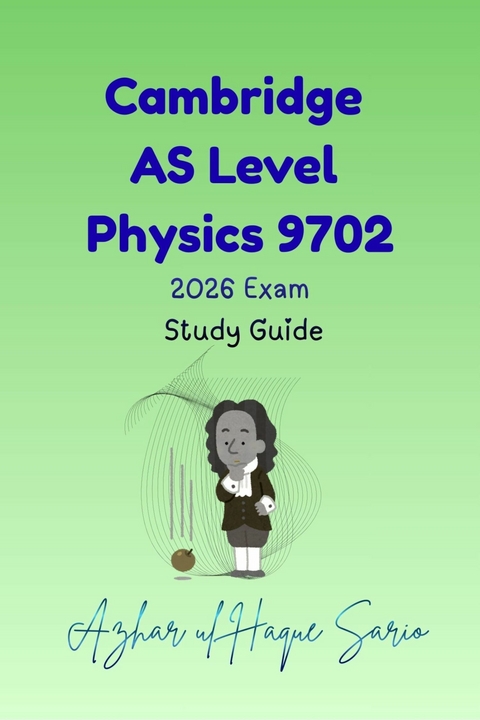
Cambridge AS Level Physics 9702 (eBook)
200 Seiten
Azhar Sario Hungary (Verlag)
978-3-384-79348-5 (ISBN)
Unlock the secrets of the universe and master the 2026 syllabus with a physics guide that actually speaks your language.
This book is a comprehensive journey through the entire Cambridge AS Level Physics 9702 syllabus for the 2026 exams. You will start with the very language of the universe. You will master physical quantities and the new 2026 SI unit standards. You will move into kinematics and learn to predict motion. You will explore dynamics and Newton's laws. You will see how forces shape our world. You will dive deep into the physics of matter. You will understand density and pressure. You will calculate the hidden forces of upthrust. You will journey through work, energy, and power. You will discover how energy is conserved and transformed. You will study the deformation of solids. You will learn about stress, strain, and the Young Modulus. You will investigate the behavior of waves. You will visualize superposition and interference. You will understand the Doppler effect. You will decode the mysteries of electricity. You will analyze current, resistance, and DC circuits. You will finish with the fundamental architecture of matter. You will meet quarks, leptons, and the Standard Model. You will explore the nucleus and radiation. Every topic is here. Every concept is broken down. You will find clear definitions. You will find step-by-step derivations. You will find practical examples.
This guide provides a competitive advantage by stripping away the dry, robotic language of traditional textbooks and replacing it with a vibrant, human perspective. While other books ask you to memorize static formulas, this book teaches you the 'why' behind the math using real-world contexts relevant to 2026. You won't just study resistance; you will analyze the battery degradation of modern electric vehicles. You won't just look at wave diagrams; you will explore how polarization powers 6G networks and how 'time-reflecting' metamaterials are changing computing. It uses 'Deep Dive' sections to connect A-Level concepts to cutting-edge innovations like 'Hyperadaptor' alloys and gravity batteries. It replaces confusing jargon with intuitive analogies, explaining voltage like a ski lift and circuits like traffic systems. It clarifies common student misconceptions, such as the difference between EMF and potential difference, or the reality of electron drift velocity. This is not just a list of facts; it is a conversation with an expert who wants you to succeed. It is completely free from AI generation and is designed to make physics intuitive, logical, and genuinely interesting.
Copyright Disclaimer: Copyright © 2026 by Azhar ul Haque Sario. All rights reserved. This book is an independent publication. It is not affiliated with, endorsed by, or connected to Cambridge Assessment International Education or the Cambridge AS Level board. All use of trademarks is for nominative and descriptive purposes only under fair use principles.
Deformation of solids
In this module, we explore Elasticity—the property that allows materials to resist deformation and return to their original shape. To understand this, we must first agree on the simplified world we are operating in. For the purpose of your Cambridge A-Level studies, we assume all forces and deformations occur in one dimension (1D).
1.1 Tensile and Compressive Forces
Imagine a single metal rod. We can apply force to this rod in two distinct ways:
Tensile Force (Tension): Imagine grabbing both ends of the rod and pulling them away from each other. The forces act outwards, attempting to stretch the material.
Effect: The object lengthens.
Atomic Perspective: You are fighting the inter-atomic bonds, pulling atoms slightly further apart than their equilibrium position.
Real-world Example: The cables supporting a suspension bridge, or a tow rope pulling a car.
Compressive Force (Compression): Imagine pushing both ends of the rod toward the center. The forces act inwards, attempting to squash the material.
Effect: The object shortens.
Atomic Perspective: You are forcing atoms closer together, overcoming the electrostatic repulsion between their electron clouds.
Real-world Example: The concrete pillars of a building foundation, or the leg of a chair when you sit on it.
Course Note: In our calculations, we treat these as mirror images. A tensile force causes a positive extension, while a compressive force causes a negative extension (shortening).
Unit 2: The Language of Load and Extension
Before we reach the elegant mathematics of the Young Modulus, we must master the basic behavior of springs and wires. This is the domain of Hooke’s Law.
2.1 Key Terminology
Load (F): The force applied to the object, usually measured in Newtons (N). In experiments, this is often the weight of hung masses (W=mg).
Extension (x or ΔL): The increase in length of the object.
Formula: x=Current Length−Original Length
Limit of Proportionality: The specific point on a Load-Extension graph where the linear relationship ends. Beyond this point, Hooke's Law is no longer obeyed, though the material may still be elastic.
Elastic Limit: The point of no return. If you stretch the material beyond this point, it will suffer plastic deformation—it will change shape permanently and never return to its original length.
2.2 Hooke’s Law
Robert Hooke, a contemporary of Newton, observed a simple truth: Ut tensio, sic vis—"As the extension, so the force."
Definition:
Hooke’s Law states that the extension of a spring (or wire) is directly proportional to the force applied to it, provided the limit of proportionality is not exceeded.
The Formula:
F=kx
F = Force applied (Newtons, N)
x = Extension (meters, m)
k = Spring Constant (Newtons per meter, N/m)
Understanding the Spring Constant (k): The spring constant k is a measure of stiffness.
A high k means the spring is stiff (difficult to stretch). Imagine the suspension spring of a truck.
A low k means the spring is soft (easy to stretch). Imagine the spring in a ballpoint pen.
Visualizing the Graph: If you plot Force (y-axis) against Extension (x-axis):
The line will be a straight diagonal starting from the origin.
The gradient (slope) of this line is equal to the spring constant k.
The line eventually curves; the point where it starts curving is the Limit of Proportionality.
Unit 3: From Geometry to Intrinsic Properties—Stress and Strain
Here is the flaw with Hooke's Law: The spring constant k is specific to a particular object, not the material.
Imagine you have a thick copper wire and a thin copper wire. The thick wire is harder to stretch (higher k), but they are both made of copper! To compare materials fairly (e.g., "Is steel stronger than aluminum?"), we need to remove the geometry (length and area) from the equation. We do this by converting Force and Extension into Stress and Strain.
3.1 Stress (σ)
Stress is the pressure built up inside the material as it resists the load. It normalizes the force by the cross-sectional area.
σ=AF
σ (Sigma) = Tensile Stress.
F = Force (N).
A = Cross-sectional Area (m2).
Unit: Pascals (Pa) or N/m2. Since 1Pa is tiny, we usually speak in MegaPascals (MPa) or GigaPascals (GPa).
3.2 Strain (ε)
Strain is a measure of how much the material has deformed relative to its original size. It normalizes the extension by the original length.
ε=LΔL
(Sometimes written as ε=Lx)
ε (Epsilon) = Tensile Strain.
ΔL = Extension (m).
L = Original Length (m).
Unit: None. Strain is a ratio of lengths, so it is dimensionless. (Sometimes expressed as a percentage).
Unit 4: The Young Modulus (E)
Now that we have Stress and Strain, we can define the "stiffness" of the material itself, independent of whether it's a thick bar or a thin wire. This is the Young Modulus.
Definition:
The Young Modulus is the ratio of tensile stress to tensile strain, provided the material is within its limit of proportionality.
The Formula:
E=εσ
Substituting our definitions from Unit 3:
E=ΔL/LF/A=AΔLFL
Unit: Pascals (Pa) or N/m2.
Significance:
A material with a high Young Modulus (like Diamond or Steel) is very stiff. It requires huge stress to create a tiny strain.
A material with a low Young Modulus (like Rubber) is flexible.
Table 1: Comparative Young Modulus Values (Approximate) | Material | Young Modulus (GPa) | | :--- | :--- | | Rubber | 0.01 - 0.1 | | Nylon | 2 - 4 | | Aluminum | 70 | | Copper | 120 | | Steel | 210 | | Diamond | 1200 |
Unit 5: Experimental Analysis
Objective: Determine the Young Modulus of a metal in the form of a wire.
This is a classic "Required Practical" for A-Level Physics. The goal is to obtain data to plot a Stress-Strain graph.
5.1 The Apparatus (Searle’s Method or Vernier Method)
We usually use a long test wire (over 2 meters) because metal wires stretch very little. A longer wire produces a larger, more measurable extension (x).
Setup:
Ceiling Support: Clamp the wire firmly to a rigid beam.
Control Wire: Often, a second "dummy" wire is hung next to the test wire. This carries the Vernier scale but no extra load. Why? To compensate for thermal expansion. If the room gets hot, both wires expand equally, so the scale reading doesn't change due to temperature.
Test Wire: Carries the variable load (slotted masses).
Measurement: A micrometer screw gauge is used for diameter, and a Vernier scale is used for extension.
5.2 Procedure
Measure Geometry:
Measure the original length (L) of the wire using a tape measure (from clamp to marker).
Measure the diameter (d) of the wire using a micrometer. Crucial: Measure at 3 different points along the wire and at different angles to catch any irregularities. Calculate the mean diameter.
Calculate Area: A=π(d/2)2.
Initial Reading: Record the Vernier scale reading with a small initial load (just enough to straighten the wire). This is your "zero" extension point.
Loading: Add masses in regular intervals (e.g., 100g or 0.98N).
Recording: For each mass, record the new scale reading.
Unloading: Remove masses one by one and check the readings again. Why? To ensure the wire hasn't passed its elastic limit. If the unloading readings match the loading readings, the deformation was elastic.
5.3 Analysis
Calculate Force (F=mg) and Extension (x)...
| Erscheint lt. Verlag | 5.1.2026 |
|---|---|
| Reihe/Serie | Cambridge A Level Courses |
| Sprache | englisch |
| Themenwelt | Naturwissenschaften ► Physik / Astronomie |
| Schlagworte | A Level Physics revision • Cambridge AS Level Physics 9702 • Cambridge Physics 2026 Exam Study Guide • Electricity and DC Circuits • kinematics and dynamics • Particle Physics Standard Model • Waves and Superposition |
| ISBN-10 | 3-384-79348-X / 338479348X |
| ISBN-13 | 978-3-384-79348-5 / 9783384793485 |
| Informationen gemäß Produktsicherheitsverordnung (GPSR) | |
| Haben Sie eine Frage zum Produkt? |
 EPUB (Ohne DRM)
Digital Rights Management: ohne DRM
Dieses eBook enthält kein DRM oder Kopierschutz. Eine Weitergabe an Dritte ist jedoch rechtlich nicht zulässig, weil Sie beim Kauf nur die Rechte an der persönlichen Nutzung erwerben.
Dateiformat: EPUB (Electronic Publication)
EPUB ist ein offener Standard für eBooks und eignet sich besonders zur Darstellung von Belletristik und Sachbüchern. Der Fließtext wird dynamisch an die Display- und Schriftgröße angepasst. Auch für mobile Lesegeräte ist EPUB daher gut geeignet.
Systemvoraussetzungen:
PC/Mac: Mit einem PC oder Mac können Sie dieses eBook lesen. Sie benötigen dafür die kostenlose Software Adobe Digital Editions.
eReader: Dieses eBook kann mit (fast) allen eBook-Readern gelesen werden. Mit dem amazon-Kindle ist es aber nicht kompatibel.
Smartphone/Tablet: Egal ob Apple oder Android, dieses eBook können Sie lesen. Sie benötigen dafür eine kostenlose App.
Geräteliste und zusätzliche Hinweise
Buying eBooks from abroad
For tax law reasons we can sell eBooks just within Germany and Switzerland. Regrettably we cannot fulfill eBook-orders from other countries.
aus dem Bereich