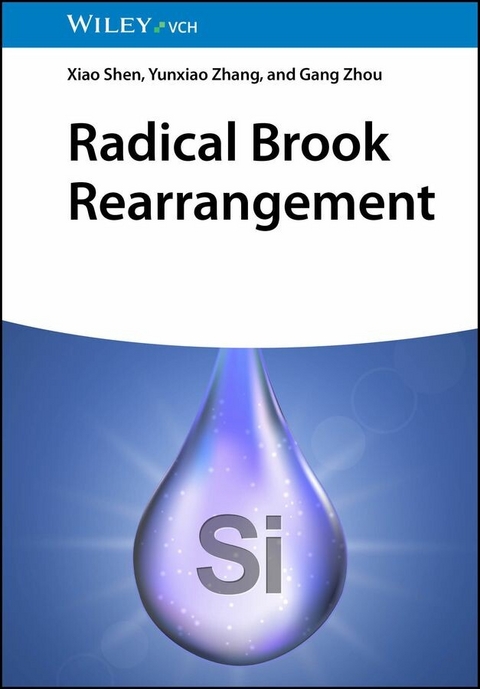
Radical Brook Rearrangement (eBook)
336 Seiten
Wiley-VCH (Verlag)
978-3-527-85022-8 (ISBN)
In-depth monograph presenting innovative radical methodologies in the Brook rearrangement and their utility in organic synthesis
Radical Brook Rearrangement chronicles the evolution of radical Brook rearrangements, synthesizes recent advances in the field, and outlines future research directions. The book focuses on three key reactive intermediates - ?-siloxy radicals, siloxycarbenes, and silenes - providing detailed analyses of their generation methods, substrate scope, mechanistic insights, and synthetic applications, along with practical experimental protocols.
Readers will find insights on alkoxy radical generation, photocatalytic systems, and the selection of radical/carbene acceptors. This book deliberately focuses on radical processes, excluding anionic pathways.
Written by a team of highly qualified researchers in the field, Radical Brook Rearrangement includes information on:
- Generation of siloxycarbenes for metal siloxycarbene reaction, with information on aminooxycarbene reactions
- Generation of siloxycarbenes for nucleophilic addition reaction, covering aldehydes and ketones as electrophiles and other electrophilic reagents
- Generation of ?-siloxy silyl radicals with (TMS)3SiOH, covering photoredox reactions and metallaphotoredox reactions with (TMS)3SiNHAd
- Generation of ?-siloxy radicals with ?-silyl alcohol, covering metal-free, metal-catalyzed, photocatalyzed, and electrophotocatalyzed reactions
Containing cutting-edge research discoveries on the subject, Radical Brook Rearrangement is an essential reference for chemists across specializations, materials scientists, and professionals in the pharmaceutical industry.
Xiao Shen is Professor at the Institute for Advanced Studies, Engineering Research Center of Organosilicon Compounds & Materials, Ministry of Education, State Key Laboratory of Metabolism and Regulation in Complex Organisms, Wuhan University, China. He is the winner of 2025 RSC Fluorine Prize. He serves on the Advisory Board of Chem Catalysis, the Early-Career Advisory Board of Organic Chemistry Frontiers, and is an Early-Career Editorial Board Member for Chinese Chemical Letters and the Chinese Journal of Organic Chemistry.
Yunxiao Zhang is a postdoctoral fellow of The Institute for Advanced Studies at Wuhan University, China.
Gang Zhou is a postdoctoral fellow of The Institute for Advanced Studies at Wuhan University, China.
Chapter 1
Introduction
Rearrangement reactions highlight the elegance of synthetic chemistry. They provide a pathway for building complex, often highly functionalized structures with remarkable precision, enabling innovations across various fields like pharmaceuticals, materials science, and agrochemicals. The ability to manipulate bond formation and cleavage in a controlled manner offers endless possibilities for the design of new molecules with specific properties or activities, underscoring the creativity and sophistication inherent in synthetic chemistry.[1]
Among various types of rearrangement, the Brook rearrangement is a fascinating and highly significant reaction within organosilicon chemistry.[2] It involves the migration of a silyl group from a carbon atom to an oxygen atom in a compound that contains an oxygen-centered anion. The Brook rearrangement has been widely exploited for the preparation of diverse organic compounds, including those used in pharmaceuticals, agrochemicals, and materials science. It also serves as an elegant example of how organosilicon chemistry can intersect with anionic and radical processes, offering a versatile tool for constructing complex molecular architectures.
The Brook rearrangement was first observed by the Gilman group in the 1950s, but its mechanism wasn’t fully understood at the time.[3] It was the Brook group that, in subsequent years, meticulously elucidated the reaction mechanism and its significance.[4] Their work clarified the crucial role of the silicon-containing alkoxide and silyl group migration, paving the way for a deeper understanding of the reactivity of organosilicon compounds. Since then, the anionic Brook rearrangement (ABR) has become a cornerstone reaction in organic synthesis, particularly for its ability to efficiently introduce functional groups and construct complex molecular frameworks.[2] ABR can be extended to achieve [1,n]-silyl transfer processes, depending on the size of the molecule and the spatial positioning of the atoms involved.[5] This ability for silyl migration is sensitive to the distance between the carbon and the heteroatom (oxygen, sulfur, nitrogen, etc.), with shorter distances generally favoring stronger and more efficient migration. This phenomenon is one of the key features that gives the ABR its remarkable versatility in organic synthesis, as it can be tuned to create a wide range of functionalized products with varying complexity. The migration of the silyl group to different atoms—sulfur, nitrogen, or oxygen—opens up a whole new level of reactivity and selectivity for ABR. There are interesting variations of the ABR that involve heteroatoms like sulfur[6] and nitrogen,[7] leading to the specific types of rearrangements. Moreover, the retro-anion Brook rearrangement (r-ABR) is a fascinating counterpart to the classic ABR, and it adds another layer of versatility to organosilicon chemistry.[1c] The retro-Brook rearrangement involves the migration of a silyl group from an oxygen atom to a carbon atom, effectively reversing the direction of the migration seen in the ABR. It was first observed by the Speier group in 1952,[8] with further elucidation of its mechanism and scope coming from the West group in subsequent years.[9]
While the ABR has seen extensive exploration due to its predictable mechanism and wide applicability, the radical Brook rearrangement (RBR) has received comparatively less attention, primarily because the generation of alkoxyl radicals—which are key intermediates in RBR—is challenging. Alkoxy radicals are often less stable and harder to generate selectively, which has limited the widespread use of RBR compared to its anionic counterpart. In recent years, photocatalytic, transition-metal-catalytic and radical initiator-based strategies have been developed to overcome the challenges of generating alkoxyl radicals. These approaches have enabled chemists to harness RBR more efficiently, opening up new avenues for its use in organic synthesis. In this book, we discuss the development of RBR by summarization of the reactions based on different reactive intermediates generated from this unique radical rearrangement. Selected seminal works are briefly outlined below to provide an overview of the development of the RBR, highlighting key contributions that have shaped the evolution of this transformation.
The first type of reactive intermediates is -siloxyl carbon radicals (Scheme 1.1). In 1991, the Walton group reported the first example of the radical initiation of -silyl alcohols, leading to the generation of -siloxyl carbon radicals.[10] This pioneering work also demonstrated the application of these radicals in hydrogenation reactions, marking a significant advancement in the field of radical-mediated transformations involving organosilicon compounds. From 1991 to 2011, the Tsai group reported the radical initiation of bromoalkyl acylsilanes, which subsequently underwent radical cyclization and RBR processes.[11] These transformations lead to the generation of cyclic -siloxyl carbon radicals, which are then available for further functionalization, expanding the scope of RBR. In 2017, the Smith group reported the first photoredox-catalyzed oxidative Brook rearrangement of -silyl alcohols, enabling the generation of -siloxyl carbon radicals.[12] These radicals were subsequently employed in alkylation and arylation reactions, demonstrating the potential of photoredox catalysis to facilitate efficient radical transformations in organosilicon chemistry, although these reactions were proposed not to go through alkoxyl radicals. From 2018, The MacMillan group discovered that (TMS)3SiOH undergoes the RBR process to generate -siloxyl silyl radicals, which can abstract halogen atoms from alkyl or aryl halides to form corresponding radicals that participate in further cross-coupling reactions.[13] From 2020, the Shen group has reported various metal- and photo-catalyzed RBR processes involving fluoroalkyl and alkyl -silyl alcohols. These transformations proceeded through the generation of alkoxyl radicals, enabling the formation of a variety of functionalized products.[14] Recently, Shen’s group reported the pioneering application of RBR in enantioconvergent cross-coupling of -silyl alcohols through photoredox/nickel dual catalysis, enabling efficient access to chiral -fluoroalkyl alcohols.[15] These work highlighted the versatility and efficiency of combining metal and photocatalysis in RBR reactions, expanding the scope of radical-based transformations in organosilicon chemistry.
Scheme 1.1 Generation of -siloxy radicals.
The second type of reactive intermediates generated from the RBR are siloxycarbenes (Scheme 1.2). These highly reactive species are formed when the silyl groups of acylsilanes undergo migration, leading to the generation of carbene-like intermediates stabilized by the adjacent oxygen atom. Siloxycarbenes are versatile intermediates that can undergo a variety of further transformations, such as nucleophilic addition, cyclization, or insertion reactions, making them valuable tools in synthetic chemistry. In 1967, the Brook group reported the first example of the RBR of acylsilanes, which led to the generation of siloxycarbenes.[16] These highly reactive intermediates subsequently underwent insertion reactions with the bond of alcohols. In 1971, the Brook group reported the nucleophilic addition of siloxycarbenes, generated from acylsilanes, to ketones.[17] This reaction showcased the reactivity of siloxycarbenes as nucleophiles, leading to the formation of new carbon–carbon bonds and expanding the synthetic utility of these intermediates in organosilicon chemistry. Ten years later, the Dalton group provided a detailed mechanistic study of acylsilanes undergoing the RBR process to generate siloxycarbenes.[18] These intermediates were shown to insert into the bond of alcohols, providing further insight into the reactivity of siloxycarbenes and their ability to participate in functional group transformations. This work contributed significantly to the understanding of the RBR mechanism and the role of siloxycarbenes in various organic reactions. Since 2001, the Cunico and Chen groups have reported that carbamoylsilanes underwent the RBR process under heating conditions to generate nucleophilic aminooxycarbenes.[19] These highly reactive intermediates can then undergo a variety of subsequent chemical transformations, expanding the scope of RBR reactions and enabling the synthesis of diverse nitrogen-containing organic compounds. In 2021, the Kusama group reported the first example of electrophilic copper-siloxycarbenes undergoing a formal [4 + 1] cycloaddition reaction with electron-rich dienes.[20] This pioneering work demonstrated the potential of siloxycarbenes, activated by copper, to engage in cycloaddition reactions, expanding the scope of their reactivity and providing a new strategy for the synthesis of cyclic structures in organosilicon chemistry. Recently, the Shen group reported that fluoroalkyl acylsilanes undergo the RBR process to generate donor-acceptor carbenes.[21] These carbenes can then participate in [2 + 1] cycloaddition reactions with both electron-rich and electron-deficient alkenes and alkynes, offering a versatile method for constructing highly functionalized compounds. This work further underscores the potential of RBR-derived intermediates in enabling diverse and selective cycloaddition reactions.
Scheme 1.2 Generation of siloxycarbenes.
The third type of...
| Erscheint lt. Verlag | 30.12.2025 |
|---|---|
| Sprache | englisch |
| Themenwelt | Naturwissenschaften ► Chemie |
| ISBN-10 | 3-527-85022-8 / 3527850228 |
| ISBN-13 | 978-3-527-85022-8 / 9783527850228 |
| Informationen gemäß Produktsicherheitsverordnung (GPSR) | |
| Haben Sie eine Frage zum Produkt? |
 EPUB (Adobe DRM)
Größe: 31,5 MB
Kopierschutz: Adobe-DRM
Adobe-DRM ist ein Kopierschutz, der das eBook vor Mißbrauch schützen soll. Dabei wird das eBook bereits beim Download auf Ihre persönliche Adobe-ID autorisiert. Lesen können Sie das eBook dann nur auf den Geräten, welche ebenfalls auf Ihre Adobe-ID registriert sind.
Details zum Adobe-DRM
Dateiformat: EPUB (Electronic Publication)
EPUB ist ein offener Standard für eBooks und eignet sich besonders zur Darstellung von Belletristik und Sachbüchern. Der Fließtext wird dynamisch an die Display- und Schriftgröße angepasst. Auch für mobile Lesegeräte ist EPUB daher gut geeignet.
Systemvoraussetzungen:
PC/Mac: Mit einem PC oder Mac können Sie dieses eBook lesen. Sie benötigen eine
eReader: Dieses eBook kann mit (fast) allen eBook-Readern gelesen werden. Mit dem amazon-Kindle ist es aber nicht kompatibel.
Smartphone/Tablet: Egal ob Apple oder Android, dieses eBook können Sie lesen. Sie benötigen eine
Geräteliste und zusätzliche Hinweise
Buying eBooks from abroad
For tax law reasons we can sell eBooks just within Germany and Switzerland. Regrettably we cannot fulfill eBook-orders from other countries.
aus dem Bereich