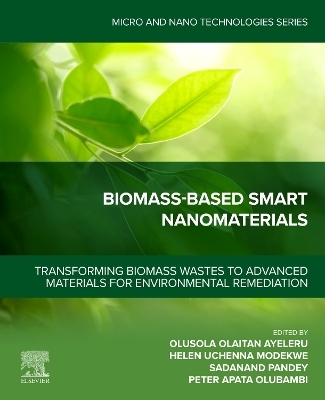
Biomass‐Based Smart Nanomaterials
Elsevier - Health Sciences Division (Verlag)
978-0-443-36622-2 (ISBN)
- Noch nicht erschienen (ca. August 2026)
- Versandkostenfrei
- Auch auf Rechnung
- Artikel merken
Dr. O.O. Ayeleru is a SEnior Research Fellow at the Centre for Nanoengineering and Advanced Material, Department of Engineering Metallurgy, University of Johannesburg, South Africa. He obtained his B.Eng. degree in Chemical Engineering from the Federal University of Technology, Yola, Adamawa State, Nigeria, and MTech. and PhD degrees from the University of Johannesburg, Johannesburg, South Africa. His field of research is in the Advanced Materials Synthesis, Municipal Solid Waste Management, Soft-Computing Applications, Fruit and Vegetable Research, Water and Wastewater Treatment, Electrical Energy Consumption and Renewable Energy Research. He was part of the team who developed a Feasibility Study Report on Biomethane Generation from Municipal Organic Solid Waste for the City of Johannesburg in 2016 and is a co-innovator of a patented innovation (filed in South Africa). Dr. H.U. Modekwe is a postdoctoral researcher at the Department of Chemical Engineering, University of Johannesburg, South Africa. She earned her Ph.D. in Chemical Engineering from the same institution. Her primary research interests lie in environmental, chemical, material synthesis, and processing engineering, focusing on nanotechnology and nanomaterials such as carbon nanotubes, graphene, graphene oxide, and their composites. Her research also encompasses plastics and solid waste management and valorization, water and wastewater treatment, membrane technology, and heterogeneous catalysis. Dr. Modekwe applies chemical synthesis principles to develop strategies and processes for treating and valorizing waste materials into valuable products. She works to strike a balance between fundamental research and industrial applications to offer sustainable solutions to environmental challenges in South Africa, Africa, and globally. Sadanand Pandey is a Professor in the School of Bioengineering and Food Technology at Shoolini University. He brings over 12 years of expertise to the field of Materials Science, specialising in organic-inorganic nanocomposites with applications in water purification, nanosensors, energy, and biomedicine. He completed his PhD at the University of Allahabad and then became a UGC-Kothari fellow at the prestigious Indian Institute of Science, Bangalore. He continued his academic journey with international experiences, including a research professorship at Yeungnam University in South Korea from 2019 to 2023. He also had a stint at the University of Johannesburg, South Africa, from 2014 to 2018. Throughout his career, he received prestigious fellowships, including the DST/NRF Innovation Fellowship in South Africa, Dr Kothari's Postdoctoral Fellowship in India, and JRF and SRF fellowships from DST, India. He contributed significantly to research projects funded by the National Research Foundation (NRF) and the Korea Institute of Marine Science & Technology Promotion (KIMST) in South Korea. His primary research areas include polymer science, nanotechnology, and nanocomposites, composite materials, and surface modification. His recent work has explored hydrogels for applications in nutrient recovery, controlled drug delivery, water purification, and biomedicine. He has also delved into the development of photocatalysts with implications for nanotechnology, energy research, and environmental science. Prof. Pandey has authored more than 250 publications in peer-reviewed journals and international conferences. His scholarly contributions have garnered more than 9000 citations on Google Scholar in the past five years. Additionally, he is a guest editor for various scientific journals, including Materials Letters, Frontier in Chemistry, Biosensors, Chemosensors, Water, Materials, Molecules, and Polymers. He is an active member of scientific communities, including The Korean Society of Industrial and Engineering Chemistry, the Royal Society of Chemistry (RSC), the American Chemical Society, the Indian Science Congress Association (ISC), and the Materials Research Society of India (MRSI). He has received the Young Scientist award at the Indian Science Congress in India and has been recognised among the top 2% of scientists worldwide for year (2019, 2020, 2021, 2022 & 2023) in subject-wise analyses conducted by Stanford University. He has also authored more than 20 book chapters on advanced materials and technology for esteemed publishers in the USA. He has presented at numerous domestic and international conferences. Pandey has reviewed over 2000 articles while serving as a reviewer for over 300 internationally renowned scientific journals and research foundations. Professor Peter Olubambi obtained BEng (Hons), MEng and PhD in Metallurgical and Materials Engineering. He is a Professor of Materials Engineering and is presently the Director of the Centre for Nanoengineering and Advanced Materials, as well as the Head of the School of Mining, Metallurgy and Chemical Engineering at the University of Johannesburg (UJ). His research activities focus on three key and interrelated fields of advanced materials processing; Powder Metallurgy, Nanomechanics and Tribocorrosion. His research efforts centered on the utilization of innovative powder metallurgical techniques for developing nanoengineered materials for automotive, aerospace, microelectronics, mines, energy storage, chemical and allied industries as well as for biomedical applications. He is a vibrant scholar and an NRF-rated researcher (C2). Through the various funding he has attracted, he has established a hi-tech powder metallurgy research laboratory at the Tshwane University of Technology, and the laboratories for Nanoengineering and Advanced Materials Research at UJ. He is an editorial board member of two international journals, a reviewer to many high impact factor journals, and has served as an organizing committee member to many local and international conferences. Over the past 10 years, he has graduated 36 master’s students, 22 doctoral students, and mentored six postdoctoral research fellows; 16 of these young, multicultural, and multinational persons currently hold academic positions as lecturers, senior lecturers, and associate professors within the South African HEI sector and outside South Africa. Prof Olubambi is currently supervising and co-supervising 21 doctoral students, 19 master’s students and mentoring 11 postdoctoral research fellows.
Part I: Introduction
1. General Introduction to Biomass-Derived Smart Nanomaterials
2. Fundamentals and Potentials of Biomass-Derived Smart Nanomaterials for Environmental Applications
3. Recent Advances in Biomass-Derived Carbon Nanomaterials for Environmental Remediation Application
4. Towards Sustainable Production and Utilization of Plant-Biomass-Based Nanofibers: Current Trends
5. Transforming Agricultural Wastes into Nanosilica
6. Biomass to Nanoparticles
Part II: Synthesis and Characterization of Biomass-Based Smart Nanomaterials
7. Innovative Developments for Synthesis of Carbon Nanomaterials from Agricultural Wastes
8. Nanocarbon from Biomass
9. Synthesis, Characterization and Application of Porous Carbon Nanomaterials from Brown Algae
10. Green Synthesis Methods of Biomass-Based Nanomaterials
11. Synthesis, Characterization and Application of Biomass-Derived Carbon-Based Nanomaterials
12. Facile Synthesis, Characterization and Applications of Nanoparticles Made from Biomass Wastes
Part III: Environmental Applications
13. Biomass-Derived Smart Nanomaterials for Water Treatment Applications
14. Biomass-Derived Renewable Nano-Structured Materials for Sustainable Environmental Remediation Applications
15. The Production and Application of Carbon Nanomaterials from High Alkali Silicate Herbaceous Biomass
16. Agricultural Waste Biomass-Assisted Nanofibers
17. Biogenic Green Synthesis of Metal Oxide Nanoparticles Using Biomass for Wastewater Treatment
18. Pyrolysis of Agricultural Biomass Residues
19. Advancements in Graphene and Carbon Nanotubes from Waste Biomass
20. Biomass-Derived Nanochips and Nanofiltration
21. Utilization of Carbonaceous Nanomaterials from Biomass for Manufacturing Wastewater Treatment
Part IV: Lifecycle Assessment, Techno-Economic Analysis, Impact and Future Outlook of Biomass-Derived Smart Nanomaterials
22. Case Studies of Specific Applications of Biomass-Derived Smart Nanomaterials for Wastewater Treatment
23. Lifecycle Analysis (LCA) of Biomass and Intelligent Nanomaterials
24. Techno-Economic Analysis, Scalability, and Market Size of Biomass-Based Smart Nanomaterial
25. Future Direction, Challenges and Future Outlooks and Conclusion
| Erscheint lt. Verlag | 1.8.2026 |
|---|---|
| Reihe/Serie | Micro & Nano Technologies |
| Verlagsort | Philadelphia |
| Sprache | englisch |
| Maße | 191 x 235 mm |
| Gewicht | 450 g |
| Themenwelt | Naturwissenschaften ► Biologie ► Ökologie / Naturschutz |
| Technik ► Elektrotechnik / Energietechnik | |
| Technik ► Maschinenbau | |
| ISBN-10 | 0-443-36622-5 / 0443366225 |
| ISBN-13 | 978-0-443-36622-2 / 9780443366222 |
| Zustand | Neuware |
| Informationen gemäß Produktsicherheitsverordnung (GPSR) | |
| Haben Sie eine Frage zum Produkt? |
aus dem Bereich