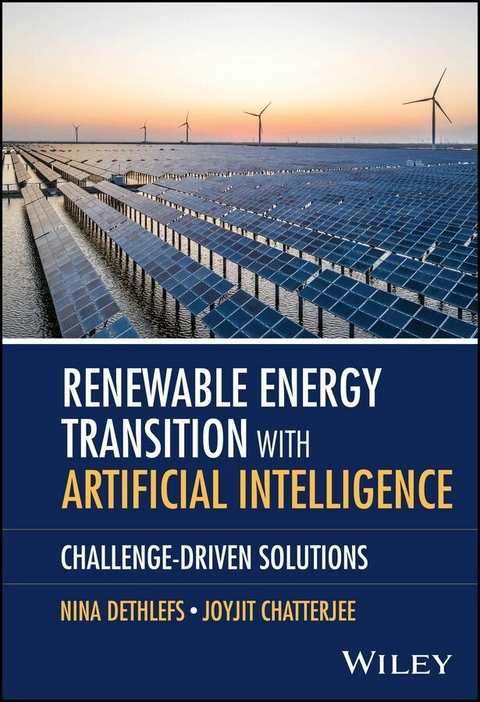
Renewable Energy Transition with Artificial Intelligence (eBook)
275 Seiten
Wiley (Verlag)
978-1-394-30005-1 (ISBN)
Explores harnessing AI to overcome strategic and operational challenges in renewable energy transition
The urgent need to decarbonize global energy systems has propelled renewable energy into a position of unprecedented importance, yet this shift presents major technical, economic, and policy challenges. Increasing reliance on intermittent energy sources such as solar and wind demands more effective forecasting, grid coordination, and flexibility. Artificial Intelligence (AI) offers powerful tools to meet these challenges by learning from data, modeling complex interactions, and enabling real-time optimization across generation, transmission, and consumption.
Renewable Energy Transition with Artificial Intelligence: Challenge-driven Solutions highlights successful pathways of knowledge transfer between academia and industry through case studies drawn from wind, solar, and emerging energy sources. Focusing on challenge-driven problem solving, the authors showcase transferable strategies that overcome pressing obstacles such as the lack of open datasets, the reluctance to adopt opaque predictive models, and insufficient performance benchmarks.
Contributions by leading experts emphasize explainable AI, collaborative innovation, and the vital role of shared infrastructures for data and knowledge exchange. The book also draws from the authors' international workshop with diverse stakeholders, underscoring the importance of cross-sector cooperation in ensuring sustainable and scalable impact.
Adopting a challenge-driven framework linking AI innovation with renewable energy adoption, this title:
- Integrates perspectives from academia, industry, and the public sector to identify scalable solutions
- Demonstrates methods for bridging the 'black box' problem in neural network-based energy forecasting
- Addresses data scarcity by proposing solutions for open access, standardization, and benchmarking in renewables AI
- Provides practical insights for distributed generation, storage, and demand-response management
- Explores future directions for explainable AI in energy system integration and resilience
Both a roadmap and a reference point for integrating AI into renewable systems to accelerate global decarbonization, this book is designed for advanced students, researchers, and practitioners in engineering, computer science, and renewable energy. It is suitable for courses such as Renewable Energy Systems, Artificial Intelligence Applications in Engineering, and Energy Policy and Technology within graduate and postgraduate degree programs in engineering, data science, and environmental studies.
NINA DETHLEFS is Professor of Computer Science (Artificial Intelligence) at Loughborough University, where she leads the Language and Data Research Group and contributes to UK-based doctoral training in offshore wind energy. Her research lies at the intersection of AI, natural language processing, and sustainability, with a focus on developing ethical, interpretable, and data-efficient methods to address climate resilience and renewable energy challenges. She has published widely on applying AI to environmental and energy domains.
JOYJIT CHATTERJEE is Lead Data Scientist at EPAM Systems, UK, and an invited visiting academic at Loughborough and Hull universities. His expertise bridges academic and industrial applications of AI in sustainability, manufacturing, and energy. His work has been featured in global outlets such as Forbes and the World Economic Forum, and he frequently engages with Fortune 500 leaders, European Commission projects, and international energy agencies on the future of AI-enabled renewables.
| Erscheint lt. Verlag | 24.12.2025 |
|---|---|
| Sprache | englisch |
| Themenwelt | Naturwissenschaften ► Physik / Astronomie |
| Technik ► Elektrotechnik / Energietechnik | |
| Schlagworte | AI climate resilience • AI decarbonization • AI distributed generation • AI energy forecasting • AI energy systems • AI energy transition • AI grid management • AI renewable energy • AI solar energy • AI sustainable technology • AI wind energy • Explainable AI |
| ISBN-10 | 1-394-30005-0 / 1394300050 |
| ISBN-13 | 978-1-394-30005-1 / 9781394300051 |
| Informationen gemäß Produktsicherheitsverordnung (GPSR) | |
| Haben Sie eine Frage zum Produkt? |
 PDF (Adobe DRM)
Kopierschutz: Adobe-DRM
Adobe-DRM ist ein Kopierschutz, der das eBook vor Mißbrauch schützen soll. Dabei wird das eBook bereits beim Download auf Ihre persönliche Adobe-ID autorisiert. Lesen können Sie das eBook dann nur auf den Geräten, welche ebenfalls auf Ihre Adobe-ID registriert sind.
Details zum Adobe-DRM
Dateiformat: PDF (Portable Document Format)
Mit einem festen Seitenlayout eignet sich die PDF besonders für Fachbücher mit Spalten, Tabellen und Abbildungen. Eine PDF kann auf fast allen Geräten angezeigt werden, ist aber für kleine Displays (Smartphone, eReader) nur eingeschränkt geeignet.
Systemvoraussetzungen:
PC/Mac: Mit einem PC oder Mac können Sie dieses eBook lesen. Sie benötigen eine
eReader: Dieses eBook kann mit (fast) allen eBook-Readern gelesen werden. Mit dem amazon-Kindle ist es aber nicht kompatibel.
Smartphone/Tablet: Egal ob Apple oder Android, dieses eBook können Sie lesen. Sie benötigen eine
Geräteliste und zusätzliche Hinweise
Buying eBooks from abroad
For tax law reasons we can sell eBooks just within Germany and Switzerland. Regrettably we cannot fulfill eBook-orders from other countries.
aus dem Bereich