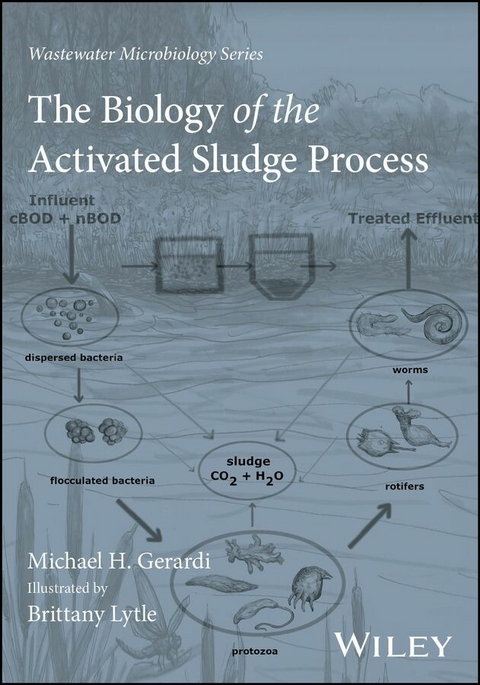
The Biology of the Activated Sludge Process (eBook)
479 Seiten
Wiley (Verlag)
978-1-119-79521-6 (ISBN)

A manual for linking operational changes to shifts in microbes and microbial populations
In The Biology of the Activated Sludge Process, experienced wastewater microbiologist, Michael Gerardi, delivers a hands-on, biological approach to the activated sludge process. The book offers a 'natural' perspective, focusing on simplistic, reliable, and practical measures that professionals can use to quickly identify and correct operational problems in activated sludge processes (ASPs).
Gerardi covers the biochemical fundamentals of the ASP and in-plant techniques that enable operators to monitor and correct daily changes in operational conditions, sewer systems, and industrial discharges. He also explores the commonly overlooked distinction between sludge and solids and how this difference affects the day-to-day work of wastewater treatment plant operators.
Readers will also find:
- Examinations of significant organisms involved in treatment processes, their positive and negative roles, and operational conditions controlling their growth
- Detailed discussions of different types of BODs (Biochemical Oxygen Demand), such as particulate, colloidal, lipids, complex soluble, and simple soluble
- Explorations of problems that may be created by the addition of chemical compounds and how wastewater treatment success or failure is determined by biochemical reactions
- Effective and inexpensive tests and parameters useful for the identification and correction of common operational problems
This is an essential troubleshooting guide for wastewater operators to incorporate into their process control measures. The text is also useful for laboratory technicians at wastewater treatment plants and commercial laboratories, regulatory personnel who inspect wastewater treatment plants, and consulting engineers.
MICHAEL H. GERARDI is a wastewater microbiologist. He has operated activated sludge treatment processes and has 45 years of experience in wastewater collection, treatment, and disposal. He has provided consulting and microscopy services for domestic, municipal, and industrial wastewater treatment plants throughout the United States, Canada, and the Caribbean. He has developed and taught wastewater biology classes for Penn State University to over 15,000 operators and authored 11 textbooks in wastewater biology.
1
Introduction
Before the industrial revolution (1760–1840) and the rapid increase in population growth of cities, domestic and municipal wastewaters were simply discharged into a receiving body of water, and the natural “cleansing” ability of the biota in the water along with its dissolved oxygen and nitrate (NO3−) reduced the pollution, i.e., it reduced the quantities of carbonaceous and nitrogenous pollutants in the wastewater. Then, water pollution was not considered to be a significant problem. The natural treatment of wastewaters by bacteria and a host of other microorganisms in the receiving body of water was performed over miles that the wastewater traveled in the receiving body of water (Figure 1.1). The distance traveled by the wastewater in the receiving body of water and the amount of treatment that the wastewater received are illustrated by the use of “saprobic” indices.
The saprobic index is a monitoring tool that is used to measure water quality. It addresses the ability of a body of water to degrade carbonaceous (organic) matter. The index is derived from saprobes or organisms that depend on the degradation of organic matter. The saprobic index is divided into several indices that are based on the presence of indicator organisms or bioindicators that include protozoa, metazoa, and fish.
There are four commonly used saprobic indices that describe the degree of pollution in a body of water (Table 1.1). The indices include oligosaprobic, beta‐mesosaprobic, alpha‐mesosaprobic, and polysaprobic. The distance that each index occupies in the water is determined by (1) the strength and composition of pollution and (2) the ability of the water to cleanse the pollution. The ability of the water to cleanse or degrade the pollution is dependent upon the organisms, including algae that are present, the quantities of dissolved oxygen and nitrate, and the water temperature.
Figure 1.1 Saprobic indices of pollution in a body of water receiving untreated wastewater. In the absence of a biological wastewater treatment plant, untreated wastewater is discharged to a receiving body of water. Immediately upstream of the entrance of the raw wastewater is an unpolluted zone or an oligosaprobic condition. The immediate impact of the untreated wastewater in the receiving stream produces a heavily polluted or polysaprobic condition. Depending on the strength of the untreated wastewater, the receiving body of water would “naturally” cleanse or degrade the untreated wastewater. Treatment would require the travel time of the untreated wastewater along the flow of the receiving body of water. As the strength of the untreated is reduced, the quality of the receiving body of water would change from an alpha‐mesosaprobic condition to a beta‐mesosaprobic condition and then finally return to an oligosaprobic condition that was present upstream of the discharge point of the untreated wastewater into the receiving body of water.
TABLE 1.1 Saprobic Indices for a Body of Water
| Saprobity | Saprobiological Water Quality Class or Description |
|---|
| Oligosaprobic | Unpolluted |
| Beta‐mesosaprobic | Moderately polluted |
| Alpha‐mesosaprobic | Strongly polluted |
| Polysaprobic | Excessively polluted |
Upstream of the entry of raw wastewater into the receiving body of water, there is unpolluted water or an oligosaprobic condition or index. Where the wastewater enters the receiving body of water, there is an immediate and severe or excessive pollution. This is a polysaprobic condition or index. As the wastewater travels downstream from its entry point, a large number and diversity of organisms using dissolved oxygen and nitrate in the receiving body of water degrade the carbonaceous wastes. With the degradation of carbonaceous waste, the amount of pollution decreases over the distance traveled. From the polysaprobic condition, the amount of pollution again decreases to a strongly polluted condition (alpha‐mesosaprobic index) and then to a moderately polluted (beta‐mesosaprobic index) condition. Eventually, with continued degradation of carbonaceous wastes, the stream would return to an unpolluted condition or oligosaprobic index.
Significant organisms in the receiving body of water that treat the carbonaceous wastes include archaea, bacteria, and protozoa. The most essential of these organisms are the bacteria. Bacteria are found suspended in the water, flocculated in biofilm on the shoreline, and captured in sediment. Bacteria along with archaea and protozoa simply capture energy and carbon from nonliving carbonaceous wastes or carbonaceous biochemical oxygen demand (cBOD) and transform some of the carbonaceous wastes into new living cells or offspring.
Also present are macroscopic organisms that serve as bioindicators of the saprobic condition or quality of the water (Table 1.2). Examples of species of insects and fish that can be found in the oligosaprobic portion of a body of water in the temperate region of North America would include caddisflies (order Trichoptera) and mayflies (order Ephemeroptera) (Figure 1.2) and brook trout (Salvelinus fontinalis) and sculpins (Cottus gobio) (Figure 1.3). Examples of species of insects and fish that can be found in a polysaprobic portion of a body of water in the temperate region of North America include midge flies (Chironomidae spp.) and drone fly (Eristalis tenax) (Figure 1.4) and common carp (Cyprinus carpio) and hognose sucker (Hypentelium nigricans) (Figure 1.5). Insect larvae and fish feed upon algae, archaea, bacteria, protozoa, and other organisms in order to capture carbon and energy for reproduction.
TABLE 1.2 Macroinvertebrates and Fish as Bioindicators of Water Quality of Stream in Pennsylvania
| Water Quality | Macroinvertebrates | Fish |
|---|
| Poor (polluted) | Midge fly Drone fly | Common carp Hog nose sucker |
| Rich (unpolluted) | Caddisfly Mayfly | Brook trout Sculpin |
Figure 1.2 Commonly observed insects in an oligosaprobic index of a body of water. Insects, adult and larvae, commonly found in an oligosaprobic condition in a body of water include the caddisfly and the mayfly. Caddisflies have aquatic larvae and terrestrial adults. They are an important food source for fish. The flies have a variety of colors, including gray, brown, purplish‐brown, yellowish‐tan, and green. Mayflies also have aquatic larvae and terrestrial adults. Although the flies have a very short lifespan, the larvae serve as a food source for fish and help recycle nutrients in a body of water.
Figure 1.3 Commonly observed fish in an oligosaprobic index of a body of water. Fish commonly found in an oligosaprobic index in a body of water include the brook trout (Salvelinus fontinalis) and sculpin (Cottis gobio). The brook trout is typically 6–15 inches in length and 1–5 lb in weight. The sculpin (C. gobio) is relatively short in length at <6 inches and relatively small in weight at <3 lb. It has a large head with a long snout. Instead of scales, the sculpin has plates.
With the industrial revolution and rapid increase in population growth of cities, receiving bodies of water were soon overwhelmed with pollution, i.e., the distance for treating each saprobic index of pollution became greater. Eventually, receiving bodies of water could no longer adequately treat the pollution. To address water pollution concerns, numerous biological wastewater treatment processes were developed in the late 1800s and early 1900s to treat wastewater to an acceptable level, before the treated wastewater is discharged to a receiving body of water.
The first activated sludge process, the sequencing batch reactor (SBR) was developed in England in the early 1900s. It is a biological wastewater treatment process and was later modified into the conventional, activated sludge process. The activated sludge process cleanses wastewater in a similar fashion to the receiving body of water. It uses many of the same organisms, especially bacteria for degrading carbonaceous wastes, but the activated sludge process uses time rather than distance to treat the wastewater, i.e., it captures and holds organisms and wastewater in an aerated box, and over time, the captured organisms treat the wastewater.
In the activated sludge process, high concentrations of bacteria grow in floc particles and are held in suspension through aeration and mixing action. The bacteria and pollutants in the wastewater are placed in contact with each other for hours, often days. The time is expressed as hydraulic retention time (HRT) in the aeration tank or mean cell residence time (MCRT) in the activated sludge process.
Figure 1.4 Commonly observed insects in a polysaprobic index of a body of water. Insects, adult and larvae, commonly found in a...
| Erscheint lt. Verlag | 23.12.2025 |
|---|---|
| Reihe/Serie | Wastewater Microbiology |
| Sprache | englisch |
| Themenwelt | Naturwissenschaften ► Chemie |
| Schlagworte | activated sludge process troubleshooting • asp troubleshooting • Biochemical oxygen demand • Brittany Lytle • Sewage treatment • sewer system conditions • wastewater • wastewater process control • Wastewater Treatment • wastewater treatment microbiology |
| ISBN-10 | 1-119-79521-4 / 1119795214 |
| ISBN-13 | 978-1-119-79521-6 / 9781119795216 |
| Informationen gemäß Produktsicherheitsverordnung (GPSR) | |
| Haben Sie eine Frage zum Produkt? |
 EPUB (Adobe DRM)
Kopierschutz: Adobe-DRM
Adobe-DRM ist ein Kopierschutz, der das eBook vor Mißbrauch schützen soll. Dabei wird das eBook bereits beim Download auf Ihre persönliche Adobe-ID autorisiert. Lesen können Sie das eBook dann nur auf den Geräten, welche ebenfalls auf Ihre Adobe-ID registriert sind.
Details zum Adobe-DRM
Dateiformat: EPUB (Electronic Publication)
EPUB ist ein offener Standard für eBooks und eignet sich besonders zur Darstellung von Belletristik und Sachbüchern. Der Fließtext wird dynamisch an die Display- und Schriftgröße angepasst. Auch für mobile Lesegeräte ist EPUB daher gut geeignet.
Systemvoraussetzungen:
PC/Mac: Mit einem PC oder Mac können Sie dieses eBook lesen. Sie benötigen eine
eReader: Dieses eBook kann mit (fast) allen eBook-Readern gelesen werden. Mit dem amazon-Kindle ist es aber nicht kompatibel.
Smartphone/Tablet: Egal ob Apple oder Android, dieses eBook können Sie lesen. Sie benötigen eine
Geräteliste und zusätzliche Hinweise
Buying eBooks from abroad
For tax law reasons we can sell eBooks just within Germany and Switzerland. Regrettably we cannot fulfill eBook-orders from other countries.
aus dem Bereich