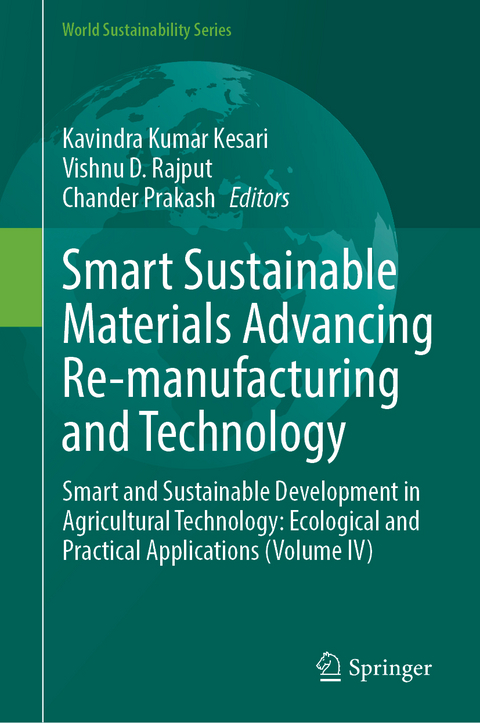
Smart Sustainable Materials Advancing Re-manufacturing and Technology
Springer International Publishing (Verlag)
978-3-032-17906-7 (ISBN)
- Noch nicht erschienen - erscheint am 13.04.2026
- Versandkostenfrei
- Auch auf Rechnung
- Artikel merken
This book mainly focus to explore the possibilities in the age of frequent climate change globally. Because the most defined challenges in the world is to produce enough food for the growing population. Our researchers, scientists already developed several techniques to solve the issues, but they are not free from drawbacks, for example, genetically modified organisms (GMOs). This is not a permanent solution. However, the development of techniques in a smarter and sustainable way is more in demand. Specially, agriculture is associated with various problems, such as the exhaustion of non-renewable natural resources; soil damage; the adverse effects of agricultural chemical products for human and environmental health; and poorer food quality. These problems cannot be solved only using technological aspects; in fact with technology, sustainable development is required. Such problems give rise to interest in sustainability in agriculture and the spread of sustainable development in the sector or sustainable agriculture. Therefore, using SMART and suitable technology, not only monitor the climatic and environmental conditions but also play an important role in high-yielding verities, including irrigation water and fertilizers. Sustainability in agriculture can be achieved through limiting toxic chemicals, saving natural resources, and reducing greenhouse gas emissions. Technology applications could help farmers to use proper data in decision-making, which leads to low-input agriculture. This book series specially focuses to develop green and sustainable materials for future development to restrict environmentally harmful materials, which are directly or indirectly associated with human health. The proof of concept of this book series will be to utilize all kinds of waste materials, i.e., straws after wheat/ rice harvesting, sugarcane bagasse, used cloths, metals, etc., for agriculture use, i.e., biofertilizers. This book provides in-depth knowledge about challenges faced during the processing of advanced materials and discusses possible ways to achieve sustainability in manufacturing.
Dr. Kavindra Kumar Kesari is a Senior Researcher, Aalto University, Espoo, Finland. Previously, he worked as a Researcher at VTT Technical Research Center of Finland, Espoo, Finland. Also, as a Postdoctoral Researcher at the University of Helsinki, and University of Eastern Finland, Kuopio, Finland (since 2013). He also served as an Associate Professor at Lovely Professional University, Punjab and Full Professor at Chandigarh University, Punjab in recent years. He is actively involved in material-based research on biomaterials, hybrid materials and cancer research. He has published over 150 papers (H-index 52: Google Scholar as of November 2025) in reputed scientific journals, 30 book chapters, and 7 books, and has presented over 50 papers at national and international scientific meetings. He is listed in the Top 2% world s leading scientists published by Stanford University and Elsevier. Also acting as a visiting fellow for INTI International University, Malaysia and Adjunct Professor for Chandigarh University, Mohali, India. He received four times Young Scientist Award for his outstanding contribution to research.
Dr. Vishnu D. Rajput working as Head of Soil Health Lab at Southern Federal University, Rostov-on-Don, Russia. His research of research is how nanoparticles/heavy metals interact with plants, soil, microbial community, and the larger environment as well as possible remediation technology using nanoparticles/nano-biochar. He has published 331 scientific publications, 70 chapters, 18 books, H-Index: 37. He is an internationally recognized reviewer, received an Outstanding Reviewing Certificate by Elsevier and Springer. He is Editorial Board Member of various high-impacted journals such as biochar. He has also received Highly Qualified Specialist status by the Russian government. In year 2023, he is included in the list of 2% world s potential scientists by Elsevier BV publishing house.
Introduction.- Sustainable development towards 3D printing replacing agriculture waste.- Sustainable cellulose films as packaging (coating) materials to reduce plastic use.- Recovery of energy or nutrients from natural resources, biomass, and solid wastes.- Wood and harvested crop straws for 3D printing and greener solutions.- Replacing plastic with cellulose film-based plastic towards greener solutions.- Utilizing modern technology for on-farm planning and production efficiency (crop identification, environmental effect, energy efficiency, adoption studies, and socioeconomic evaluation).- Technologies for Sustainable Agricultural Development.- Smart farming technologies for sustainable agricultural development: crops to cattle.- Concluding remarks and future perspectives.
| Erscheint lt. Verlag | 14.7.2026 |
|---|---|
| Reihe/Serie | World Sustainability Series |
| Zusatzinfo | Approx. 350 p. 70 illus., 50 illus. in color. |
| Verlagsort | Cham |
| Sprache | englisch |
| Maße | 155 x 235 mm |
| Themenwelt | Naturwissenschaften ► Biologie ► Ökologie / Naturschutz |
| Naturwissenschaften ► Geowissenschaften | |
| Schlagworte | biomass • cellulose film coating • climate change • Green chemistry • nanomaterials • sustainability |
| ISBN-10 | 3-032-17906-8 / 3032179068 |
| ISBN-13 | 978-3-032-17906-7 / 9783032179067 |
| Zustand | Neuware |
| Informationen gemäß Produktsicherheitsverordnung (GPSR) | |
| Haben Sie eine Frage zum Produkt? |
aus dem Bereich