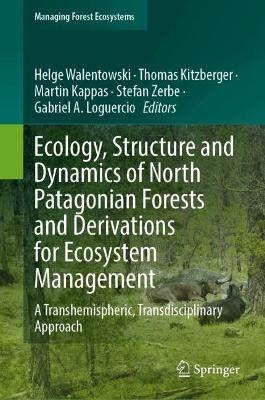
Ecology, Structure and Dynamics of North Patagonian Forests and Derivations for Ecosystem Management
Springer International Publishing (Verlag)
978-3-032-17736-0 (ISBN)
- Noch nicht erschienen - erscheint am 08.04.2026
- Versandkostenfrei
- Auch auf Rechnung
- Artikel merken
This volume of Managing Forest Ecosystems addresses the urgent challenge of managing temperate forests under accelerating climate change. It adopts a comparative, transhemispheric perspective by examining forest ecosystems in both the Southern and Northern Hemispheres, with a particular focus on the trans-Andean gradient in Northern Patagonian Nothofagus forests and Central European Fagus (beech) forests.
Through an interdisciplinary and evidence-based approach, the volume examines ecological adaptations, species responses, and disturbance dynamics under accelerating global change. It emphasizes strategies for climate-adapted forestry, the integration of ecological and technological knowledge, and the importance of long-term monitoring and international collaboration.
By linking scientific insights with global policy frameworks such as the UN 2030 Agenda and the Decade on Ecosystem Restoration, this book offers a foundation for nature-based solutions and knowledge transfer. It is an essential resource for researchers, practitioners, and policymakers in forestry, ecology, and environmental sciences, as well as graduate students seeking a comprehensive understanding of climate-adapted forest management.
Helge Walentowski is a Full Professor at the HAWK University of Applied Sciences and Arts Hildesheim/Holzminden/Göttingen, Germany. He teaches Forest Geobotany, Forest Pedology, and Nature Conservation, and was responsible for developing an inter- and transdisciplinary Master s program. He also leads the faculty s Latin America research group. His research focuses on ecologically sustainable forest management based on analyses of the effects of land use and climate change on forest ecosystems, combining applied forest ecology with biodiversity conservation and interdisciplinary approaches to sustainability.
Thomas Kitzberger is a Full Professor at the Universidad Nacional del Comahue (UNCo) and a Researcher for INIBIOMA-CONICET in Bariloche, Argentina. His research focuses on forest dynamics under climate change in northern Patagonia, addressing drought-induced forest mortality, climate effects on tree masting, and altered fire regimes. He contributes expertise on fire prevention, carbon fixation, and post-fire restoration. With extensive experience in international collaboration, he has participated in multiple research networks and projects and is a contributing author of several chapters in Springer textbooks on forest ecology and management.
Martin Kappas is a Geographer and Full Professor at the University of Göttingen, Germany, where he heads the Department of Cartography, GIS, and Remote Sensing. His research addresses climate change detection, landscape dynamics, land-use potential, and biomass energy for sustainable development. He has led numerous interdisciplinary projects linking remote sensing and environmental management. Professor Kappas is the author and editor of several Springer books and serves on the Editorial Board of Ecological Processes (Springer Open), promoting integrative approaches to global environmental change research.
Stefan Zerbe is a Landscape and Restoration Ecologist who served until September 2025 as a Full Professor at the Free University of Bozen-Bolzano (Italy), and currently holds a Senior Professorship at the University of Hildesheim and an Honorary Professorship at the HAWK University of Applied Sciences and Arts Hildesheim/Holzminden/Göttingen. His work focuses on restoration ecology and the interdisciplinary integration of the environmental and social sciences in sustainable landscape development. He has coordinated and managed two international Master s programs and edited several Springer volumes, emphasizing inter- and transdisciplinary approaches to ecological restoration and landscape management.
Gabriel Angel Loguercio is a Researcher at the Centro de Investigación y Extensión Forestal Andino-Patagónico (CIEFAP) based in Esquel, Argentina. His expertise includes silviculture and ecology of Andean-Patagonian native forests, forest management and planning, biomass and carbon stocks, post-fire dynamics, and plantation establishment. He has authored multiple peer-reviewed articles, technical manuals, and field guides, and actively contributes to extension and training programs. His work bridges applied forest research and management, promoting sustainable use and conservation of native forest ecosystems in northern Patagonia. He also teaches Forest Management at the Universidad Nacional de la Patagonia "San Juan Bosco", sede Esquel.
Section A: Section A EXPANDIG OUR HORIZONS: Trans-hemispheric and trans-disciplinary approach - the fundamental idea of bringing together experiences and perspectives from different regions in the middle latitudes.- Chapter 1. Structure of the Overall Project and Aim of the Book.- Chapter 2. Transhemispheric Space-for-Time Substitution Concepts to Investigate Forest Responses to Climate Change.- Chapter 3. Two Northern and Southern Hemisphere Keystone Tree Species in the Face of Global Change European Fagus sylvatica L. and Patagonian Nothofagus dombeyi (Mirb.) Ørst.- Section B EXAMPLARY MODEL APPROACH: Interdisciplinary transect research - covering the variability of the landscape along macroclimatic gradients - exemplified by the southern hemisphere, trans-Andean rainfall gradient in northern Patagonia.- Chapter 4. Climate Variations Across Landscape Gradients of Northern Patagonian Andean Forests: Lessons from High-Resolution Climate Datasets and Microclimatic Records.- Chapter 5. From Herbs to Canopy: Spatiotemporal Patterns of Forest Plant Communities in Northern Andean Patagonia.- Chapter 6. Tree-Ring-Based Assessment of Climate Vulnerability in Native and Introduced Tree Species in Northern Patagonia.- Chapter 7. The Canopy of Large Old Trees: A Structural Component for Biodiversity Conservation in Northern Patagonian Rainforests.- Chapter 8. Vulnerability to Climate Change of Andean Mountain Forests in Southern Chile Based on Long-Term Forest Monitoring.- Section C NATURE BASED SOLUTIONS / BRIDGING NATURE AND HUMANS: Closing the gap between research and practice using the example of southern hemisphere southern beech forests and circulating the potentials for a trans-hemispheric transfer of ideas and perspectives.- Chapter 9. Spatially Explicit Modeling as a Tool for Collaborative-Oriented Management of Patagonian Forest Landscapes - Can we Reduce Fire Extent and Severity by Basin-Oriented Management?- Chapter 10. Current Topics in Vegetation Dynamics and Plant Succession in Northern Patagonian Andean Forests: Bridging Knowledge Gaps for Ecosystem-Based Management.- Chapter 11. Restoration in Northern Andean-Patagonian forests: Insights from the Past, Directions for the Future.- Chapter 12. Ecosystem-based Landscape Planning and Management of Southern Temperate Forests.- Chapter 13: Synthesis: Key Findings, Gaps, and Future Directions.
| Erscheint lt. Verlag | 15.4.2026 |
|---|---|
| Reihe/Serie | Managing Forest Ecosystems |
| Zusatzinfo | Approx. 450 p. 24 illus. |
| Verlagsort | Cham |
| Sprache | englisch |
| Maße | 155 x 235 mm |
| Themenwelt | Naturwissenschaften ► Biologie ► Ökologie / Naturschutz |
| Weitere Fachgebiete ► Land- / Forstwirtschaft / Fischerei | |
| Schlagworte | Forest Landscape Planning and Management • Forest Restoration • Forest Structure, Phytodiversity and Soil Conditions • Multifactoral Modeling and Multi-sensor Remote Sensing • Trans-hemispheric and Transdisciplinary Approach • Vitality Analysis of Trees |
| ISBN-10 | 3-032-17736-7 / 3032177367 |
| ISBN-13 | 978-3-032-17736-0 / 9783032177360 |
| Zustand | Neuware |
| Informationen gemäß Produktsicherheitsverordnung (GPSR) | |
| Haben Sie eine Frage zum Produkt? |
aus dem Bereich