A-Z of Memory
Routledge (Verlag)
978-1-041-00722-7 (ISBN)
- Noch nicht erschienen (ca. Juli 2026)
- Versandkostenfrei
- Auch auf Rechnung
- Artikel merken
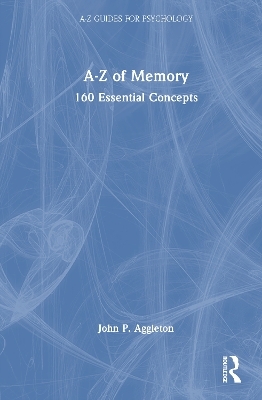
This book compiles and explains the key terms and core concepts related to memory in an easy-to-navigate A-Z format.
The quest to understand how memory works and how it fails remains a cornerstone of both Psychology and Neuroscience; however, defining memory is not easy. At a higher level, memory is sometimes seen as a psychological function for the preservation of information, while other definitions focus on remembering. In this innovative book, John P. Aggleton delves into the many definitions and attributes that constitute memory and guides the reader through over 160 entries ranging from Aging to Repression; Dementia to Working Memory. Each entry explores the various psychological and biological elements of memory and includes recommended further reading and cross-referencing.
This guide will serve as an overview and introductory resource for students and scholars involved in memory studies and memory research, as well as practitioners working with sufferers of memory disorders. It will also be of great interest to anyone interested in the utterly remarkable memory skills we all possess.
John Aggleton is a world-wide recognised researcher and author. He has published over 300 papers, principally on brain systems devoted to different forms of memory. His contribution to the field was recognised by the Royal Society in 2012 when he was elected as a Fellow. He has also served as President of the British Neuroscience Association and of the European Brain and Behaviour Society. He is currently Emeritus Professor of Cognitive Neuroscience at Cardiff University.
Introduction
A)
Absent-minded – being forgetful, often from a failure to pay attention to one’s actions
Adaptive memory – that our learning and memory skills are tuned to solving fitness-based problems, reflecting how our memory evolved
Aging – the impact of time on an organism once maturity is reached
Alcohol – a chemical (ethanol) with psychoactive effects that is globally used as a recreational drug
Alzheimer's disease (AD) – the commonest form of dementia characterised by the presence of brain atrophy, amyloid plaques, and neurofibrillary tangles, along with pronounced cognitive decline
Amnesia – the loss of memory despite the sparing of other cognitive abilities
Amygdala – a limbic brain structure in the anterior part of the medial temporal lobes
Anaesthetics – see Unconscious learning
Anterograde amnesia – the failure to encode, consolidate, or retrieve new information that would normally reside in explicit long-term memory
Associative learning – the ability of organisms to make connections between related events in their environment
Autobiographical memory – individual personal episodes along with more general life information that concerns the same individual
Autonoesis – see Episodic memory, Remember
Availability heuristic – see Heuristics
B)
Bartlett – on the contributions of Sir Frederick Bartlett (1886-1969)
Bias – how our memories are shaped by learnt expectations and prejudices
Binding – the bringing together of different elements in space and time to create a cohesive entity, be it a sensory percept or a mnemonic representation
Blocking – 1) The ability of a previously acquired association to block further associative learning about the same contingency, 2) The ability of an initial (incorrect) recalled item to block the recall of other potential solutions
Bottom-up processing – see Top-down processing
C)
Caffeine – a widely used stimulant with some positive effects on cognition (see also Nootropics)
Central executive – a core component of working memory that helps to regulate attention, make decisions, and guide the brief holding of information
Change blindness – see Illusions of memory
Childhood amnesia (also called Infantile amnesia) – the inability to recall or recognise personal events from our earliest years
Classical conditioning –the associative learning of how one stimulus predicts another
Cognitive control – see Executive functions
Cognitive enhancers – see Nootropics
Comprehension and learning – see Understanding and learning
Concept learning – see Grandmother cells, Hub and Spoke model, Semantic memory
Conditioned taste aversion – the long-lasting, deep dislike of a taste that had been associated with feeling nauseous
Confabulation – the fabrication of narratives and other information, often to fill in memory gaps
Confirmation bias – see Bias
Consolidation – the progressive stabilization of information post encoding
Constructivism in memory – the belief that memories reflect our personal understanding of an event, rather than an objective representation
Context and memory – how the same contextual cues at learning and recall can benefit retrieval while changed contextual cues can disrupt retrieval
Cross-sectional study – see Longitudinal study
Curiosity – an intrinsic motivation to seek novel information and so reduce uncertainty
D)
Declarative memory – explicit long-term memory that incorporates both semantic and episodic memory
Deese-Roediger-McDermott paradigm (DRM) – using related words or images to create false memories of a never-presented, but closely related item
Default mode network – the network of brain areas that increases coordinated activity in between tasks, typically when self-reflecting or mind wandering
Demand characteristics – the array of cues that convey an experimental hypothesis to the participant
Dementia – an umbrella term that covers numerous neurological conditions that progressively disrupt brain function and cause the breakdown of multiple cognitive functions
Depression and memory – the impact of major depression on memory
Depth of processing – see Levels of processing
Developmental amnesia – a syndrome of memory loss and memory preservation seen after bilateral hippocampal damage in childhood
Diencephalon – a core brain area largely consisting of the thalamus, subthalamus, and hypothalamus
Digit span – see Memory span
Dissociative amnesia – see Psychogenic amnesia
Distributed practice – see Spaced training
Directed forgetting – see Motivated forgetting
E)
Ebbinghaus – Hermann Ebbinghaus (1850-1909) is principally famous for his systematic studies of rates of learning and rates of forgetting
Echoic memory – the brief sensory store for auditory information, including words
Ecological validity – a term typically used when considering how well a set of experimental findings can be generalized to real-world settings
Ecphory – when a cue helps trigger the memory of a past event
Eidetic memory – an unusually vivid form of visual memory that is highly accurate
Elaborative rehearsal – the process of considering the meaning of a stimulus and its implications, processes that create additional connections and enhance recall
Embodied cognition – the notion that the way we think is shaped by our bodily perceptions and experiences
Emotion and memory – the interplay between affect and the elements of memory
Encoding specificity principle – see Context-dependent memory and Ecphory
Engram – the enduring trace that records a memory and is potentially available for retrieval
Epigenetics – how cellular experiences may modify gene expression without altering the underlying (DNA) genetic code
Episodic buffer – a subsystem within working memory that provides a two-way bridge with episodic memory and other aspects of long-term memory
Episodic foresight (Episodic future thinking) – see Future memory
Episodic memory – our long-term memory for individual events located in a particular time and place (an episode)
Errorless learning – a method of teaching in which people are prevented as far as possible from making errors whilst learning a new skill or new information
Event segmentation – how a continuous stream of activity is broken down into meaningful units
Executive functions – an umbrella term for a set of related cognitive skills that help planning, problem solving, and adapting to new situations
Expert knowledge – the superior ability to acquire and retain new information within one’s domain of expertise
Explicit (declarative) memory – the division of long-term memory that holds information over which we have conscious access and awareness
Extinction – the reduction in frequency or intensity of a conditioned response following the removal of reinforcement
Eyewitness memory – the study of how and when the remembrance of witnessed events may differ from reality
F)
False memory (syndrome) – personal narratives for events that never occurred
Familiarity principle – see Mere-exposure effect
Fear conditioning – learning in which a stimulus or context becomes associated with fear
Feeling of knowing – a sense of familiarity indicating the presence of a memory that cannot be fully retrieved
Flashbulb memory – a vivid, detailed memory of a surprising, emotional event that often includes what the observer was doing when the event occurred
Forgetting – the absence or error in a memory, whether by inadequate encoding, alteration, erasure, or retrieval failure
Forgetting curve – the decline in memory over time
Free recall – the recollection of information as it comes to mind without explicit cues or prompts
Fugue – a temporary loss of personal identity that appears unaccompanied by physical brain damage
Future memory (episodic future thinking) – our ability to imagine or simulate future autobiographical events
Fuzzy trace theory – see Gist
G)
Generation Effect – how self-generated information is remembered better than information that you have read or heard
Gist – that some memories only capture the essence of an experience, its gist
Grandmother cell – a neuron that only responds to a highly specific, complex stimulus (such as one’s grandmother)
Grid cells – spatial neurons whose firing fields are organized in a horizontal lattice that covers the environment, with each firing field being equally spaced (forming a grid)
H)
Habit – a behaviour that can be performed without conscious control or a behaviour that is gradually acquired over many repetitive trials
Habituation – the gradual lessening of a reaction to a stimulus after the repeated presentation of the same or similar stimulus
Head-direction cells – neurons that selectively fire when facing a particular direction (‘the brain’s compass’)
Hebb – Donald O. Hebb (1904-1985), a Canadian psychologist best known for his pioneering work on neural networks and learning
Heuristic – a cognitive shortcut (rule-of-thumb) that aids rapid decision making
Highly Superior Autobiographical Memory (HSAM) (also known as Hyperthymesia) – the ability to retain past autobiographical memories at exceptional levels of detail
Hippocampal formation (Hippocampus) – a medial temporal lobe structure that critically contributes to a range of memory functions, including those required for episodic memory and spatial navigation
Hippocampal replay – see Memory replay
H.M. – Henry Molaison (1926-2008) is the best-known and most studied case of amnesia
Homunculus – i) the seductive fallacy of a little human solving problems inside our head, ii) the outline of a human body across our motor and somatosensory cortices
Hub and Spoke model of semantic memory – a model of how we represent semantic information
Hyperthymesia – see Highly Superior Autobiographical Memory
Hypnosis and memory – on whether hypnosis can aid the retrieval of memories or disrupt aspects of memory
I)
Iconic memory – a brief visual store thought to combine two forms of visual persistence
Illusions of memory – when our recall or recognition of a past event markedly deviates from the real experience
Imagery and memory – how a mental pictorial representation impacts on memory
Imagination inflation (see also False memories) – how imagining events that did not occur increases the likelihood of believing in their reality
Imitation (Imitative learning) – social learning that involves copying the actions of others
Implicit memory (Nondeclarative memory) – that component of long-term memory which is not consciously accessible
Imprinting – whereby an animal learns, during a sensitive period, to confine its preferences to a specific stimulus (typically another individual), class of stimuli, or location
Inattentional blindness – see Illusions of memory
Incidental learning – learning that occurs without the explicit intention to learn and memorise
Infantile amnesia – See Childhood amnesia
Instrumental learning (Operant conditioning) – associative learning in which the likelihood or intensity of a response is regulated by its outcome
Interference – competition between similar information that can cause memory errors
Irrelevant speech (sound) effect – how background speech or word-like sounds can disrupt ongoing memory tasks and comprehension
Isolation effect – see von Restorff effect
J)
Jost’s law – see Ebbinghaus, Ribot’s law
K)
Korsakoff’s disease (syndrome) – a form of organic amnesia associated with vitamin B1 (thiamine) deficiency, and most often seen in chronic alcoholics
L)
Latent inhibition – when a familiar stimulus takes longer to acquire a new association than a novel stimulus
Learning – at its simplest, learning is commonly defined as behavioral change brought about by experience
Learning-set – learning to learn, so that previous similar problems lead to the acquisition of a rule (learning-set) to help solve the same class of problems
Learning styles – a teaching vogue which presumes that students learn better when receiving information in their preferred medium (style), e.g., auditory, visual, or kinaesthetic
Levels of processing – the concept that the deeper you process information the better it is subsequently remembered
Lloyd-Morgan’s canon – see Instrumental learning
Longitudinal study – repeatedly testing the performance of the same individual over time
Long-term memory – a repository of stored information that persists for minutes, days, or even years (sometimes referred to as secondary memory)
Long-term depression (LTD) – although the term can refer to a chronic depressive disorder, here it concerns a process that weakens connections between neurons, often acting in the opposite way to long-term potentiation (LTP)
Long-term potentiation (LTP) – the lasting strengthening of synaptic efficacy following pulses of stimulation
M)
Maintenance rehearsal – see Elaborative rehearsal
Mammillary bodies – see Diencephalon, Korsakoff’s syndrome
Massed learning – see Spaced learning
Memory – the meaning of memory
Memory in sensitive plants and unicellular organisms, including slime moulds – on whether memory exists in organisms that lack neurons
Memory replay – the reactivation of sequential activity patterns in neuronal assemblies that replays their prior patterns of activity during learning
Memory span – a test of short-term memory in which a series of items are recalled in their order of presentation
Mental time travel – see Future memory (Future episodic memory)
Mere-exposure effect – how, after repeated exposure, a neutral stimulus acquires positive values
Metamemory – the introspective ability to monitor your own memory processes, including its content and capabilities
Method of loci – A memory aid (mnemonic) that involves making visual images of items to be remembered, and placing these images in a pre-set sequence of visualised locations
Mild cognitive impairment – a condition causing memory or other thinking problems that is often, but not always, a transitional phase leading to dementia
Mirror neuron – a neuron that increases its activity when performing an action and when observing that same action
Mnemonics – effortful cognitive strategies used to improve memory
Mnemonists – individuals who possess exceptional memory abilities, whether seemingly spontaneously or by dint of exhaustive training
Mood congruency – see Context-dependent memory
Motivated forgetting – an effortful process that helps us to forget unwanted memories
Motor learning – see Procedural learning
Multiple trace theory (of consolidation and retrieval) – that each retrieval effort creates a new memory trace, as a result of which the hippocampus remains necessary for the consolidation and retrieval of past episodic memories, irrespective of their age
N)
n-back task – where participants mentally hold a continuous sequence of items while checking for any repeats from a specified number of places (n) back in the sequence
Neurogenesis – the creation of new neurons
Nicotine – an addictive drug that activates one of the two major types of acetylcholine receptors (nicotinic) and is thought to influence cognition
Nondeclarative memory – see Implicit memory
Nootropics (‘Cognitive enhancers’, ‘Neuroenhancers’, ‘Smart drugs’) – chemicals and supplements purported to improve cognition, including learning and memory
O)
Observational learning – social learning based on imitation that makes it possible to acquire new behaviours and knowledge
Olfactory memory – memory for smells
Operant learning – see Instrumental learning
P)
Partial reinforcement extinction effect – see Extinction
Partial report method – see Iconic memory, Echoic memory
Pattern completion and Pattern separation – ‘Pattern completion’ is the process of retrieving a complete memory representation from a partial or degraded cue; ‘Pattern separation’ is the process of segregating similar experiences into distinct, dissimilar representations
Pavlovian conditioning – see Classical conditioning
Penfield (Wilder Penfield, 1891-1976) – see Engram
Perceptual learning – see Expert knowledge
Phenotype – the observable attributes displayed by an individual
Phonological loop – a working memory subsystem for speech-based sounds
Place cells – neurons that signal a specific location by increasing their activity
Prediction error – the mismatch between a prior expectation and the experienced event
Preverbal learning – that period of learning by infants prior to verbal communication, typified by other communication skills such as vocalizations, gestures, and eye contact
Primacy effect – the superior recall of the first few items in a sequence
Primary memory – see Short-term memory
Priming – when exposure to a stimulus (now ‘primed’) influences our response to a subsequent stimulus
Proactive interference – see Interference
Procedural memory – the implicit memory for skills, habits, and cognitive actions that are performed automatically and for which we lack conscious awareness of their underlying nature
Prospective memory – the cognitive ability to remember to perform an intended action or recall a planned intention at an appropriate future time
Psychogenic amnesia (or Dissociative amnesia) – a memory dysfunction, typically involving a loss of personal memories, which arises from psychological stress or trauma yet without detectable brain damage (or damage that could account for the degree of memory loss)
Q)
Qualia – the subjective conscious experience of a quality or property
R)
Reality monitoring – see Source monitoring
Recall – see Remember
Recency effect – the superior recall of information presented at the end of a list over those items presented in the middle
Recognition memory – the ability to detect the re-occurrence of a stimulus
Reconsolidation (and Reconstruction) – the process whereby the retrieval of a memory renders it unstable and prone to modification
Recovered memories – see Repression of memory
Rehearsal – the mental repetition of an item to prolong its storage
Reinforcement and Reward – terms describing how pleasant or unpleasant stimuli can influence the likelihood of a preceding action
Remember (Recall, Retrieve) – to access a memory (or past representation)
Remember/Know – see Recognition memory
Replication crisis (Reproducibility crisis) – a methodological crisis concerning how many published findings (e.g., in psychology) are difficult or seemingly impossible to reproduce
Repression (memory) – the self-removal of a traumatic memory that cannot be accommodated in conscious memory
Retrieval – see Remember
Retrieval effect (Retrieval practice effect) – see Testing effect
Retroactive interference – see Interference
Retrograde amnesia – the sudden loss of past memories, typically following a neurological insult
Ribot’s law (1881) – that in retrograde amnesia, recent memories are more likely to be lost than older memories
S)
Savants – people who display spectacular feats of memory, the term ‘savant syndrome’ being largely reserved for those who also face neurodevelopmental challenges
Savings – using rates of relearning to assess original levels of learning and retention
Schema – an acquired mental framework that guides the interpretation, organization, and recollection of incoming information
Scripts – see Schemas
Semantic dementia – a subtype of frontotemporal dementia that predominantly affects language skills, in particular, word comprehension and naming
Semantic memory – a division of explicit long-term memory that holds general knowledge about the world, including facts, concepts, words, and number meanings
Sensitization – when the repeated exposure to a stimulus results in an amplification of responsiveness to that stimulus, and potentially to other stimuli
Sensory memory – see Echoic memory, Iconic memory
Serial position effect – see Primacy effect, Recency effect
Short-term memory – a store holding restricted amounts of information over short time periods
Smart drugs – see Nootropics
Source monitoring – the cognitive ability to identify the origin of a memory
Spaced training (Spaced learning) – how distributed practice results in more effective learning and more durable retention
State-dependent learning (State-dependency) – see Context and memory
Superstitious learning – the mistaken learning that occurs when an action is coincidentally paired with a reinforcer
Synaptic plasticity – see Long-term depression and Long-term potentiation
T)
Taxi drivers (London) – insights into brain plasticity and spatial learning made possible by the unique training demands on London taxi drivers
Testing effect – how taking tests during the learning phase facilitates later retrieval from long-term memory
Tip-of-the-tongue (tip-of-the-finger, tip-of-the-eye) – the feeling that you are on the brink of recollecting a word, but the correct word will not come to mind
Tobacco smoking – see Nicotine
Top-down processing (also Bottom-up processing) – how our prior knowledge and expectations influence perceptual and cognitive decisions
Trace decay – that memories get weaker over time, with time being the critical agent of forgetting
Transient global amnesia – an anterograde amnesia of sudden origin and brief duration that selectively affects the ability to make or access new memories while sparing other cognitive abilities
U)
Unconscious learning when anaesthetised – evidence that new implicit learning is possible despite being unconscious
Understanding and memory – the relationship between depth of understanding and subsequent memory (also see Constructivism, Elaborative rehearsal, Expert knowledge, Levels of processing, Mnemonics, Schemas)
V)
Visuospatial sketchpad – a subsystem within the multicomponent model of working memory that holds visual and spatial information
von Restorff effect (Isolation effect) – the enhanced memorability of an item that stands-out from the array by being different or unexpected
W)
White matter plasticity – how experience-induced changes to white matter accompany learning
Wisconsin Card Sorting Test – see Learning-set
Working memory – a cognitive system with limited capacity and temporary duration that actively holds information making it available for reasoning, decision-making, and planning (a more restricted definition applies to animal working memory)
Y)
Yerkes-Dodson law – see Emotion and memory
Z)
Zebra fish – a model vertebrate species that has optically transparent embryonic and young larval stages
Zeigarnik effect – that uncompleted or interrupted tasks are remembered better
Acknowledgements
| Erscheint lt. Verlag | 15.7.2026 |
|---|---|
| Reihe/Serie | A-Z Guides for Psychology |
| Zusatzinfo | 43 Halftones, black and white; 43 Illustrations, black and white |
| Verlagsort | London |
| Sprache | englisch |
| Maße | 156 x 234 mm |
| Themenwelt | Geisteswissenschaften ► Psychologie ► Allgemeine Psychologie |
| Geisteswissenschaften ► Psychologie ► Biopsychologie / Neurowissenschaften | |
| Naturwissenschaften ► Biologie ► Humanbiologie | |
| Naturwissenschaften ► Biologie ► Zoologie | |
| ISBN-10 | 1-041-00722-1 / 1041007221 |
| ISBN-13 | 978-1-041-00722-7 / 9781041007227 |
| Zustand | Neuware |
| Informationen gemäß Produktsicherheitsverordnung (GPSR) | |
| Haben Sie eine Frage zum Produkt? |
aus dem Bereich