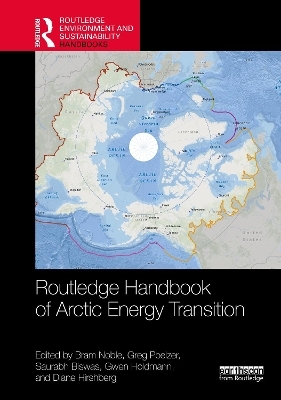
Routledge Handbook of Arctic Energy Transition
Routledge (Verlag)
978-1-032-78542-4 (ISBN)
- Noch nicht erschienen (ca. Juli 2026)
- Versandkostenfrei
- Auch auf Rechnung
- Artikel merken
Arctic energy is at a crossroads. Climate change and advances in renewable energy technologies are setting the foundation for what may be the most significant transition since the industrial revolution; yet energy transitions across the Arctic are highly uneven. Against this backdrop, the Routledge Handbook of Arctic Energy Transitions draws together contributions from leading experts in the field to explore the diverse Arctic energy landscape and establish several conceptual themes and frameworks for understanding Arctic energy transitions. The authors emphasize the critical role of planning and governance in achieving sustainable Arctic energy security—from understanding the transaction costs of local energy to the barriers and enablers of the regulatory and institutional environments. They also outline the social value of energy, from establishing the foundational concepts of social value to just transitions in the Arctic. Finally, the chapters situate Arctic energy transitions in the context of global energy security and set an agenda for Arctic energy futures research that supports community-appropriate energy solutions.
This timely Handbook will be of great interest to an internationally and professionally diverse audience studying the Arctic and sub-Arctic energy geography itself, as well as in relation to global issues. It will be an essential resource to students and scholars of energy transitions, energy policy, Indigenous rights and justice, international geopolitics and the human development dimensions of climate change.
Bram Noble is Professor of Geography and Planning at the University of Saskatchewan, Canada. Greg Poelzer is a Professor in the School of Environment and Sustainability, and Co-Lead of the Energy and Minerals for a Sustainable Future Signature Area, University of Saskatchewan, Canada. Saurabh Biswas is an Assistant Professor at Asian Institute of Technology, Thailand, and a Research Affiliate with the CASES project at the University of Saskatchewan, Canada. Gwen Holdmann is Chief Scientist and Program Lead, Alaska Center for Energy and Power, University of Alaska Fairbanks, United States. Diane Hirshberg is Director of the Institute of Social and Economic Research and a Professor of Education Policy at the University of Alaska Anchorage, United States.
1. Arctic Energy Transition Part I – Arctic Energy Landscapes 2. Energy Security in Canada: The Paradox of the Canadian North 3. Energy Security in the United States — Alaska 4. Energy Security in Finland 5. Energy Security in Iceland 6. Energy Security in Norway 7. Energy Security in Arctic Russia 8.Energy Security in Sweden 9. Energy Security and Sovereignty in Kalaallit Nunaat (Greenland) Part II – Planning and Governance of Arctic Energy Transitions 10. Impact Assessment for Arctic Energy Development 11. Energy Development in Canada’s Arctic Territories 12. Offshore Renewable Energy Projects in Arctic and Northern Regions 13. Understanding the Transaction Costs of Community Energy Development in the Arctic 14. Quantifying and Deploying Responsible Carbon Dioxide Removals in the Nordic Countries 15. Assessment of Community Bioenergy Potential in the Northern Boreal 16. Risk Perception, Nuclear, and Community Decision-Making 17. Reframing Energy Security: Agency and Local Control in the Net-Zero Energy Transition 18. Upscaling Local Experiences Related to Energy Transition: Cases of Wind Power in Northern Finland Part III – Social Value of Energy in the Arctic 19. Social Value of Energy – Planning Energy Transitions as if People Mattered 20. Arctic Energetics: Renewable Energy Projects Meet Local Communities in Norway 21. Energy as Relationship: A Relational Framework Grounded in Indigenous Worldviews for Arctic and Global Energy Security 22. Local Energy Vulnerabilities: Bottom-up Versus Top-down Priorities 23. Indigenous-led Energy Transition: Exploring the Tu Deh-kah Geothermal Project as a Path to Reconciliation 24. Communities of Place, Communities of Interest, and Renewable Energy in the Arctic: Analysis of a Bioenergy Project in Galena, Alaska 25. Renewable Energy as a Catalyst for Sustainable Community Development: Insights from Nation-Building and the Creative Class 26. Community Innovation Hubs and Energy Test Beds: Approaches to Community and Research Partnerships 27. Water-energy-food Nexus in the Arctic: Energy is Power and Cooperatives Are Fuel Part IV – Arctic Energy Transition in Geopolitical Context 28. The Arctic in the context of global energy security: conflicts and geopolitics 29. Complex Dynamics of Energy Transitions in the Arctic 30. The Energy-Poverty Nexus and Just Transitions in the Arctic 31. “Nothing About Us Without Us”: Indigenous Peoples Response to Climate and Renewable Energy Goals in Arctic Norway and Sweden 32. A Just Energy Transition in a Geopolitical Hotspot? The Process of Energy Transition in Longyearbyen, Svalbard 33. Self Interest or Altruism? How Arctic and Pacific Small Island Energy Systems Shape US Security 34. The Global Critical Minerals Rush for Renewable Energy Technologies: Implications for the Arctic
| Erscheint lt. Verlag | 6.7.2026 |
|---|---|
| Reihe/Serie | Routledge Environment and Sustainability Handbooks |
| Zusatzinfo | 33 Tables, black and white; 33 Line drawings, black and white; 17 Halftones, black and white; 50 Illustrations, black and white |
| Verlagsort | London |
| Sprache | englisch |
| Maße | 174 x 246 mm |
| Themenwelt | Naturwissenschaften ► Biologie ► Ökologie / Naturschutz |
| Technik ► Bauwesen | |
| Technik ► Elektrotechnik / Energietechnik | |
| ISBN-10 | 1-032-78542-X / 103278542X |
| ISBN-13 | 978-1-032-78542-4 / 9781032785424 |
| Zustand | Neuware |
| Informationen gemäß Produktsicherheitsverordnung (GPSR) | |
| Haben Sie eine Frage zum Produkt? |
aus dem Bereich