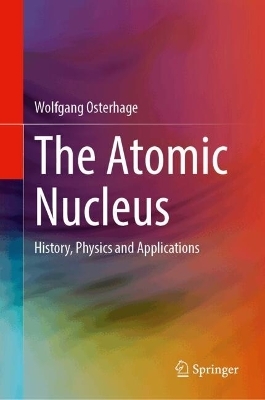
The Atomic Nucleus
Springer International Publishing (Verlag)
978-3-032-17714-8 (ISBN)
- Noch nicht erschienen (ca. Juni 2026)
- Versandkostenfrei
- Auch auf Rechnung
- Artikel merken
This book is a comprehensive exploration of the atomic nucleus. It recounts the history of research into the atomic nucleus, the physical laws governing it and how it may be harnessed in technology.
The atomic nucleus, after having been a subject of interest for very few specialists for a long time, arose to importance after the first fission experiments by Otto Hahn and has since dominated politics, military strategy and energy supply on a world scale. This book depicts the most important historical milestones, the physical laws governing it and a broad range of engineering applications from reactor technology to the treatment of radioactive waste. The historic starts out with ancient concepts of the nature of the atom, followed by break-through experiments by the Curies, Thomson, Rutherford and others, after which a more and more refined theory of the nucleus on the basis of quantum theory evolved. After the discovery of radioactivity, the neutron and first fission, the structure of the nucleus was revealed and described by complementary models, like the liquid drop model or the optical model as well as the laws of radioactive decay. Finally nuclear reactions are put into perspective in comparison with other forces in nature.
After first military application, the atomic nucleus was put in use in various types of nuclear reactors for energy generation, described in detail with their components and fuel types, the fuel cycle, including breeder technology and enrichment. Recent developments regarding a new generation of reactors, like molten salt reactors, gas cooled fast reactors and others, are discussed together with possible fusion reactors and transmutation technologies to treat radioactive waste.
This book brings together the physics foundations and the engineering solutions and problems in a single comprehensive volume.
Dipl.-Ing. Wolfgang Osterhage has docorates in Physics and Information Science. He was a visiting professor at the Johann Wolfgang Goethe University Frankfurt and a lecturer at various other institutions, He now lives and works as an independent author in the Rhineland.
Introduction.- Part 1: History.- Antiquity.- Scattering experiments.- The discovery of radioactivity.- Early models.- The neutron.- Bohr´s model.- Nuclear fission.- Part 2: Physics.- The periodic system and isotopes.- Quantum physics.- Structure of the atomic nucleus.- Nuclear models.- Interactions.- Radioactive decay.- Nuclear reactions.- Cross sections.- Transuranic isotopes.- Chain reaction.- Part 3: Applications.- Military use.- Civil use.- Part 4: Outlook.- Nuclear building blocks.
| Erscheint lt. Verlag | 13.6.2026 |
|---|---|
| Zusatzinfo | X, 166 p. 62 illus., 19 illus. in color. |
| Verlagsort | Cham |
| Sprache | englisch |
| Maße | 155 x 235 mm |
| Themenwelt | Naturwissenschaften ► Physik / Astronomie ► Atom- / Kern- / Molekularphysik |
| Schlagworte | history of nuclear physics • Nuclear Engineering • nuclear models • nuclear physics • Nuclear power • nuclear reactors • Transmutation of Radioactive Waste |
| ISBN-10 | 3-032-17714-6 / 3032177146 |
| ISBN-13 | 978-3-032-17714-8 / 9783032177148 |
| Zustand | Neuware |
| Informationen gemäß Produktsicherheitsverordnung (GPSR) | |
| Haben Sie eine Frage zum Produkt? |
aus dem Bereich