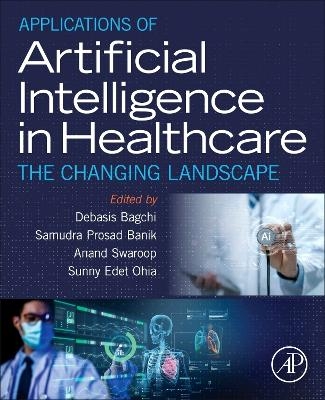
Applications of Artificial Intelligence in Healthcare
Academic Press Inc (Verlag)
978-0-443-43934-6 (ISBN)
- Noch nicht erschienen (ca. Juli 2026)
- Versandkostenfrei
- Auch auf Rechnung
- Artikel merken
Applications of Artificial Intelligence in Healthcare: The Changing Landscape is primarily written for Health Professionals, Pharmacists, Scientists, Industrial Scientists, Physicians, Graduate Students, Doctoral and Post-Doctoral Scientists.
Debasis Bagchi, PhD, MACN, CNS, MAIChE, received his Ph.D. in Medicinal Chemistry in 1982. He is a Professor in the Department of Pharmacological and Pharmaceutical Sciences at the University of Houston College of Pharmacy, Houston, TX, and Chief Scientific Officer at Cepham Research Center, Piscataway, NJ, Adjunct Faculty in Texas Southern University, Houston, TX. He served as the Senior Vice President of Research & Development of InterHealth Nutraceuticals Inc, Benicia, CA, from 1998 until Feb 2011, and then as Director of Innovation and Clinical Affairs, of Iovate Health Sciences, Oakville, ON, until June 2013. Dr. Bagchi received the Master of American College of Nutrition Award in October 2010. He is the Past Chairman of International Society of Nutraceuticals and Functional Foods (ISNFF), Past President of American College of Nutrition, Clearwater, FL, and Past Chair of the Nutraceuticals and Functional Foods Division of Institute of Food Technologists (IFT), Chicago, IL. He is serving as a Distinguished Advisor on the Japanese Institute for Health Food Standards (JIHFS), Tokyo, Japan. Dr. Bagchi is a Member of the Study Section and Peer Review Committee of the National Institutes of Health (NIH), Bethesda, MD. He has published 321 papers in peer reviewed journals, 30 books, and 18 patents. Dr. Bagchi is also a Member of the Society of Toxicology, Member of the New York Academy of Sciences, Fellow of the Nutrition Research Academy, and Member of the TCE stakeholder Committee of the Wright Patterson Air Force Base, OH. He is also Associate Editor for the Journal of Functional Foods, Journal of the American College of Nutrition, and the Archives of Medical and Biomedical Research, and is also serving as Editorial Board Member of numerous peer reviewed journals, including Antioxidants & Redox Signaling, Cancer Letters, Toxicology Mechanisms and Methods, and The Original Internist, among others. Samudra Prosad Banik, Ph.D., received his PhD degree in Life Sciences from Jadavpur University in 2009 after working in the field of Fungal Biotechnology from the CSIR –Indian Institute of Chemical Biology, Kolkata, India. Dr. Banik is currently working as Assistant Professor at the Department of Microbiology, Maulana Azad College, University of Calcutta at Kolkata, India. After completing his Masters in Biophysics and Molecular Biology at the University of Kolkata in 2003, Dr. Banik was awarded a travel grant to work in a short project of genetically engineered rice with increased photosynthetic efficiency at International Rice Research Institute, Philippines. Thereafter he completed his PhD. at IICB where he identified an alternative pathway of vesicles mediated protein secretion in filamentous fungus, and performed biophysical characterization of the glycosylated fungal enzyme assemblies. Upon joining Maulana Azad College, Dr. Banik continued his research on behavior of glycosylated/glycated proteins in higher eukaryotes. In the process, he eventually shifted his attention towards glycated proteins formed during hyperglycemia and its associated consequences chiefly with regards to neuronal disorders. He has been the recipient of three research projects and has published more than 32 research articles in SCOPUS/Web of Science indexed journals along with 15 book chapters published by CRC Press/Wiley/CRC Press. Dr. Banik has edited one book on Biofuels which is scheduled to come out early next year from CRC Press/Taylor and Francis. He is an active reviewer of significant journals including Heliyon, PLOS One and Journal of American Nutrition Association. He is presently the Joint-Convenor of Research Committee at Maulana Azad College. His current research interests include understanding the mechanism of stabilization of proteins by osmolytes as well as structural changes inflicted in proteins due to glycation. Anand Swaroop is a trained scientist turned entrepreneur with a rich background in biochemistry. After spending a decade in various positions in the pharmaceutical sector, he began exploring natural product chemistry. Over the last three decades, Dr. Swaroop has earned diversified global management experience in the Natural Products business. His expertise includes natural product chemistry, research, supply chain management, and strategic planning. His diverse experience in research, quality assurance, product development, manufacturing, and marketing has given him a unique and multidisciplinary perspective on the industry. In 2016, he was selected as a Fellow of the American College of Nutrition. He's also a member of the task force constituted by the Government of India in 2021 to recommend the development of the Nutraceutical Sector in India and worldwide for Ayurvedic products. Currently he's the Founder President of reputable companies, including Cepham Inc., Nutrify Today, and Cepham Life Sciences Inc. Sunny Ohia is a Professor of Pharmacology in the College of Pharmacy and Health Sciences at Texas Southern University. Dr. Ohia has over 38 years of experience in higher education having served as a member of faculty in five universities in Canada and the United States. He holds other academic appointments as adjunct professor of ophthalmology and visual sciences at the University of Nebraska Medical Center, Omaha and as an adjunct professor of integrative biology and pharmacology at the University of Texas Health Sciences Center in Houston. Dr. Ohia is a Fellow of the Nigerian Academy of Science and a Fellow of the Association for Research in Vision and Ophthalmology. He's authored over 250 original papers, book chapters, books, and abstracts and, holds three U.S. and five international Patents for his scientific work.
Section 1: Introduction to AI and Healthcare
1. Introduction to Fundamentals of AI Application in Healthcare
2. Bottlenecks in Medical Science: Why do We Need the Interventions of AI
3. Fuzzy Rule-based Systems for Disease Diagnosis
4. The Potential of Quantum AI in Augmentation of Human Health
Section 2: The Role of AI in Holistic Healthcare and Disease Diagnosis
5. State-of-the-Art AI Assisted Disease Detection Tools
6. AI in Biomedical Image Processing
7. Use of AI Chatbots for Primary Diagnosis at Home
8. AI Assisted Imaging Technologies for Disease Diagnosis
9. AI for Detection and Arrest of Infectious Diseases
10. Understanding Key Algorithms for Construction of AI Assisted Prediction Tools
11. Minimizing Vulnerability of AI Programmes from Cyber-attacks
Section 3: Use of AI in Organ Transplantation and Precision Surgery
12. Predictive AI to Increase Success of Heart Transplantation
13. AI Assisted Augmented Reality Overlay in Precision Surgeries
14. AI Driven Robotics in Neurosurgery
15. AI in Minimally Invasive Surgeries
16. AI in Cosmetic Surgery
Section 4: Domain Specific Applications in Medical Science through AI Intervention
17. Use of AI in Assisted Reproduction
18. AI for Management of Cardiovascular Diseases
19. AI in Telemedicine: The Evolution of Virtual Ophthalmology
20. The Role of Machine Learning in Autoimmune Disease Prediction
21. AI in Psychotherapy and Counseling
22. AI in Detecting and Mitigation of Neurological Disease
23. AI in Remote Monitoring of Patients
Section 5: New Frontiers of AI
24. The Evolution of ChatGPT in AI Assisted Biomedical Care
25. Role of Generative AI in Drug Designing, Toxicity Assessment and Bio-diversity
26. AI-based Predictive Models for Nutraceutical and Functional Food Industry
27. AI-enabled Organoids for Clinical Applications
28. Medicinal Plant Isolates
Section 6: Conclusion: The Future of AI
29. Regulatory, Federal, and Ethical Issues of AI in Biomedical Applications
30. Commentary: The Evolution of AI and its Implications for Future Human Generation
| Erscheint lt. Verlag | 1.7.2026 |
|---|---|
| Verlagsort | San Diego |
| Sprache | englisch |
| Maße | 191 x 235 mm |
| Gewicht | 450 g |
| Themenwelt | Naturwissenschaften ► Biologie |
| ISBN-10 | 0-443-43934-6 / 0443439346 |
| ISBN-13 | 978-0-443-43934-6 / 9780443439346 |
| Zustand | Neuware |
| Informationen gemäß Produktsicherheitsverordnung (GPSR) | |
| Haben Sie eine Frage zum Produkt? |
aus dem Bereich