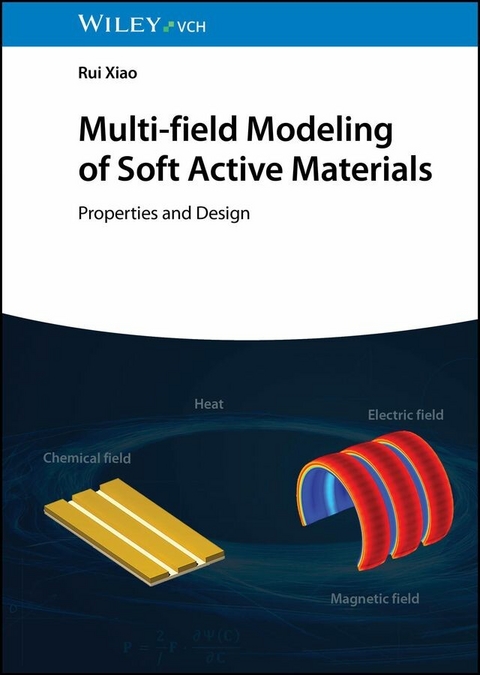
Multi-field Modeling of Soft Active Materials (eBook)
255 Seiten
Wiley-VCH (Verlag)
978-3-527-85038-9 (ISBN)
An expert and up-to-date discussion of the properties and design of soft active material modeling
In Multi-Field Modeling of Soft Active Materials: Properties and Design, Professor Rui Xiao delivers an up-to-date exploration of the multi-field modeling of soft active materials, including shape-memory polymers, liquid crystal elastomers, dielectric elastomers, magnetic elastomers, and hydrogels. The book provides a deep understanding of the underlying mechanisms of stimulus-response behaviors in polymers.
The author provides guidance on future development of the theoretical approaches for active materials, as well as efficient tools to design functional soft machines composed of active materials.
Readers will also find:
- A thorough introduction to the basics of continuum mechanics
- Comprehensive explorations of hyperelastic and viscoelastic models
- Thermodynamically consistent frameworks for multi-field coupling models
- Complete implementation procedures for finite element analysis
Primarily aimed at graduate students and researchers in solid mechanics, materials science, and polymer physics, Multi-Field Modeling of Soft Active Materials is particularly relevant for those specializing in the soft materials and responsive polymers.
Rui Xiao, PhD, is a Professor in the Department of Engineering Mechanics at Zhejiang University. His research focuses on the constitutive relationship of polymers, smart materials and structures, and the mechanics of soft materials.
Chapter 1
Basics of Continuum Mechanics
1.1 Vectors and Tensors
Continuum mechanics relies on vectors and tensors. We first introduce vector/tensor operations. In this book, scalars are denoted by italic lowercase letters, while vectors and tensors are represented by upright boldface letters.
1.1.1 Vector
If a physical quantity contains only magnitude information, such as time, mass, temperature, density, and length, it is referred to as a scalar. A vector represents a directed line segment in space. The length of the line segment indicates the magnitude of the vector, while the direction of the line segment represents the direction of the vector. It is used to describe physical quantities that have both direction and magnitude, such as displacement, velocity, acceleration, and force.
The addition of vectors follows the same rules as scalar addition, satisfying the commutative law and the associative law of addition:
The sum of two vectors is still a vector, and the magnitude and direction of the resultant vector are determined according to the parallelogram law.
The product of a vector and a scalar is a new vector that has the same direction as if , or the opposite direction if . The multiplication of a scalar and a vector satisfies the commutative law, the associative law, and the distributive law as follows:
The dot product of vectors and , denoted by , results in a scalar:
where is the angle between two vectors and . The dot product of vectors has the following properties:
- ,
- .
The cross product of vectors and , denoted by , results in a vector. Its magnitude is given by:
The direction of is perpendicular to the plane formed by and , which follows the right-hand rule. The cross product of vectors has the following properties:
- ,
- .
1.1.2 Index Notation
To introduce the coordinate (or component) expression of a vector in a right-handed orthogonal system, we first introduce a set of fixed basis vectors , , , called a Cartesian basis, with the following properties:
These three vectors are of unit length and mutually orthogonal. A vector in three-dimensional space can be expressed as
which can be written in summation notation as
This expression can be further simplified by using a dummy index to omit the summation symbol, written as
An index that repeats exactly twice in an expression is called a dummy index, which signifies the summation convention. An index that is not summed over in an expression is referred to as a free index. For example:
where is the free index and is the dummy index.
The calculus operations involving scalars and vectors often carry clear physical significance. We begin by introducing two commonly used symbols in continuum mechanics: the Kronecker delta and the permutation symbol . The Kronecker delta is defined as follows:
The following are some of its useful properties:
Another commonly used symbol is the permutation symbol , which is defined as follows:
The permutation symbol has the following properties:
1.1.3 Tensor
A second-order tensor can be viewed as a linear operator acting on a vector , producing a new vector as
A second-order tensor can be written in the index notation as
where is the dyad of vectors.
A unit tensor can be represented using the Kronecker delta symbol as
The dot product of two second-order tensors and is typically denoted as , which is still a second-order tensor. The components of the dot product can be represented as
The double dot product of two second-order tensors results in a scalar, as given by the following expression:
The transpose of a second-order tensor is denoted as , with the following property:
The trace of a second-order tensor equals to the sum of the diagonal terms represented as
The determinant of a tensor is the determinant of the matrix , represented as
For a nonsingular tensor, namely, , there exists a unique inverse of the tensor, denoted as , which satisfies as
A tensor can be decomposed into a symmetric part and a skew part as
A second-order tensor has different component forms in different coordinate systems:
These two component forms can be related through the transformation of the basis vectors corresponding to the two coordinate systems, as
where represents the direction cosines between the basis vectors of the two coordinate systems. is an orthogonal second-order matrix with .
Furthermore, we have:
A vector can be treated as a tensor with order 1. Thus, higher order tensors can also be defined in a similar way. For example, tensors with an order 3 or 4 can be defined as
1.1.4 Gradient, Divergence, and Curl
We introduce the vector operator , commonly referred to as the Nabla operator, which is frequently used in computations:
Thus, the gradient vector of a scalar field at any point is given as
The gradient of a vector is a second-order tensor, defined as follows:
Similarly, the gradient operator can also be applied to a tensor. For example, the gradient of a second-order tensor can be written as
The Nabla operator can also be combined with a vector through dot and cross products. The dot product of the Nabla operator with a vector is referred to as the divergence of the vector:
The divergence of a second-order tensor is represented as
If the Nabla operator is dotted with the gradient of a scalar field, the result is
The operator is known as the Laplacian operator.
The cross product of the Nabla operator with a vector is referred to as the curl of the vector:
which indicates the curl of a vector field representing the degree of rotation of the field vectors around any point.
1.2 Kinematics
1.2.1 Deformation Gradient
Different from the small strain condition, finite deformation needs to consider higher order geometric and mechanical quantities. The analysis based on the undeformed or deformed configuration leads to different descriptions of the same deformation: material (Lagrangian) description or spatial (Eulerian) description.
In the theory of continuum mechanics, a body is assumed to possess continuity in both space and time (or at least be piecewise continuous), allowing its various physical quantities to be represented by continuous functions. As illustrated in Figure 1.1, the continuous spatial regions it occupies before and after a time interval are denoted by and , respectively. The position of any point between these two configurations is related by a mapping:
where represents the position of any point in the current configuration and represents the corresponding position of that point in the reference configuration.
Figure 1.1 Deformation of a continuous medium.
With the coordinates of each point in both the reference configuration and the current configuration, the displacement of each point can be computed as follows:
The deformation gradient is then introduced to relate the point vector in the reference configuration and that in the current configuration, which is represented as
We can further derive the relationship between the deformation gradient tensor and the displacement field as follows:
We can then easily relate the vector line in the reference and current configurations as
The determinant of the deformation gradient matrix (or ) represents the deformation state of the infinitesimal volume element as
where and are the infinitesimal volume elements defined in the undeformed and deformed configurations, respectively. When , the deformation is isochoric, meaning the infinitesimal volume element remains constant.
The infinitesimal volume element can be calculated through the dot product of a small surface and a material line element as
where and are the infinitesimally small areas in the reference and current configurations, respectively, and and are the line elements...
| Erscheint lt. Verlag | 17.12.2025 |
|---|---|
| Sprache | englisch |
| Themenwelt | Naturwissenschaften ► Chemie |
| Schlagworte | active material design • functional soft machines • soft active material modeling • soft active material properties • soft active material simulation • soft active material theoretical approaches • soft active material theory • Soft material modeling |
| ISBN-10 | 3-527-85038-4 / 3527850384 |
| ISBN-13 | 978-3-527-85038-9 / 9783527850389 |
| Informationen gemäß Produktsicherheitsverordnung (GPSR) | |
| Haben Sie eine Frage zum Produkt? |
 EPUB (Adobe DRM)
Kopierschutz: Adobe-DRM
Adobe-DRM ist ein Kopierschutz, der das eBook vor Mißbrauch schützen soll. Dabei wird das eBook bereits beim Download auf Ihre persönliche Adobe-ID autorisiert. Lesen können Sie das eBook dann nur auf den Geräten, welche ebenfalls auf Ihre Adobe-ID registriert sind.
Details zum Adobe-DRM
Dateiformat: EPUB (Electronic Publication)
EPUB ist ein offener Standard für eBooks und eignet sich besonders zur Darstellung von Belletristik und Sachbüchern. Der Fließtext wird dynamisch an die Display- und Schriftgröße angepasst. Auch für mobile Lesegeräte ist EPUB daher gut geeignet.
Systemvoraussetzungen:
PC/Mac: Mit einem PC oder Mac können Sie dieses eBook lesen. Sie benötigen eine
eReader: Dieses eBook kann mit (fast) allen eBook-Readern gelesen werden. Mit dem amazon-Kindle ist es aber nicht kompatibel.
Smartphone/Tablet: Egal ob Apple oder Android, dieses eBook können Sie lesen. Sie benötigen eine
Geräteliste und zusätzliche Hinweise
Buying eBooks from abroad
For tax law reasons we can sell eBooks just within Germany and Switzerland. Regrettably we cannot fulfill eBook-orders from other countries.
aus dem Bereich