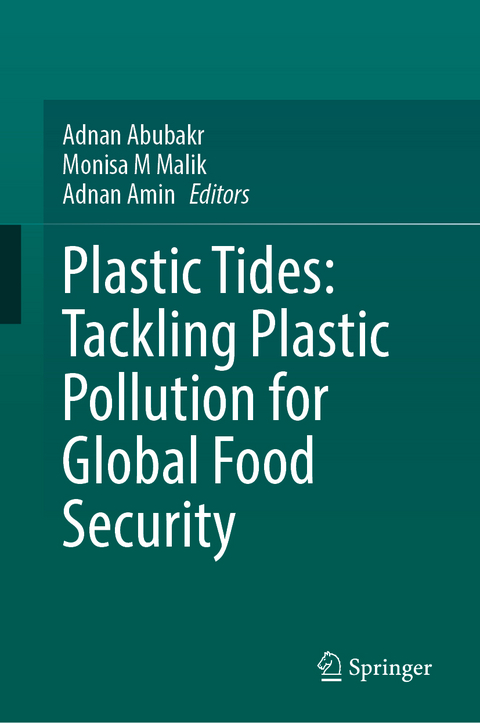
Plastic Tides: Tackling Plastic Pollution for Global Food Security
Springer International Publishing (Verlag)
978-3-032-17410-9 (ISBN)
- Noch nicht erschienen (ca. März 2026)
- Versandkostenfrei
- Auch auf Rechnung
- Artikel merken
As plastics, including microplastics, increasingly infiltrate freshwater and marine ecosystems, they pose serious risks to aquatic organisms, particularly those that are part of the human food chain. To address this crisis, researchers and policymakers require a multidisciplinary exploration of both the origins of plastic pollution and the potential mitigation strategies, including biodegradable alternatives, circular economy approaches, policy frameworks, and community-led efforts to reduce environmental impact.
Plastic Tides: Tackling Plastic Pollution for Global Food Security will not only examine the sources of plastics in water bodies, their accumulation in aquatic food species, and the potential health and economic impacts on communities reliant on these resources, but also explore practical solutions, including plastic reduction strategies and sustainable material alternatives. Special emphasis will be placed on regions and populations that are particularly dependent on fisheries and agriculture, highlighting their heightened exposure and vulnerability. Insights from across the fields of environmental science, toxicology, and public health, together offer a comprehensive guide to tackling this influx of pollution on a scientific and public policy level.
Professor (Dr.) Adnan Abubakr
Professor (Dr.) Adnan Abubakr is a distinguished academic and researcher currently serving as Professor of Limnology and Head of the Division of Aquatic Environmental Management, Faculty of Fisheries, Sher-e-Kashmir University of Agricultural Sciences and Technology of Kashmir (SKUAST-K). He holds both M.Sc. and Ph.D. degrees in Limnology from the Department of Limnology, Barkatullah University, Bhopal, with expertise in water and wastewater analysis, including analytical and bacteriological techniques applicable to freshwater and brackish water systems.
Dr. Abubakr specializes in the design and development of artificial wetland systems for wastewater treatment. With over 15 years of extensive experience in teaching, research, and extension in the field of aquatic ecology, he has significantly contributed to the advancement of aquatic environmental sciences. He played a pivotal role in establishing the M.F.Sc. and Ph.D. degree programs in Aquatic Environmental Management within the Division of AEM at SKUAST-K.
A prolific researcher, Dr. Abubakr has published more than 60 research papers in peer-reviewed journals. He has successfully completed two externally funded and three university-funded research projects and has supervised more than 20 postgraduate and doctoral students in their research pursuits.
Dr. Monisa M. Malik
Dr. Monisa M. Malik is currently serving as an Assistant Professor cum Junior Scientist in the Division of Aquatic Environmental Management, Faculty of Fisheries, Rangil, Ganderbal, Sher-e-Kashmir University of Agricultural Sciences and Technology - Kashmir (SKUAST-K). She holds a Bachelor s degree in Fisheries Science from Dr. Balasaheb Sawant Konkan Krishi Vidyapeeth (DBSKKV), Dapoli, where she was recognized as the Best Academic Performer and honored with the Best Student Award.
Dr. Malik completed both her Master s and Ph.D. in Fisheries Science from SKUAST-Kashmir, earning a Gold Medal for her outstanding performance during her Master s program. She is also a recipient of the prestigious National INSPIRE Fellowship for her doctoral research.
Her research expertise includes Limnology, Wastewater Treatment, Aquatic Ecology, and Aquatic Environmental Management. Dr. Malik is an active member of several editorial boards, including the International Journal of Energy and Environmental Science, Journal of Zoo Biology, and Nature Science e-Magazine. In addition, she holds life memberships in reputed organizations such as the Journal of Fisheries and Life Sciences and the Journal of Environmental Biology.
Dr. Malik has contribu
Plastic Pathways Threaten Ecosystems and Undermine Global Food Stability.- Plastics in the Food Chain A Scoping Review of Their Environmental Health and Food Security Implications.- Microplastic Pollution in Aquatic Ecosystems A Comparative Review of Sources Impacts and Management in Marine and Freshwater Habitats.- Microplastic Contamination in Pet Foods and Fish Meals Implications Beyond Human Health.- Plastic Debris Alters Aquatic Habitats and Disrupts Sustainable Fisheries.- Bioaccumulation of Plastics in Fish Raises Health Concerns and Regulatory Gaps.- Nanoplastics Penetrate Biological Barriers and Pose Risks to Aquatic Productivity.- Linking Terrestrial and Aquatic Systems Pollutant Transport Bioaccumulation Cycles and Global Food Security.- Agricultural Runoff and Plastic Inputs Create a Synergistic Threat to Food Webs.- Socioeconomic Consequences of Plastic Pollution Undermine Coastal Livelihoods.- Integrating the circular economy principles to tackle plastic pollution in aquaculture.- Climate Change Interacts with Plastic Stressors and Amplifies Food Insecurity.- Physiological Alterations and Immune Modulation in Fish Exposed to Microplastics.- Monitoring Plastic Contamination Demands Innovation and Global Coordination.- Food System Resilience Requires Addressing the Plastic lifecycle and Policy Reform.- Public Awareness and Behaviour Change Critical for Mitigating Plastic Risks.- Integrated Waste Management Supports Healthy Oceans and Secures Global Nutrition.- Future Research Directions on Plastic-Food Interactions and Global Sustainability Goals.- Flowing Together Public Awareness and Stakeholder Synergy for Sustainable Aquatic Pollution Governance.
| Erscheint lt. Verlag | 22.3.2026 |
|---|---|
| Zusatzinfo | XII, 447 p. 31 illus., 29 illus. in color. |
| Verlagsort | Cham |
| Sprache | englisch |
| Maße | 155 x 235 mm |
| Themenwelt | Naturwissenschaften ► Biologie ► Ökologie / Naturschutz |
| Technik ► Lebensmitteltechnologie | |
| Schlagworte | Agricultural runoff • Aquatic environments • bioaccumulation • climate change • ecological health • fishery regulation • food contamination • food security • food system pollution • heathy oceans • Marine microplastics • Nanoplastics • plastic accumulation • plastic debris • Plastic pollution |
| ISBN-10 | 3-032-17410-4 / 3032174104 |
| ISBN-13 | 978-3-032-17410-9 / 9783032174109 |
| Zustand | Neuware |
| Informationen gemäß Produktsicherheitsverordnung (GPSR) | |
| Haben Sie eine Frage zum Produkt? |
aus dem Bereich