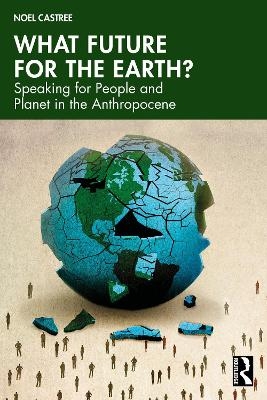
What Future For the Earth?
Routledge (Verlag)
978-0-367-81881-4 (ISBN)
- Noch nicht erschienen (ca. Juni 2026)
- Versandkostenfrei
- Auch auf Rechnung
- Artikel merken
· In an age of scepticism, division and rancour, whose claims and counter-claims about human impacts should we believe?
· What questions do we need to ask about global environmental change?
· How do we grope towards actionable answers in a disunited world?
The scale, scope and magnitude of human impacts on the Earth are unprecedented. Geoscientists warn of a perilous future in which the Earth System has been forced out its interglacial Holocene state. But geoscience can’t tell us what the root causes of anthropogenic planetary change are, nor how humanity should best respond to it. It’s for others to do this analytical and normative work.
What Future For the Earth? examines a growing landscape of thought ranged across the social sciences, humanities and the arts. Setting geoscience in its wider institutional and epistemological context, this multidisciplinary book addresses a set of key societal questions arising from escalating Earth System change. It offers an advanced introduction to concepts, arguments and propositions ventured by environmentally-minded historians, geographers, anthropologists, sociologists, political theorists and many others. Placing capitalism and ‘strong anthropocentrism’ at the centre of analysis, What Future For The Earth? tackles a set of big issues, such as how we should think about time and future, about ‘environmental crisis’ and the moral status of the non-human world. The book lends shape to an urgent debate about the many profound implications of what people are doing to our one and only planet. Who gets to speak for the Earth and its inhabitants, how and to what ends? Who gets to identify causes, propose solutions and enact them? As the technological power of certain private firms and many national governments grows prodigiously, these questions focus our attention on how influential actors can be held accountable and a more just world be created.
University students and instructors across a wide range of disciplines will find this book of interest, as will general readers concerned about climate change, biodiversity loss and related problems. This book identifies issues of common concern and outlines ways of addressing them in a world riven by conflict and dissent yet in need of urgent, cooperative action among otherwise different peoples.
Noel Castree is Professor of Geography at the University of Manchester, UK. He is author of Making Sense of Nature (Routledge, 2013). His many writings about the Anthropocene have appeared in the journals Nature Climate Change, Ambio, The Anthropocene Review, South Atlantic Quarterly, Environmental Humanities and Dialogues in Climate Change. He’s previously worked at the universities of Liverpool and Wollongong, as well the University of Technology Sydney, where he’s an honorary professorial fellow.
Chapter 1: Introduction: Who gets to speak for people and planet? PART 1: MAKING REPRESENTATIONS: THE WHO, WHY AND HOW OF SPEAKING FOR PLANET AND PEOPLE Chapter 2: If the Earth could speak: Geoscientific representations of a fast-changing planet Chapter 3: (Mis)trust in geoscience: understanding belief and scepticism in today’s age of dissent Chapter 4: Beyond geoscience: the ‘social heart’ of global environmental change Chapter 5: Framing the social heart of planetary change PART 2: HOW TO TACKLE SOME BIG QUESTIONS I Chapter 6: The war of the wor(l)ds: what’s the right name for the post-Holocene epoch? Chapter 7: The age of which humans? Anatomising the ‘human condition’ in a (more than) capitalist world Chapter 8: Where on Earth do we live? Imagining the planet otherwise Chapter 9: ‘Five minutes past midnight’: Are we living in the end times? PART 3: HOW TO TACKLE SOME BIG QUESTIONS II Chapter 10: Earth 2.o: do we now live on an unnatural planet, and in what ways does it matter? Chapter 11: Geography unbound: how to think, feel and act at multiple spatial scales? Chapter 12: Telescoping time: can we escape the ‘tyranny of immediacy’? Chapter 13: Speaking-up for the non-human, now and tomorrow: can social values really be ‘greened’ CONCLUSION Chapter 14: So then, what future for the Earth?
| Erscheint lt. Verlag | 30.6.2026 |
|---|---|
| Zusatzinfo | 10 Tables, black and white; 8 Line drawings, color; 23 Halftones, color; 31 Illustrations, color |
| Verlagsort | London |
| Sprache | englisch |
| Maße | 174 x 246 mm |
| Gewicht | 453 g |
| Themenwelt | Naturwissenschaften ► Geowissenschaften ► Geologie |
| Technik ► Umwelttechnik / Biotechnologie | |
| Weitere Fachgebiete ► Land- / Forstwirtschaft / Fischerei | |
| ISBN-10 | 0-367-81881-7 / 0367818817 |
| ISBN-13 | 978-0-367-81881-4 / 9780367818814 |
| Zustand | Neuware |
| Informationen gemäß Produktsicherheitsverordnung (GPSR) | |
| Haben Sie eine Frage zum Produkt? |
aus dem Bereich