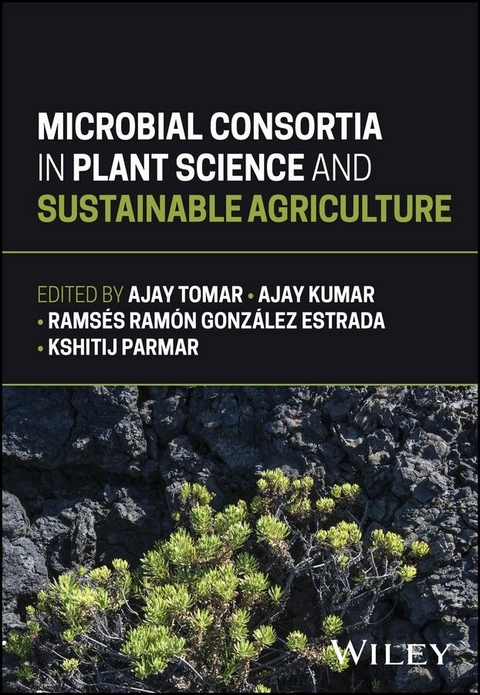
Microbial Consortia in Plant Science and Sustainable Agriculture (eBook)
496 Seiten
Wiley (Verlag)
978-1-394-32498-9 (ISBN)
An up-to-date discussion of how agriculturally important bacteria enhance plant productivity and stress tolerance
In Microbial Consortia in Plant Science and Sustainable Agriculture, a team of distinguished researchers delivers an expert discussion of how bacteria can be used to enhance plant productivity and alleviate stress in plants. The book focuses on the physiological, biochemical, and molecular aspects of microbial consortia. It updates the existing body of knowledge with the latest studies on the benefits of using plant growth-promoting bacteria.
You'll find expansive explorations of how bacteria counteract the stress caused by abiotic factors. You'll also discover deep dives into plant-microbiota interactions and various molecular methods used by microbial consortia to diagnose plant diseases.
Inside the book:
- A thorough introduction to the identification of plant-derived microbial consortia to biotic stresses
- Comprehensive explorations of probiotics as plant biostimulants for sustainable agriculture
- Practical discussions of how to control root and foliar plant diseases with microbial consortia
- Complete treatments of the use of microbial consortia to increase crop resilience in droughts and as biofertilizers and biocontrol agents
Perfect for researchers, academics, students, and professionals working in the agricultural and biological sciences, Microbial Consortia will also benefit professionals in the bio-fertilizer and bio-pesticide industries.
Ajay Tomar is an Assistant Professor at the Amity Institute of Organic Agriculture at Amity University Uttar Pradesh, India.
Ajay Kumar is an Assistant Professor at the Amity Institute of Biotechnology at Amity University in Noida, India.
Ramsés Ramón González Estrada is a Professor in the National Technological Institute of Mexico.
Kshitij Parmar works in the Amity Institute of Organic Agriculture at Amity University Uttar Pradesh, India.
List of Contributors
-
Selene Aguilera-Aguirre
Agrobiotechnology and Electrochemistry Laboratory-Integral Food Research Laboratory
National Technological Institute of Mexico/Technological Institute of Tepic
Tepic, Nayarit, México
-
and
-
Laboratorio Integral de Investigación en Alimentos/Departamento de Ingeniería Química y Bioquímica
Tecnológico Nacional de México-Instituto Tecnológico de Tepic
Tepic, Nayarit, México
-
Ashwini Ananda
AICRP-Vegetable Crops, School of Agricultural Sciences, Nagaland University
Medziphema, Nagaland, India
-
Aparna
Department of Agriculture
Jagan Nath University
Chaksu, Jaipur, India
-
Aastha
Department of Biotechnology
School of Applied and Life Sciences, Uttaranchal University
Dehradun, Uttarakhand, India
-
Miriam del Carmen Bañuelos-González
Laboratorio Integral de Investigación en Alimentos/Departamento de Ingeniería Química y Bioquímica
Tecnológico Nacional de México-Instituto Tecnológico de Tepic
Tepic, Nayarit, México
-
Nidhi Bhatt
Surajmal University Kichha
Udham Singh Nagar, Uttarakhand, India
-
Gema Cárdenas-Flores
Agrobiotechnology and Electrochemistry Laboratory-Integral Food Research Laboratory
National Technological Institute of Mexico/Technological Institute of Tepic
Tepic, Nayarit, México
-
and
-
Laboratorio Integral de Investigación en Alimentos/Departamento de Ingeniería Química y Bioquímica
Tecnológico Nacional de México-Instituto Tecnológico de Tepic
Tepic, Nayarit, México
-
Mercedes Susana Carranza-Patiño
Facultad de Ciencias Agrarias y Forestales
Universidad Técnica Estatal de Quevedo
Quevedo, Ecuador
-
Martina Alejandra Chacón-López
Agrobiotechnology and Electrochemistry Laboratory-Integral Food Research Laboratory
National Technological Institute of Mexico/Technological Institute of Tepic
Tepic, Nayarit, México
-
and
-
Laboratorio Integral de Investigación en Alimentos/Departamento de Ingeniería Química y Bioquímica
Tecnológico Nacional de México-Instituto Tecnológico de Tepic
Tepic, Nayarit, México
-
Juan Edgardo Cortés-Aguilera
Agrobiotechnology and Electrochemistry Laboratory-Integral Food Research Laboratory
National Technological Institute of Mexico/Technological Institute of Tepic
Tepic, Nayarit, México
-
Devashish
Ramakrishna Mission Vivekananda Educational and Research Institute
Kolkata, India
-
Ana Yareli Flores-Ramírez
Agrobiotechnology and Electrochemistry Laboratory-Integral Food Research Laboratory
National Technological Institute of Mexico/Technological Institute of Tepic
Tepic, Nayarit, México
-
Ramsés Ramón González Estrada
Tecnológico Nacional de México/I. T. Tepic
Tepic, Nayarit, México
-
Lucky Gupta
Faculty of Agricultural Sciences
GLA University
Mathura, Uttar Pradesh, India
-
Benjamín Hernandez-Vazquez
Resilient and Sustainable Agriculture Research Group (ASORE)
SECIHTI-Chapingo Autonomous University
Texcoco, Estado de México, México
-
Robinson J. Herrera-Feijoo
Facultad de Ciencias Agrarias y Forestales
Universidad Técnica Estatal de Quevedo
Quevedo, Ecuador
-
Raj Kishor Kapardar
The Energy and Resources Institute
New Delhi, India
-
Aditya Kumar
Amity Institute of Organic Agriculture, Amity University Noida
Noida, Uttar Pradesh, India
-
Rocky Kumar
Department of Biotechnology
School of Applied and Life Sciences, Uttaranchal University
Dehradun, Uttarakhand, India
-
Vikash Kumar
School of Agriculture Science and Technology, Kargil Campus
University of Ladakh
Ladakh, India
-
Dalpat Lal
College of Agriculture, Agriculture University
Mandor, Jodhpur, India
-
Ulises Miguel López-García
Agrobiotechnology and Electrochemistry Laboratory-Integral Food Research Laboratory
National Technological Institute of Mexico/Technological Institute of Tepic
Tepic, Nayarit, México
-
and
-
Laboratorio Integral de Investigación en Alimentos/Departamento de Ingeniería Química y Bioquímica
Tecnológico Nacional de México-Instituto Tecnológico de Tepic
Tepic, Nayarit, México
-
Guneshori Maisnam
Department of Rural Development and Planning
Nagaland University
Medziphema Campus, Nagaland, India
-
Manoj Kumar Maurya
Department of Vegetable Science
Acharya Narendra Dev University of Agriculture and Technology
Kumarganj, Ayodhya, India
-
Bernardo Murillo-Amador
Agriculture in Dry Zones Program (PAZA)
Centro de Investigaciones Biológicas del Noroeste
La Paz, Baja California Sur, México
-
María Fernanda Olmedo-Díaz
Laboratorio Integral de Investigación en Alimentos/Departamento de Ingeniería Química y Bioquímica
Tecnológico Nacional de México-Instituto Tecnológico de Tepic
Tepic, Nayarit, México
-
Rosa Isela Ortiz-Basurto
Agrobiotechnology and Electrochemistry Laboratory-Integral Food Research Laboratory
National Technological Institute of Mexico/Technological Institute of Tepic
Tepic, Nayarit, México
-
and
-
Laboratorio Integral de Investigación en Alimentos/Departamento de Ingeniería Química y Bioquímica
Tecnológico Nacional de México-Instituto Tecnológico de Tepic
Tepic, Nayarit, México
-
Shivani Pal
Department of Biotechnology
School of Applied and Life Sciences, Uttaranchal University
Dehradun, Uttarakhand, India
-
Durga Prasad
College of Agriculture, Agriculture University
Mandor, Jodhpur, India
-
Pablo Preciado-Rangel
Departamento de Horticultura
Universidad Autónoma Agraria Antonio Narro
Periférico Raúl López Sánchez and Carretera Santa Fe S/N
Torreón, México
-
Riya Raghav
Amity Institute of Biotechnology, Amity University Uttar Pradesh
Noida, Uttar Pradesh, India
-
Nikhil Raghuvanshi
Department of Agronomy
DDU Gorakhpur University
Gorakhpur, Uttar Pradesh, India
-
Rakesh
Department of Biotechnology
School of Applied and Life Sciences, Uttaranchal University
Dehradun, Uttarakhand, India
-
Agrim Rattan
Atmospheric Sciences
IIT Delhi
Delhi, India
-
Tomás Rivas-García
Resilient and Sustainable Agriculture Research Group (ASORE)
SECIHTI-Chapingo Autonomous University Texcoco
Estado de México, México
-
Justine Sanasam
(Agriculture) Agronomy
Amity Institute of Organic Agriculture
Noida, Uttar Pradesh, India
-
Rita Schwentesius-Rindermann
Resilient and Sustainable Agriculture Research Group (ASORE)
Chapingo Autonomous University
Texcoco, Estado de México, México
-
R.S. Sengar
Department of Plant Biotechnology
Sardar Vallabhbhai Patel University of Agriculture and Technology
Meerut, Uttar Pradesh, India
-
Abha Sharma
Amity Institute of Organic Agriculture, Amity University Noida
Noida, Uttar Pradesh, India
-
Abhay Sharma
Regional Horticultural Research & Training Station
Kullu, Himachal Pradesh, India
-
Deepika Sharma
Amity Institute of Organic Agriculture, Amity University
Noida, Uttar Pradesh, India
-
Meenakshi Sharma
Department of Botany
Daulat Ram College, University of Delhi
Delhi, India
-
Saurabh Sharma
Department of Agricultural Extension Education
Nagaland University
Dimapur, Nagaland, India
-
Aashita Shree
Amity Institute of Organic Agriculture
Amity University Noida
Noida, Uttar Pradesh, India
-
Karuna Singh
Department of Biotechnology
School of Applied and Life Sciences, Uttaranchal University
Dehradun, Uttarakhand, India
-
Monika Singh
Department of...
| Erscheint lt. Verlag | 11.12.2025 |
|---|---|
| Sprache | englisch |
| Themenwelt | Naturwissenschaften ► Biologie ► Botanik |
| Schlagworte | Agricultural bacteria • microbial consortia applications • microbial consortia book • microbial consortia research • microbial consortia studies • microbial consortiums • Plant productivity • plant stress • sustainable agriculture bacteria |
| ISBN-10 | 1-394-32498-7 / 1394324987 |
| ISBN-13 | 978-1-394-32498-9 / 9781394324989 |
| Informationen gemäß Produktsicherheitsverordnung (GPSR) | |
| Haben Sie eine Frage zum Produkt? |
 EPUB (Adobe DRM)
Kopierschutz: Adobe-DRM
Adobe-DRM ist ein Kopierschutz, der das eBook vor Mißbrauch schützen soll. Dabei wird das eBook bereits beim Download auf Ihre persönliche Adobe-ID autorisiert. Lesen können Sie das eBook dann nur auf den Geräten, welche ebenfalls auf Ihre Adobe-ID registriert sind.
Details zum Adobe-DRM
Dateiformat: EPUB (Electronic Publication)
EPUB ist ein offener Standard für eBooks und eignet sich besonders zur Darstellung von Belletristik und Sachbüchern. Der Fließtext wird dynamisch an die Display- und Schriftgröße angepasst. Auch für mobile Lesegeräte ist EPUB daher gut geeignet.
Systemvoraussetzungen:
PC/Mac: Mit einem PC oder Mac können Sie dieses eBook lesen. Sie benötigen eine
eReader: Dieses eBook kann mit (fast) allen eBook-Readern gelesen werden. Mit dem amazon-Kindle ist es aber nicht kompatibel.
Smartphone/Tablet: Egal ob Apple oder Android, dieses eBook können Sie lesen. Sie benötigen eine
Geräteliste und zusätzliche Hinweise
Buying eBooks from abroad
For tax law reasons we can sell eBooks just within Germany and Switzerland. Regrettably we cannot fulfill eBook-orders from other countries.
aus dem Bereich