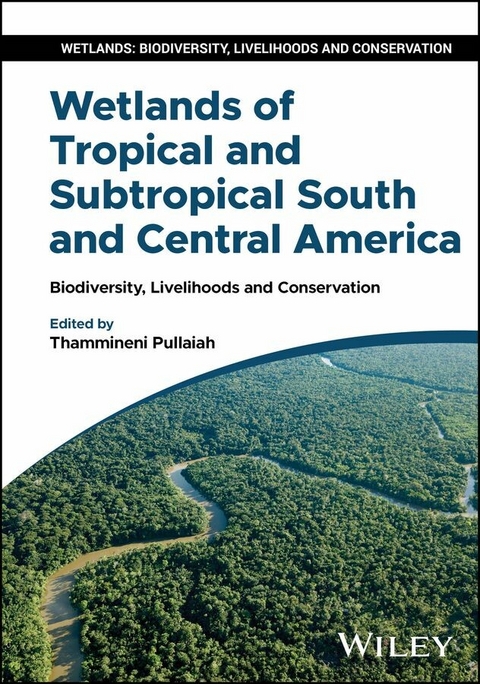
Wetlands of Tropical and Subtropical South and Central America (eBook)
466 Seiten
Wiley (Verlag)
978-1-394-30714-2 (ISBN)
Comprehensive wetland analysis for conservationists, professionals, and researchers
Wetlands of Tropical and Subtropical South and Central America: Biodiversity, Livelihoods and Conservation explores the challenges confronted by those managing wetland ecosystems. It offers expert analyses of specific wetland environments across South and Central America, examining how these ecosystems can be protected while sustaining the livelihoods of communities that depend upon them.
This book takes a unique comparative approach by analysing similar wetlands from different regions and continents, allowing best practices in conservation and management to emerge that are globally relevant. Each chapter is authored by recognized regional experts and covers issues like biological resources, ecosystem services including carbon sequestration and water filtration, and implemented conservation measures. Aligned with UN sustainable development goals by considering both ecological and economic value, the collection also offers:
- Regional expert analysis of biodiversity hotspots across tropical and subtropical South and Central America, from Bolivian lowlands to the Pantanal
- Comprehensive examination of ecosystem services including carbon sequestration, water filtration, nutrient retention, and flood mitigation
- Conservation strategies and management practices applicable across global wetland systems
- Case studies spanning marine and coastal wetlands, Amazonian freshwater systems, and extra-Andean subtropical wetlands
- Discussions of threats to wetlands as well as in-depth comparisons of wetlands in different regions and continents
Wetlands of Tropical and Subtropical South and Central America is essential for ecologists, conservation scientists, hydrologists, and environmental and water resource managers seeking evidence-based approaches to wetland conservation. Public servants and professionals in fisheries, agriculture, and rural development will find practical guidance for balancing biodiversity protection with sustainable resource use.
Thammineni Pullaiah (retired) was a Professor of Botany in the Department of Botany at Sri Krishnadevaraya University, India. He served as President of the Indian Botanical Society and President of the Indian Association for Angiosperm Taxonomy and was a member of the Species Survival Commission of the International Union for Conservation of Nature (IUCN).
List of Contributors
Ana Paula Dalbem Barbosa
Northern Pantanal Environmental Research Laboratory
Graduate Program in Environmental Science
University of the State of Mato Grosso
Cáceres
Brazil
Department of Ecology
Radboud Institute for Biological and Environmental Sciences
Radboud University
Nijmegen
The Netherlands
Bonifacia Benitez
Faculty of Exact and Natural Sciences (UNA-FACEN)
Laboratory of Plant Resources (LAREV)
National University of Asunción
San Lorenzo
Paraguay
Roberto F. Bó
Wetland Ecology Research Group
Department of EGE and IEGEBA
Faculty of Exact and Natural Sciences
University of Buenos Aires
University City
CABA
Argentina
Caicedo-Garcia
Marine and Coastal Research Institute
“José Benito Vives de Andréis”
INVEMAR
Santa Marta
Colombia
Indra Candanedo
Western Panamá Regional Centre
Technological University of Panamá
La Chorrera
Panamá
Josiane Santos Batista Carioca de Paula
Northern Pantanal Environmental Research Laboratory
Graduate Program in Environmental Science
University of the state of Mato Grosso
Cáceres
Brazil
Acisa Raimunda de Souza
Northern Pantanal Environmental Research Laboratory
Graduate Program in Environmental Science
University of the state of Mato Grosso
Cáceres
Brazil
Derick Victor de Souza Campos
Northern Pantanal Environmental Research Laboratory
Graduate Program in Environmental Science
University of the state of Mato Grosso
Cáceres
Brazil
Daiana Ferreira Dias
Northern Pantanal Environmental Research Laboratory
Graduate Program in Environmental Science
University of the State of Mato Grosso
Cáceres
Brazil
Maísa Consuelo dos Santos
Northern Pantanal Environmental Research Laboratory
Graduate Program in Environmental Science
University of the state of Mato Grosso
Cáceres
Brazil
Oscar Feltes
Faculty of Exact and Natural Sciences (UNA-FACEN)
Laboratory of Plant Resources (LAREV)
National University of Asunción
San Lorenzo
Paraguay
Francisco Firpo Lacoste
Directorate of Terrestrial and Aquatic Ecosystems
Undersecretariat of Environment of the Nation
Autonomous City of Buenos Aires
Argentina
Alejandro Giraudo
National Institute of Limnology (CONICET-UNL)
University City
Santa Fe
Argentina
Diana Isabel Gómez-López
Marine and Coastal Research Institute
“José Benito Vives de Andréis”
INVEMAR
Santa Marta
Colombia
James Gruber
Environmental Studies
Antioch University New England
Keene, NH
USA
Daniel Guerrero
Marine and Coastal Research Institute
“José Benito Vives de Andréis”
INVEMAR
Santa Marta
Colombia
Milena Hernández
Marine and Coastal Research Institute
“José Benito Vives de Andréis”
INVEMAR
Santa Marta
Colombia
Sebastián Herrera-Fajardo
Marine and Coastal Research Institute
“José Benito Vives de Andréis”
INVEMAR
Santa Marta
Colombia
Tania Hoyos
Marine and Coastal Research Institute
“José Benito Vives de Andréis”
INVEMAR
Santa Marta
Colombia
Solange Kimie Ikeda-Castrillon
Graduate Program in Water Resources Management and Regulation Environmental Science
University of the state of Mato Grosso
Cáceres
Brazil
Educare Laboratory
University of the State of Mato Grosso
Cáceres
Brazil
Patricia Kandus
Institute of Environmental Research and Engineering
School of Habitat and Sustainability
National University of San Martín (UNSAM)
General San Martín
Buenos Aires
Argentina
Sarian Kosten
Department of Ecology
Radboud Institute for Biological and Environmental Sciences
Radboud University
Nijmegen
The Netherlands
Daniel Larrea-Alcázar
Asociación Boliviana para la Investigación y
Conservación de Ecosistemas Andino-Amazónicos
La Paz
Bolivia
Wilkinson Lopes Lázaro
Northern Pantanal Environmental Research Laboratory
Graduate Program in Environmental Science
University of the state of Mato Grosso
Cáceres
Brazil
Graduate Program in Water Resources
Management and Regulation Environmental Science
University of the state of Mato Grosso
Cáceres
Brazil
Fausto López Rodríguez
Department of Biological and Agricultural Sciences
Universidad Técnica Particular de Loja
Loja
Ecuador
Zuleica Marchetti
CONICET -FICH/UNL
Santa Fe
Argentina
José Luis Marín-Muñiz
Department of Environmental Engineering
National Technology of Mexico/Instituto
Tecnológico Superior de Misantla
Veracruz
Mexico
Santiago Millán
Marine and Coastal Research Institute
“José Benito Vives de Andréis”
INVEMAR
Santa Marta
Colombia
Priscilla Gail Minotti
Institute of Environmental Research and Engineering
School of Habitat and Sustainability
National University of San Martín (UNSAM)
General San Martín
Buenos Aires
Argentina
Gulich Institute
National Commission for Space Activities
National University of Córdoba
Córdoba
Argentina
Camilo Montes-Chaura
Marine and Coastal Research Institute
“José Benito Vives de Andréis”
INVEMAR
Santa Marta
Colombia
Mónica Moraes R.
Herbario Nacional de Bolivia
Instituto de Ecología
Universidad Mayor de San Andrés
La Paz
Bolivia
Claumir Cesar Muniz
Northern Pantanal Environmental Research Laboratory
Graduate Program in Environmental Science
University of the state of Mato Grosso
Cáceres
Brazil
Graduate Program in Water Resources
Management and Regulation Environmental Science
University of the state of Mato Grosso
Cáceres
Brazil
Raúl Navas-Camacho
Marine and Coastal Research Institute
“José Benito Vives de Andréis”
INVEMAR
Santa Marta
Colombia
Sonia Pardo-Spiess
Marine and Coastal Research Institute
“José Benito Vives de Andréis”
INVEMAR
Santa Marta
Colombia
Tiago da Rocha Pedra
Northern Pantanal Environmental Research Laboratory
Graduate Program in Environmental Science
University of the state of Mato Grosso
Cáceres
Brazil
Thiago Ferreira Pereira
Northern Pantanal Environmental Research Laboratory
Graduate Program in Environmental Science
University of the state of Mato Grosso
Cáceres
Brazil
Sandra Lee Pinel
Environmental Studies
Antioch University New England
Keene, NH
USA
Rubén D. Quintana
IIIA (CONICET UNSAM)
Institute of Environmental Research and Engineering
School of Habitat and Sustainability (EHyS)
National University of San Martín
Buenos Aires
Argentina
Leticia Rodríguez
Center for River and Hydro-environmental
Studies of the Litoral-CEFHAL Faculty of Engineering and Water Sciences
National University of the Litoral
Santa Fe
Argentina
Adriano Marcos Romano
Northern Pantanal Environmental Research Laboratory
Graduate Program in Environmental Science
University of the state of Mato Grosso
Cáceres
Brazil
Diana Romero
Marine and Coastal Research Institute
“José Benito Vives de Andréis”
INVEMAR
Santa...
| Erscheint lt. Verlag | 9.12.2025 |
|---|---|
| Reihe/Serie | Wetlands: Biodiversity, Livelihoods and Conservation |
| Sprache | englisch |
| Themenwelt | Naturwissenschaften ► Biologie ► Ökologie / Naturschutz |
| Schlagworte | ecosystem services carbon sequestration • environmental restoration practices • Hydrological systems • neotropical biodiversity hotspots • sustainable livelihood strategies • tropical wetlands conservation • water resource management ecology |
| ISBN-10 | 1-394-30714-4 / 1394307144 |
| ISBN-13 | 978-1-394-30714-2 / 9781394307142 |
| Informationen gemäß Produktsicherheitsverordnung (GPSR) | |
| Haben Sie eine Frage zum Produkt? |
 EPUB (Adobe DRM)
Kopierschutz: Adobe-DRM
Adobe-DRM ist ein Kopierschutz, der das eBook vor Mißbrauch schützen soll. Dabei wird das eBook bereits beim Download auf Ihre persönliche Adobe-ID autorisiert. Lesen können Sie das eBook dann nur auf den Geräten, welche ebenfalls auf Ihre Adobe-ID registriert sind.
Details zum Adobe-DRM
Dateiformat: EPUB (Electronic Publication)
EPUB ist ein offener Standard für eBooks und eignet sich besonders zur Darstellung von Belletristik und Sachbüchern. Der Fließtext wird dynamisch an die Display- und Schriftgröße angepasst. Auch für mobile Lesegeräte ist EPUB daher gut geeignet.
Systemvoraussetzungen:
PC/Mac: Mit einem PC oder Mac können Sie dieses eBook lesen. Sie benötigen eine
eReader: Dieses eBook kann mit (fast) allen eBook-Readern gelesen werden. Mit dem amazon-Kindle ist es aber nicht kompatibel.
Smartphone/Tablet: Egal ob Apple oder Android, dieses eBook können Sie lesen. Sie benötigen eine
Geräteliste und zusätzliche Hinweise
Buying eBooks from abroad
For tax law reasons we can sell eBooks just within Germany and Switzerland. Regrettably we cannot fulfill eBook-orders from other countries.
aus dem Bereich