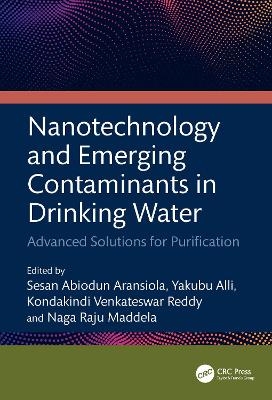
Nanotechnology and Emerging Contaminants in Drinking Water
CRC Press (Verlag)
978-1-041-09322-0 (ISBN)
- Noch nicht erschienen (ca. Mai 2026)
- Versandkostenfrei
- Auch auf Rechnung
- Artikel merken
Features:
• Discusses the concept of emerging contaminants in drinking water, such as pharmaceuticals, personal care products, and microplastics.
• Provides an overview of traditional water treatment methods and their limitations in removing these contaminants.
• Examine nanomaterials as a promising solution for capturing and degrading contaminants at the molecular level in drinking water.
• Establishes strong connections between theoretical mechanisms and nanotechnology applications.
• Presents the current state of nanomaterial-based water treatment technologies in real-world applications, including industrial and municipal water treatment plants.
This book is aimed at graduate students and researchers in environmental and chemical engineering, and water treatment.
Sesan Abiodun Aransiola is a Lecturer at the Department of Microbiology, University of Abuja, Nigeria. He has demonstrated his research expert in the production of vermicasts from vermicoposting of organic wastes to assist plants in the remediation of polluted soil with heavy metals. His expertise spans environmental health, phytoremediation, vermicomposting, marine resources and bioremediation of pollutants in the soil. Yakubu Adekunle Alli is a distinguished postdoctoral researcher at Nelson Mandela University, specializing in the design of multifunctional nanomaterials for CO₂ conversion, N₂ reduction, renewable energy, and antimicrobial drug development. His work integrates photocatalysis, electrocatalysis, environmental remediation, and advanced additive manufacturing to develop sustainable solutions for energy, climate, and health challenges. Kondakindi Venkateswar Reddy has been working as a faculty in Microbiology and Biotechnology for past15 years, teaching undergraduate and post graduate students. His forte is Industrial microbiology, Biotechnology and Environmental management. Currently, he is working as an Asst. Professor at Center for Biotechnology, University College of Engineering Science and Technology Hyderabad, Jawaharlal Nehru Technological University Hyderabad, Telangana, India. Naga Raju Maddela is working as a Full Professor at the Facultad de Ciencias de la Salud, Universidad Técnica de Manabí, Portoviejo, Ecuador. He has been actively publishing scientific articles, books (authored and edited) and chapters, since 2007.
Section I: Introduction to Water Contaminants and Purification Methods. Chapter 1: Sources and Types of Emerging Contaminants in Drinking Water. Chapter 2: Global Concerns of Accessing Safe Drinking Water. Chapter 3: Deterministic Chemical Risk Assessment of Emerging Contaminants in Drinking Water: Global Guidelines. Chapter 4: Effects and Global Diversity of Emerging Contaminants in Drinking Water. Section II: Traditional and Nanotechnology-Based Water Purification. Chapter 5: Traditional Water Treatment Methods: Limitations and Challenges. Chapter 6: Introduction to Nanotechnology for Water Purification. Chapter 7: Metal and Metal Oxide Nanoparticles for Water Purification. Chapter 8: Carbon-Based Nanomaterials: From Graphene to Carbon Nanotubes. Chapter 9: Nanocomposites and Hybrid Materials in Water Treatment. Chapter 10: Graphene derivatives in water purification: Progresses and drawbacks. Section III: Health Risks, Regulations, and Future Perspectives. Chapter 11: International Policies on Emerging Contaminants in Drinking Water. Chapter 12: Global Permissible Limits of Emerging Contaminants: Matters Arising. Chapter 13: Interactions of Emerging Contaminants with Other Contaminants in Aquatic Matrices. Chapter 14: Emerging Contaminants: Challenges and Limitations in Global Drinking Water. Chapter 15: Real-World Applications and Future Prospects of Nanomaterials in Water Treatment. Chapter 16: Future directions of research on Emerging Pollutants in Drinking water: Global perspectives. Chapter 17: Nanobiochar Biobased Nanocatalyst from Sugarcane Bagasse in Petrochemical Wastewater treatment Processes. Chapter 18: Nanotechnology in Combating Waterborne Antimicrobial Resistance. Chapter 19: Silent solution: The power of microbes and plants in water remediation
| Erscheint lt. Verlag | 7.5.2026 |
|---|---|
| Zusatzinfo | 32 Tables, black and white; 27 Line drawings, black and white; 16 Halftones, black and white; 43 Illustrations, black and white |
| Verlagsort | London |
| Sprache | englisch |
| Maße | 178 x 254 mm |
| Themenwelt | Naturwissenschaften ► Geowissenschaften ► Hydrologie / Ozeanografie |
| Technik ► Bauwesen | |
| Technik ► Umwelttechnik / Biotechnologie | |
| ISBN-10 | 1-041-09322-5 / 1041093225 |
| ISBN-13 | 978-1-041-09322-0 / 9781041093220 |
| Zustand | Neuware |
| Informationen gemäß Produktsicherheitsverordnung (GPSR) | |
| Haben Sie eine Frage zum Produkt? |
aus dem Bereich