


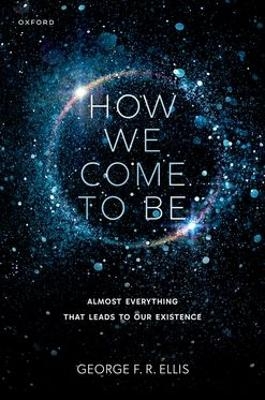
How We Come to Be
Almost Everything that Leads to Our Existence
Seiten
2026
Oxford University Press (Verlag)
9780198950172 (ISBN)
Oxford University Press (Verlag)
9780198950172 (ISBN)
- Noch nicht erschienen (ca. Mai 2026)
- Versandkostenfrei
- Auch auf Rechnung
- Artikel merken
Our existence as living beings - thinking, feeling, acting - is an extraordinary thing. This book provides a scientifically based account of how this happens through interactions between particles and molecules.
Our existence as living beings - thinking, feeling, acting - is an extraordinary thing: this book provides a scientifically based account of the entirety of factors that lead to our existence.
The text begins with the physical foundations of our existence, examining the cosmological context of the vast expanding and evolving universe, enabling the existence of the Sun and the Earth. It goes on to summarise the underlying physics and chemistry, explaining behaviour on an atomic and molecular level, and considers the nature of biological emergence, arguing that all complex systems are modular hierarchical structures, allowing function to emerge at every level, and both upward and downward interactions occur between emergent levels.
The book then goes on to examine fundamental processes such as metabolism, dealing with material and energy needs, and homeostasis, stabilising the system against perturbing influences. At the molecular level, this is all enabled by change of shape of macromolecules, and the text looks at how we come into being by a combination of natural selection and developmental processes, which interact with each other and with physiology.
Finally, the book discusses the brain and mind, emphasizing the interaction of rationality and emotions, and examining the nature of mental causation and free will. It then delves into existence on a societal level, showing how social institutions having causal powers, and arguing that society can be understood as a homeostatic feedback system relating welfare to social, economic, political, and legal interactions. All social outcomes are determined crucially by our values, the nature of which can be represented by a spectrum of values ranging from very destructive and selfish to very constructive and generous. The final chapter discusses whether meaning exists in the universe, providing evidence that the answer is yes, arguing for moral realism and the existence of a series of abstract possibility spaces that form the deep structure of the cosmos.
Our existence as living beings - thinking, feeling, acting - is an extraordinary thing: this book provides a scientifically based account of the entirety of factors that lead to our existence.
The text begins with the physical foundations of our existence, examining the cosmological context of the vast expanding and evolving universe, enabling the existence of the Sun and the Earth. It goes on to summarise the underlying physics and chemistry, explaining behaviour on an atomic and molecular level, and considers the nature of biological emergence, arguing that all complex systems are modular hierarchical structures, allowing function to emerge at every level, and both upward and downward interactions occur between emergent levels.
The book then goes on to examine fundamental processes such as metabolism, dealing with material and energy needs, and homeostasis, stabilising the system against perturbing influences. At the molecular level, this is all enabled by change of shape of macromolecules, and the text looks at how we come into being by a combination of natural selection and developmental processes, which interact with each other and with physiology.
Finally, the book discusses the brain and mind, emphasizing the interaction of rationality and emotions, and examining the nature of mental causation and free will. It then delves into existence on a societal level, showing how social institutions having causal powers, and arguing that society can be understood as a homeostatic feedback system relating welfare to social, economic, political, and legal interactions. All social outcomes are determined crucially by our values, the nature of which can be represented by a spectrum of values ranging from very destructive and selfish to very constructive and generous. The final chapter discusses whether meaning exists in the universe, providing evidence that the answer is yes, arguing for moral realism and the existence of a series of abstract possibility spaces that form the deep structure of the cosmos.
George F. R. Ellis, FRS, is Professor Emeritus of Applied Mathematics at the University of Cape Town. He was Lecturer in the Department of Applied Mathematics and Theoretical Physics (DAMTP) at Cambridge, where he wrote The Large Scale Structure of Spacetime with Stephen Hawking. He has been Visiting Professor at the University of Texas, University of Chicago, Hamburg University, Boston University, University of Alberta, Queen Mary (London University), and Oxford University, and at the International School of Advanced Studies (SISSA) in Trieste. In 1999 he was awarded the Star of South Africa Medal presented by President Nelson Mandela, and in 2006 The Order of Mapungubwe presented by President Thabo Mbeki.
| Erscheint lt. Verlag | 7.5.2026 |
|---|---|
| Zusatzinfo | 137 b/w and colour images |
| Verlagsort | Oxford |
| Sprache | englisch |
| Maße | 156 x 234 mm |
| Themenwelt | Naturwissenschaften |
| ISBN-13 | 9780198950172 / 9780198950172 |
| Zustand | Neuware |
| Informationen gemäß Produktsicherheitsverordnung (GPSR) | |
| Haben Sie eine Frage zum Produkt? |
Mehr entdecken
aus dem Bereich

aus dem Bereich
Eine kurze Geschichte | Über die Regeln unseres Lebens
Buch | Hardcover (2023)
Suhrkamp (Verlag)
CHF 47,60


