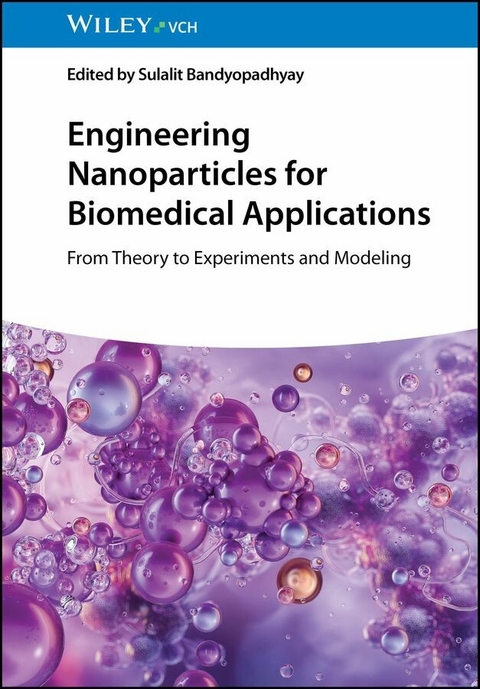
Engineering Nanoparticles for Biomedical Applications (eBook)
462 Seiten
Wiley-VCH (Verlag)
978-3-527-84477-7 (ISBN)
Practical approach to solution-based synthesis methods and mechanisms from a chemical engineering perspective
Engineering Nanoparticles for Biomedical Applications provides an in-depth, hands-on overview of synthesis and formation mechanisms, characterization, and functionalization of nanoparticles (NPs) using solution-based methods developed from fundamental principles of nucleation and growth. Various experimental synthesis strategies are supported via simulation and modeling. The NPs studied in this book are designed to target an array of biomedical applications.
In this book, readers can practice reverse engineering by first choosing a specific biomedical application, upon which the reader will be exposed to a host of synthesis options. Based on desired properties of NPs, this book can then provide all the relevant information using experimental and modeling approaches for that specific biomedical application.
Sample topics covered in Engineering Nanoparticles for Biomedical Applications include:
- Physico-chemical properties of NPs such as magnetic, plasmonic, and stimuli-sensitivity properties
- Modeling approaches including Density Functional Theory (DFT), Molecular Dynamics (MD), Monte Carlo simulations, and Population Balance Model
- Applications of NPs with emphasis on biomedical applications such as biosensing, diagnostics/imaging, and drug delivery
- Optical, magnetic, stimuli-responsive, and biological properties of multifunctional nanoparticles
- Spherical and anisotropic iron oxide and gold nanoparticles, polymeric nanoparticles and multifunctional nanoparticles
Engineering Nanoparticles for Biomedical Applications is an essential reference on the subject for chemists and engineers at every level of academia and industry.
Sulalit Bandyopadhyay is an Associate Professor in Particle Engineering and Hydrometallurgy in the Department of Chemical Engineering, NTNU. He is Centre Manager for the Particle Engineering Centre and serves as the CTO of a diagnostic company Lybe Scientific A/S. Trained as a chemical engineer, he specializes in the field of colloids, polymers, and nanomaterials with an overall interest in tailoring particles towards specific applications in the field of nanomedicine.
| Erscheint lt. Verlag | 8.12.2025 |
|---|---|
| Sprache | englisch |
| Themenwelt | Naturwissenschaften ► Chemie |
| Schlagworte | nanoparticles characterization • nanoparticles engineering • nanoparticles formation mechanisms • nanoparticles functionalization • nanoparticles mechanisms • nanoparticles modeling • nanoparticles properties • synthesis nanoparticles |
| ISBN-10 | 3-527-84477-5 / 3527844775 |
| ISBN-13 | 978-3-527-84477-7 / 9783527844777 |
| Informationen gemäß Produktsicherheitsverordnung (GPSR) | |
| Haben Sie eine Frage zum Produkt? |
 PDF (Adobe DRM)
Kopierschutz: Adobe-DRM
Adobe-DRM ist ein Kopierschutz, der das eBook vor Mißbrauch schützen soll. Dabei wird das eBook bereits beim Download auf Ihre persönliche Adobe-ID autorisiert. Lesen können Sie das eBook dann nur auf den Geräten, welche ebenfalls auf Ihre Adobe-ID registriert sind.
Details zum Adobe-DRM
Dateiformat: PDF (Portable Document Format)
Mit einem festen Seitenlayout eignet sich die PDF besonders für Fachbücher mit Spalten, Tabellen und Abbildungen. Eine PDF kann auf fast allen Geräten angezeigt werden, ist aber für kleine Displays (Smartphone, eReader) nur eingeschränkt geeignet.
Systemvoraussetzungen:
PC/Mac: Mit einem PC oder Mac können Sie dieses eBook lesen. Sie benötigen eine
eReader: Dieses eBook kann mit (fast) allen eBook-Readern gelesen werden. Mit dem amazon-Kindle ist es aber nicht kompatibel.
Smartphone/Tablet: Egal ob Apple oder Android, dieses eBook können Sie lesen. Sie benötigen eine
Geräteliste und zusätzliche Hinweise
Buying eBooks from abroad
For tax law reasons we can sell eBooks just within Germany and Switzerland. Regrettably we cannot fulfill eBook-orders from other countries.
aus dem Bereich