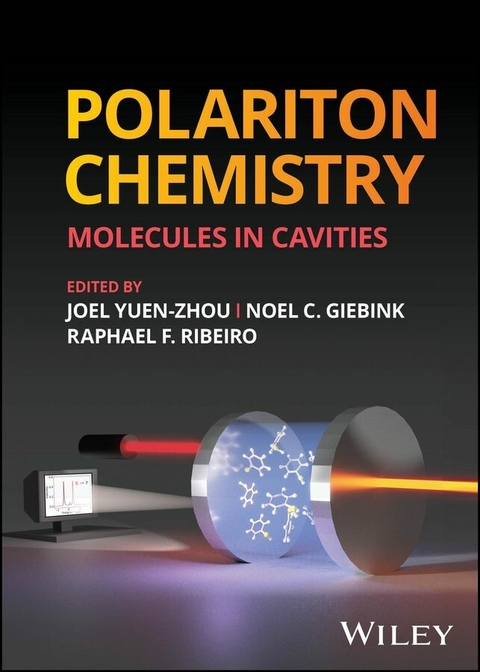
Polariton Chemistry (eBook)
672 Seiten
Wiley (Verlag)
978-1-119-78331-2 (ISBN)
Understand the emerging field of polariton chemistry with this accessible introduction
Polaritons are hybrid excitations formed when confined electromagnetic modes form strong couplings with dipole active transitions in a dielectric medium. They have long been a fixture of research in inorganic semiconductor optics but have recently also been taken up as an object of study in molecular science, where their prospective applications are many. The tunability of their molecular properties and processes have given rise to an interdisciplinary field of polariton chemistry, with important potential ramifications for a huge range of fields.
Polariton Chemistry provides a pedagogical overview of this research subject, in which optical cavities are used to control the physiochemical properties and dynamics of molecular systems. The book emphasizes the interdisciplinary nature of this burgeoning field and the need for a shared language and set of fundamentals across many research disciplines. With no existing rival in the current literature, it's a must-own for researchers in almost any of the physical sciences.
Polariton Chemistry readers will also find:
- Analysis of prospective applications including long-range excitation energy transfer, enhanced charge conductivity, and more
- Detailed discussion of topics including single molecule strong light-matter coupling, ultrastrong light-matter coupling, and many more
- Coverage of key theoretical and experimental techniques
Polariton Chemistry is ideal for any scientist in the fields of physical chemistry, materials science, photonics, quantum optics, and engineering.
Joel Yuen-Zhou, PhD is Associate Professor in the Department of Chemistry and Biochemistry at the University of California, San Diego. His research focuses on the theoretical description of novel interactions between light and molecular matter in the weak, strong, and ultrastrong coupling regimes. His pioneering work on polariton chemistry has been recognized with several awards including a Sloan Fellowship as well as the NSF CAREER, DOE Early Career and Camille-Dreyfus Teacher Scholar awards.
Noel C. Giebink, PhD, is a Professor in the Department of Electrical Engineering and Computer Science at the University of Michigan. His research focuses on light-matter interaction and the physics of organic semiconductor materials and devices. He is a senior member of IEEE, Optica, and SPIE, and has been recognized with the DARPA YFA, AFOSR YIP, and NSF CAREER awards.
Raphael F. Ribeiro, PhD is Assistant Professor in the Department of Chemistry at Emory University, Atlanta since 2020. His research is focused on theoretical models and simulation of equilibrium and non-equilibrium chemical dynamics in mesoscopic materials. His work has been recognized with awards that include NSF CAREER award and a Young Investigator Award by the Physical Chemistry Division of the American Chemical Society.
Understand the emerging field of polariton chemistry with this accessible introduction Polaritons are hybrid excitations formed when confined electromagnetic modes form strong couplings with dipole active transitions in a dielectric medium. They have long been a fixture of research in inorganic semiconductor optics but have recently also been taken up as an object of study in molecular science, where their prospective applications are many. The tunability of their molecular properties and processes have given rise to an interdisciplinary field of polariton chemistry, with important potential ramifications for a huge range of fields. Polariton Chemistry provides a pedagogical overview of this research subject, in which optical cavities are used to control the physiochemical properties and dynamics of molecular systems. The book emphasizes the interdisciplinary nature of this burgeoning field and the need for a shared language and set of fundamentals across many research disciplines. With no existing rival in the current literature, it s a must-own for researchers in almost any of the physical sciences. Polariton Chemistry readers will also find: Analysis of prospective applications including long-range excitation energy transfer, enhanced charge conductivity, and moreDetailed discussion of topics including single molecule strong light-matter coupling, ultrastrong light-matter coupling, and many moreCoverage of key theoretical and experimental techniques Polariton Chemistry is ideal for any scientist in the fields of physical chemistry, materials science, photonics, quantum optics, and engineering.
Preface
Light and material excitations can strongly couple to form hybrid modes known as polaritons. Interest in the hybridization of photonic modes with crystalline solid excitations finds its origin in the classic works of Tolpygo [1] and Huang [2] on phonon-polaritons, and of Agranovich [3] and Hopfield [4] on exciton-polaritons; it is this last paper that coins the term “polariton.” However, it was not until 1992 when Weisbuch et al. [5] demonstrated significant enhancement of these phenomena in inorganic quantum wells using Fabry–Pérot optical microcavities. In 1998, Lidzey et al. [6] replicated this achievement with excitons in a disordered organic film. In contrast to the cryogenic temperatures required for strong coupling with inorganic quantum well excitons, the organic version was readily observable at room-temperature owing to the large exciton binding energy of organic semiconductors. The demonstration of room-temperature molecular polaritons in systems that on their own right, i.e., in the absence of the cavity, would not feature strong coupling (owing to an insufficient dielectric contrast with the surrounding medium), ignited a small, but steady stream of research activity in the early 2000s in the organic photophysics community.
Early work studying the photophysics of molecular polaritons by Agranovich, Lidzey, La Rocca, and co-workers [7–10] revealed the prominent role of both static and dynamic disorder inherent to molecular excitations (the latter manifested in strong vibronic couplings) in the ensuing polariton relaxation dynamics. These studies played an important role in pursuing milestones of the polaritonics community as a whole, such as polariton lasing [11] and condensation [12, 13], but with the convenience of operating at room-temperature using molecular films [14–16]. These topics are still of much interest and are at the heart of current developments in molecular polaritonics. Naturally, throughout the course of these efforts, researchers inquired whether the photophysical kinetics of the organic molecules themselves could be modified by strong coupling; however, early work by Kéna-Cohen and Forrest [17] showed no detectable change in the kinetics of intersystem-crossing for an organic phosphor in the linear excitation regime. Yet, in the past 12 years, spearheaded notably by the Ebbesen group in Strasbourg, a shift occurred, indicating that polariton formation could in principle trigger a broad array of phenomena, including alterations in electronic excited-state [18] and even ground-state [19, 20] chemical kinetics and dynamics, phase transition hysteresis curves [21], and other chemical phenomena. These results sparked a wave of excitement in multiple disciplines, leading to the development of a new field of research broadly termed polariton chemistry [22–25], where the goal is to control the physicochemical properties and processes of matter using strong light–matter coupling. The technological significance of this field lies in its potential to bypass time-consuming and expensive conventional synthetic methods to drive chemical change with selective new processes that rely on confining the respective molecular systems inside a properly designed photonic architecture. On a fundamental level, the overarching goal is to understand the extent to which tailoring the optical environment of a material can alter its physical and/or chemical properties beyond what is expected from classical optics.
Given the aforementioned possibilities, polariton chemistry is currently a very active field, with researchers contributing from a wide range of disciplines, including physical chemistry, physical-organic chemistry, condensed matter physics, photonic engineering, plasmonics, and organic optoelectronics. Scientific meetings on the topic are vibrant, with interdisciplinary exchange among chemists, physicists, and engineers who have developed different tools to attack various facets of the problem. However, due to this same interdisciplinarity, language barriers are commonplace, and some difficulties also emerge in the discussion and assessment of results and techniques to reach certain conclusions. Furthermore, many of the mechanisms underlying strong coupling modification of material properties and chemical processes still remain opaque and controversial, with a recent realization that polaritons serve as trivial optical filters in a wide class of scenarios [CITE][26].
Although there are many good reviews on this evolving field, there is not, as of yet, a good starting point for incoming students and researchers to enter this fascinating and, by now, already vast field. The purpose of this book is to fill this important gap. It aims to present a timely overview of polariton chemistry, liberally defined to encompass any current efforts in molecular polaritonics, including its more traditional aspects involving spectroscopy and the exploration of collective phenomena (lasing, condensation, etc.). The chapters in this volume focus on both theoretical and experimental aspects of polariton chemistry, with the implicit aim of incentivizing stronger theory-experiment collaborative efforts that will be important for the field moving forward. Owing to the monographic nature of this volume and the different priorities and backgrounds of the broad readership, it is likely that a first reading will be selective and not sequential. Thus, in the next pages, we provide a diagram that is intended to help the reader navigate through the book (Figure 1).
Figure 1 Organization of the book.
This volume is organized into four parts. Part I (Basic Concepts) aims to provide the reader with an introduction to the subject, namely, the essential concepts and tools to understand molecular polaritons while simultaneously showcasing its direct relevance to current research. It begins with a pedagogical introduction to the molecular collective strong-coupling regime in Chapter 1 by del Po and Scholes, who discuss the prominent role of dark states in the interpretation of transient absorption and two-dimensional electronic spectra of these hybrid light–matter systems. These authors also discuss photophysical processes assisted by polaritons, such as intersystem crossing, triplet–triplet annihilation, and energy transfer. The contribution from Barnes in Chapter 2 connects the quantum and classical optics perspectives of strong light–matter coupling by formulating an equivalent description of the light–matter coupling strength in each case, which helps bridge the gap between quantum theory and experimentally measurable material properties. Most chapters in the volume discuss polaritons emerging from optical microcavity photon modes; however, the demonstration of the onset of strong coupling using fewer number of molecules can be achieved with plasmonic nanoparticles that feature nanoconfined photon (technically, plasmon) modes. Chapters 3 to 5 (and a small discussion in Chapter 15) address this very timely effort. Chapter 3 by Kotov and Shegai describes a variety of light–matter architectures supporting field confinement and plasmon-exciton polariton (plexciton) formation in configurations suitable for integration in devices. Highlights of this chapter are a discussion of the currently available architectures to achieve single-molecule strong coupling with these plexciton systems, as well as a description of microcavity assembly control via manipulation of the mesoscopic forces between mirrors. Chapter 4 by Finkelstein-Shapiro comprehensively describes the linear optical properties as well as dynamics of plexcitons. In these systems, the band structure, electron–phonon coupling, and other properties of the host material (metallic nanoparticles) play a key role as modulators of plexciton-assisted photophysics and photochemistry. Finally, in Chapter 5, Chickkaraddy and Baumberg go in-depth to describe the strategies to achieve single-molecule strong coupling using plasmonic nanocavities. Their focus on the design and implementation of nanoparticle-on-mirror systems provides a convenient approach to achieve extremely small mode volumes, and it stands as one of the few that has enabled single-molecule strong coupling to be realized experimentally.
Part II (Spectroscopy and Dynamics) places emphasis on the description of the relaxation processes afforded by the various types of molecular polaritons and the spectroscopic tools used to detect them. In Chapter 6, Dunkelberger et al. provide an experimental viewpoint on the nonlinear spectroscopy of vibrational polaritons (polaritons emerging from the strong coupling of high-frequency vibrational modes of molecules with infrared optical cavities). They show that, ultimately, a wide range of spectroscopic observations of these systems can be simply explained by considering changes in optical constants due to the nonstationarity of the optically prepared molecular excitations, thus demystifying the role of the cavity in the aforementioned experiments. Chapter 7 by Zhang offers a theoretical counterpart to the previous chapter, by providing a general theoretical formalism to model the multidimensional spectroscopy of molecular polaritons, both in the vibrational and electronic domain, based on density matrices and quantum Langevin equations. This formalism is useful because the standard nonlinear spectroscopy approach for bare molecular systems does not account for the multiple photon–matter exchanges that a microcavity...
| Erscheint lt. Verlag | 8.12.2025 |
|---|---|
| Sprache | englisch |
| Themenwelt | Naturwissenschaften ► Chemie ► Physikalische Chemie |
| Schlagworte | chemical recation • Frontiers • gauge ambiguity • microcavities • Multidimensional Spectroscopy • nanophatonics • photochemistry • photophysics • plasmons • polariton condensate • relaxation dynamic • spectroscopy • ultrastrong coupling |
| ISBN-10 | 1-119-78331-3 / 1119783313 |
| ISBN-13 | 978-1-119-78331-2 / 9781119783312 |
| Informationen gemäß Produktsicherheitsverordnung (GPSR) | |
| Haben Sie eine Frage zum Produkt? |
 EPUB (Adobe DRM)
Kopierschutz: Adobe-DRM
Adobe-DRM ist ein Kopierschutz, der das eBook vor Mißbrauch schützen soll. Dabei wird das eBook bereits beim Download auf Ihre persönliche Adobe-ID autorisiert. Lesen können Sie das eBook dann nur auf den Geräten, welche ebenfalls auf Ihre Adobe-ID registriert sind.
Details zum Adobe-DRM
Dateiformat: EPUB (Electronic Publication)
EPUB ist ein offener Standard für eBooks und eignet sich besonders zur Darstellung von Belletristik und Sachbüchern. Der Fließtext wird dynamisch an die Display- und Schriftgröße angepasst. Auch für mobile Lesegeräte ist EPUB daher gut geeignet.
Systemvoraussetzungen:
PC/Mac: Mit einem PC oder Mac können Sie dieses eBook lesen. Sie benötigen eine
eReader: Dieses eBook kann mit (fast) allen eBook-Readern gelesen werden. Mit dem amazon-Kindle ist es aber nicht kompatibel.
Smartphone/Tablet: Egal ob Apple oder Android, dieses eBook können Sie lesen. Sie benötigen eine
Geräteliste und zusätzliche Hinweise
Buying eBooks from abroad
For tax law reasons we can sell eBooks just within Germany and Switzerland. Regrettably we cannot fulfill eBook-orders from other countries.
aus dem Bereich