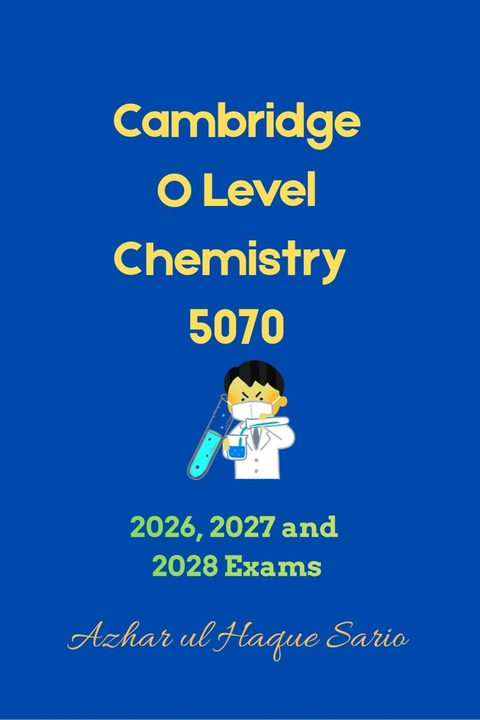
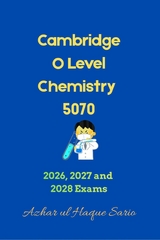
Cambridge O Level Chemistry 5070 (eBook)
198 Seiten
Azhar Sario Hungary (Verlag)
978-3-384-77374-6 (ISBN)
Chemistry is not just a subject you study in a classroom; it is the invisible architecture of the reality you live in every single day.
This book covers the complete Cambridge O Level Chemistry syllabus for the 2026, 2027, and 2028 exams. It begins with the states of matter. You will see solids described as military formations. You will visualize liquids as crowded parties. You will understand gases as lonely sprinters. It moves to the fundamental building blocks of atoms. It explains elements and compounds. It breaks down stoichiometry. It treats chemical calculations as simple accounting. It explains the mole concept using clear analogies. It uses the 'hot dog bun' theory to explain limiting reactants. It explores the world of electrochemistry. It describes electrolysis as the art of breaking matter with lightning. It explains the operation of fuel cells. It covers chemical energetics. You will learn about the heat of exothermic reactions. You will study the energy thieves of endothermic processes. It details the nature of chemical reactions. It explains collision theory using a dance floor analogy. It covers reversible reactions and equilibrium. It teaches the behavior of acids, bases, and salts. It describes the 'proton economy.' It maps out the Periodic Table. It treats the table as a city with distinct neighborhoods. You will meet the 'desperate givers' of Group I. You will meet the 'aggressive takers' of Group VII. It investigates the properties of metals. It explains why aluminum is used for aircraft. It covers the chemistry of the environment. It discusses water testing and purification. It explains the chemistry of fertilizers. It teaches the fundamentals of organic chemistry. It decodes the architecture of carbon chains. It explains the refining of fuels. It details the creation of plastics. It concludes with experimental techniques. It teaches the art of titration. It explains the detective work of chromatography. It provides a complete, sensory guide to the chemical world.
This book provides value where others fail because it rejects the dry, sterile language of traditional textbooks in favor of a vivid, narrative approach. It offers a competitive advantage by presenting chemistry through the lens of 'lived experience' and 'field notes,' rather than just abstract theory. While other resources force you to memorize static lists, this guide invites you to visualize the 'kinetic symphony' of matter. It uses relatable, human-centric analogies-comparing electron shells to onion layers and gas pressure to car tires-to make complex concepts stick. It connects the 'micro' world of atoms to the 'macro' world you can touch and smell, explaining not just the what, but the why behind phenomena like the smell of a swimming pool or the rust on a bridge. It transforms the Periodic Table from a boring chart into a cast of characters with distinct personalities, from the 'manic' alkali metals to the 'stoic' noble gases. It treats chemistry as a trade and a craft, offering the practical insights of a data scientist and researcher who has spent years in the lab. It is written in simple, conversational English that respects the reader's intelligence while stripping away unnecessary jargon. It turns a daunting subject into an engaging story of how the universe is built, making it an essential companion for any student who wants to truly understand the material rather than just pass a test.
Disclaimer: This book is an independent publication by Azhar ul Haque Sario. It is not affiliated with, endorsed by, or connected to Cambridge University Press & Assessment or the Cambridge Assessment International Education board. All use of the Cambridge name and syllabus codes is for descriptive purposes only under the doctrine of nominative fair use. The cover was designed in Canva.
Acids, bases and salts
A Field Guide to the Proton Economy
Introduction: The Invisible War
If you spend enough time in a chemistry laboratory, you eventually realize that the room is not silent. It is vibrating with invisible potential. In my years of fieldwork, analyzing soil samples in the driving rain or carefully titrating solutions in a climate-controlled white room, I have come to view acids, bases, and salts not as dry academic categories, but as the active protagonists of the material world.
They are the agents of change. They are responsible for the sour tang of a lemon, the bitter taste of dark chocolate, the cavernous weathering of limestone landscapes, and the precise electrical balance of your own blood. When we study acids and bases, we are studying a microscopic war—a constant, frantic exchange of protons that drives the machinery of the universe.
This guide is not merely a list of definitions to memorize. It is a narrative exploration of how these substances behave, how they feel, and how we, as chemists, harness their volatile nature to create stability in the form of salts. We will strip away the textbook jargon and look at the raw mechanics of these reactions, using the logic of the lab bench and the intuition of the field researcher.
Part 1: The Acidic Identity
1.1 The Liberator of Hydrogen
What makes an acid an acid? In the early days of alchemy, it was defined by taste—acidus means sour. But in the modern chemical worldview, an acid is defined by what it releases.
When I pick up a bottle of concentrated Hydrochloric Acid (HCl), I am holding a substance that is desperate to fall apart. In its pure gas form, HCl is a covalent molecule. But the moment it hits water, a violent divorce occurs. The water molecules, with their insatiable polarity, rip the hydrogen away from the chlorine.
This is the defining characteristic of an acid in aqueous solution: The release of Hydrogen ions (H+).
But here is the catch that many students miss. A hydrogen ion is just a proton. It is the naked nucleus of a hydrogen atom, stripped of its only electron. It is infinitesimally small and incredibly charge-dense. It cannot exist alone in water. It instantly latches onto a water molecule to form the Hydronium ion (H3O+). However, for the sake of our calculations and general sanity in the lab, we simply write H+.
Field Note: You can actually see this "desire" to dissociate. If you uncork a bottle of concentrated HCl on a humid day, you see white fumes. That is the hydrogen chloride gas escaping, meeting water vapor in the air, and instantly turning into microscopic droplets of acid. It is chemistry happening in mid-air.
1.2 The Proton Donor (The Bronsted-Lowry View)
While the "ions in water" definition (Arrhenius theory) is useful, it is limited. It requires water. But I have seen ammonia gas react with hydrogen chloride gas in a completely dry tube to form a white smoke of ammonium chloride. No water, yet an acid-base reaction occurred.
This is why we use the Bronsted-Lowry Model. It frames the interaction as a game of catch.
The Acid is the Pitcher (Proton Donor): It throws the proton (H+).
The Base is the Catcher (Proton Acceptor): It catches the proton.
This framework changes how you see the world. Water, for instance, is not just a background. It can be a player. When you dissolve an acid, water acts as a base—it catches the proton.
Part 2: The Base and the Alkali
2.1 The Slippery Opponent
If acids are sharp and aggressive, bases are the soothing, slippery counteractants. Chemically, they are the opposite of acids. They are substances that can neutralize an acid by accepting that aggressive proton.
But we must make a crucial distinction that often trips up novices in the field: the difference between a Base and an Alkali.
Imagine a Venn diagram. The large outer circle is labeled "Bases." These include metal oxides (like Copper Oxide) and metal hydroxides (like Iron Hydroxide). Many of these are stubborn, rock-like powders that refuse to dissolve in water. They are bases because they will react with acid, but they won't dissolve in your water beaker.
Inside that large circle is a smaller, elite circle labeled "Alkalis."
An Alkali is a soluble base.
It dissolves in water to release Hydroxide ions (OH−).
The Golden Rule: All alkalis are bases, but not all bases are alkalis.
Lived Experience: You know an alkali by touch, though I highly recommend you do not test this deliberately. Alkalis feel soapy. This is not because they are inherently smooth; it is because the hydroxide ions are actively reacting with the fatty acids in the oils of your skin, turning your own natural oils into soap (saponification). It is a chemical assault disguised as a slippery sensation.
Common alkalis I use daily include:
Sodium Hydroxide (NaOH): The heavy hitter. Used in oven cleaners and drain unblockers.
Ammonia (NH3): The pungent cleaner. It doesn't contain OH in its formula, but when it hits water, it steals a proton, leaving an OH− behind.
Part 3: The Chemical Signatures (Reactions)
3.1 The Aggression of Acids
We identify acids by their "fingerprints"—the specific ways they attack other materials. In my field kit, I don't carry complex machines; I carry small dropper bottles of acid. Why? Because the way a rock or a metal reacts to a drop of acid tells me exactly what it is.
Here are the three fundamental behaviors:
(A) Acid + Metal → Salt + Hydrogen
This is the "Pop" reaction. If I drop a strip of Magnesium into Sulfuric Acid, the liquid boils with fury. It isn't heat boiling; it is effervescence. The acid is eating the metal lattice, displacing hydrogen atoms.
Mg(s)+H2SO4(aq)→MgSO4(aq)+H2(g)
The Diagnostic Test: If you trap this gas in a tube and bring a lit splint near it, you hear a sharp, high-pitched "squeaky pop." That is the sound of hydrogen exploding on a miniature scale to form water.
(B) Acid + Base → Salt + Water (Neutralization)
This is the healing reaction. If you have an acidic soil or an acidic waste stream, you treat it with a base. The H+ from the acid marries the O2− or OH− from the base.
H+(aq)+OH−(aq)→H2O(l)
This reaction is highly exothermic. I remember neutralizing a large vat of acid in an industrial setting; the tank got so hot you couldn't touch the sides. The chemical energy was being dumped into the water as heat.
(C) Acid + Carbonate → Salt + Water + Carbon Dioxide
This is the geologist's test. If I am in the field and I find a white rock, I drop acid on it. If it fizzes, it is likely limestone or marble (Calcium Carbonate).
CaCO3(s)+2HCl(aq)→CaCl2(aq)+H2O(l)+CO2(g)
The Diagnostic Test: We bubble the gas through Limewater (Calcium Hydroxide). If the gas is CO2, the limewater turns cloudy or milky. This is actually a micro-precipitation of chalk dust forming in the water.
3.2 The Specific Behavior of Bases
Bases have their own unique trick, specifically when dealing with ammonium salts.
Base + Ammonium Salt → Salt + Water + Ammonia Gas
If you mix solid Calcium Hydroxide (slaked lime) with solid Ammonium Chloride and warm it, you won't see a dramatic fizz. But if you waft the air toward your nose, you will be hit by the smell of wet diapers and strong cleaning fluid. That is Ammonia gas (NH3).
The Test: Damp red litmus paper turns blue. This is the only common alkaline gas we encounter in basic laboratory work.
Part 4: The Spectrum of Strength
4.1 Strong vs. Weak: A Misunderstood Concept
In the public imagination, "strong" acid means it will burn through a table, and "weak" acid is safe to drink. This is a dangerous misconception.
Strength is not about concentration (how watery it is). Strength is about commitment.
Strong Acids (e.g., HCl, Nitric, Sulfuric): These are fully committed. When a strong acid molecule hits water, it dissociates 100%. Every single molecule breaks apart. It is a one-way street.
HCl→H++Cl−
Weak Acids (e.g., Ethanoic Acid in vinegar, Citric Acid): These are hesitant. They dissociate, but then they change their minds and bond back together. In a solution of vinegar, only about 1% of the molecules are actually split into ions at any moment. The rest remain whole.
CH3COOH⇌H++CH3COO−
The...
| Erscheint lt. Verlag | 9.12.2025 |
|---|---|
| Reihe/Serie | Cambridge O Level |
| Sprache | englisch |
| Themenwelt | Naturwissenschaften ► Chemie |
| Schlagworte | Cambridge O Level Chemistry 5070 • Chemical Energetics and Electrochemistry • Chemistry Exam Preparation 2026 2028 • Experimental Techniques in Science • Organic Chemistry Fundamentals • Periodic Table and Atomic Structure • Stoichiometry and Mole Concept |
| ISBN-10 | 3-384-77374-8 / 3384773748 |
| ISBN-13 | 978-3-384-77374-6 / 9783384773746 |
| Informationen gemäß Produktsicherheitsverordnung (GPSR) | |
| Haben Sie eine Frage zum Produkt? |
 EPUB (Ohne DRM)
Digital Rights Management: ohne DRM
Dieses eBook enthält kein DRM oder Kopierschutz. Eine Weitergabe an Dritte ist jedoch rechtlich nicht zulässig, weil Sie beim Kauf nur die Rechte an der persönlichen Nutzung erwerben.
Dateiformat: EPUB (Electronic Publication)
EPUB ist ein offener Standard für eBooks und eignet sich besonders zur Darstellung von Belletristik und Sachbüchern. Der Fließtext wird dynamisch an die Display- und Schriftgröße angepasst. Auch für mobile Lesegeräte ist EPUB daher gut geeignet.
Systemvoraussetzungen:
PC/Mac: Mit einem PC oder Mac können Sie dieses eBook lesen. Sie benötigen dafür die kostenlose Software Adobe Digital Editions.
eReader: Dieses eBook kann mit (fast) allen eBook-Readern gelesen werden. Mit dem amazon-Kindle ist es aber nicht kompatibel.
Smartphone/Tablet: Egal ob Apple oder Android, dieses eBook können Sie lesen. Sie benötigen dafür eine kostenlose App.
Geräteliste und zusätzliche Hinweise
Buying eBooks from abroad
For tax law reasons we can sell eBooks just within Germany and Switzerland. Regrettably we cannot fulfill eBook-orders from other countries.
aus dem Bereich