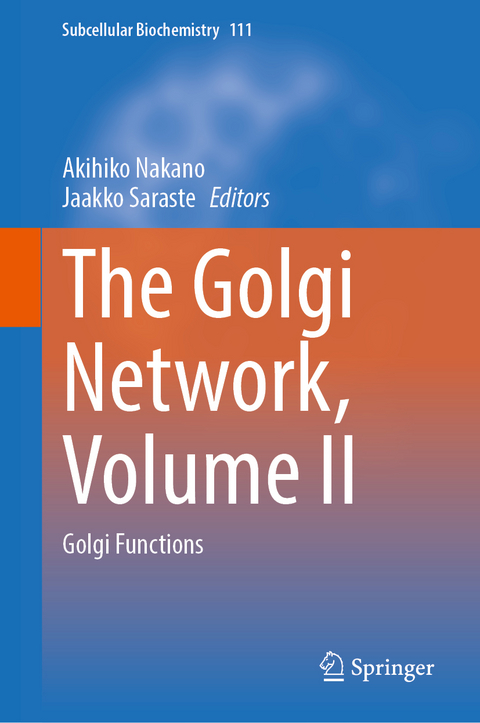
The Golgi Network, Volume II
Springer International Publishing (Verlag)
978-3-032-16832-0 (ISBN)
- Noch nicht erschienen - erscheint am 22.03.2026
- Versandkostenfrei
- Auch auf Rechnung
- Artikel merken
The second volume (of two) of The Golgi Network book, explores the role of this organelle in a plethora of cellular functions, complementing perfectly the first volume with the most recent discoveries.
In this part, the description of the machinery involved in trafficking explores the interaction of Golgi with different organelles such as ER and the vesicular system, as well as protein complexes in charge to execute these tasks, like COG, and GARP, among others. An important part of this volume studies in depth the sorting mechanisms that occur in different areas of the cell and their most important components, a part of this volume includes the effects of Golgi on glycosylation systems, and in a special section, we can learn about new Golgi-associated functions such as the nucleation of microtubules and their effect on signaling in the immune system.
The last part of this volume explores the association of Golgi and its malfunction with different diseases, focusing mainly on cancer and neurodegeneration.
In this fashion, this volume is a valuable resource for professionals working on different fields of Golgi research and is strongly suggested to those involved in translational science.
Professor Akihiko Nakano is a cell biologist/biochemist with a particular interest in the molecular mechanisms of protein sorting during membrane trafficking and of carrier formation in the trafficking pathways. He explores the roles of membrane trafficking in many aspects of basic biology and life sciences, as well as super-resolution live imaging microscopy and its application. His work on the Golgi cisternal maturation is viewed as a monumental milestone in the field, not least as it helped to settle a big debate about the transport mechanisms in the Golgi apparatus and led to a rewriting of major cell biology textbooks. His group works on several different model systems, using yeast, plant and animal cells.
Professor Jaakko Saraste is a cell biologist/morphologist with a long-term interest in membrane trafficking along the secretory pathway. He is famous for his discovery of the intermediate compartment (IC or ERGIC) operating between the endoplasmic reticulum and the Golgi apparatus and is continuing his investigations on the functional organization of this still enigmatic membrane system. Based on the emerging direct connection between the IC and the endocytic recycling system, he is also interested in the new roles of this compartment in unconventional protein secretion bypassing the Golgi, as well as in cellular egress of coronaviruses.
Part I: Golgi Functions in Traffic.- Chapter 1: Beyond Vesicular Traffic: the ERES as the gateway for biosynthetic secretion.- Chapter 2: COPI vesicle and tubule formation at the Golgi complex.- Chapter 3: The functions of RAB GTPases at the Golgi complex.- Chapter 4: The functions of the golgin family of coiled-coil proteins.- Chapter 5: ARF GTPases function at the Golgi.- Chapter 6: GARP complex in Golgi physiology.- Chapter 7: COG complex in Golgi trafficking and glycosylation.- Chapter 8: Lipid Metabolism and Trafficking in the Golgi Apparatus.- Chapter 9: Cargo sorting zones in plant trans-Golgi network.- Part II: Golgi Functions in Glycosylation and Processing.- Chapter 10: Siamese Twins: The Multimodular Mechanisms of Golgi Maturation and Glycan Synthesis are Coupled at Their Core.- Chapter 11: Regulation of Glycan Modification by Glycosyltransferases in the Golgi Apparatus.- Part III: New Golgi Functions.- Chapter 12: Insights into Microtubule Nucleation at the Golgi Apparatus.- Chapter 13: STING Innate immunity signalling from the Golgi.- Chapter 14: Golgi membrane-associated degradation (GOMED), a new intracellular proteolysis mechanism.- Chapter 15: Golgi Drivers of Cancer.- Chapter 16: Golgi Retention and Oncogenic Signaling of KIT Tyrosine Kinase in Gastrointestinal Stromal Tumor.- Chapter 17: The role of the Golgi apparatus in neurodegeneration.- Chapter 18: The dynamic role of the Golgi apparatus in neuronal function and Alzheimer s disease.- Chapter 19: Golgi fragmentation as a potential link between SARS-CoV-2 infection and Alzheimer's disease: Potential mechanisms and implications for neurodegeneration after long COVID .
| Erscheint lt. Verlag | 22.3.2026 |
|---|---|
| Reihe/Serie | Subcellular Biochemistry |
| Zusatzinfo | VI, 506 p. 81 illus., 80 illus. in color. |
| Verlagsort | Cham |
| Sprache | englisch |
| Maße | 155 x 235 mm |
| Themenwelt | Naturwissenschaften ► Biologie ► Mikrobiologie / Immunologie |
| Naturwissenschaften ► Biologie ► Zellbiologie | |
| Schlagworte | cell organelle • Glycosylation and trafficking • Golgi and diseases • golgi apparatus • Golgi body • Golgi organization • Golgi structure and function • New technologies in microscopy • Protein and lipid sorting |
| ISBN-10 | 3-032-16832-5 / 3032168325 |
| ISBN-13 | 978-3-032-16832-0 / 9783032168320 |
| Zustand | Neuware |
| Informationen gemäß Produktsicherheitsverordnung (GPSR) | |
| Haben Sie eine Frage zum Produkt? |
aus dem Bereich