Grinding of Single-Crystal Superalloys (eBook)
462 Seiten
Wiley-VCH (Verlag)
978-3-527-85246-8 (ISBN)
Comprehensive reference on state-of-the-art aerospace materials, reviewing the latest developments in the field and providing guidance on machining challenges
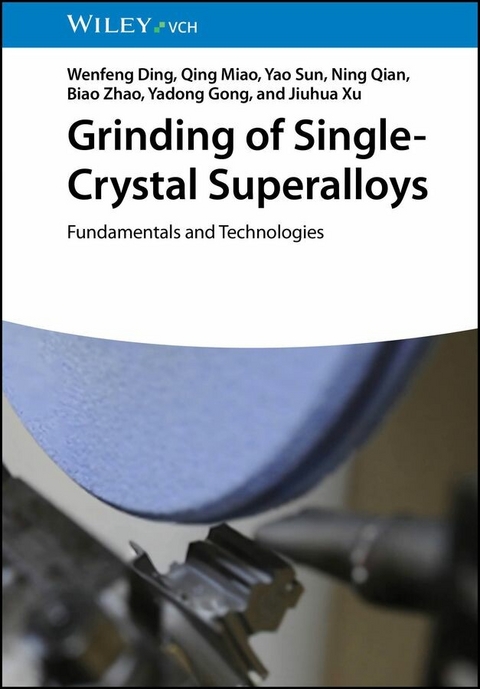
Grinding of Single-Crystal Superalloys provides a comprehensive understanding of grinding technology for single-crystal nickel-based superalloys. It explores and analyzes grinding mechanisms and characteristics using both theoretical and simulation approaches. Grinding behavior in conventional and micro grinding processes are evaluated and compared.
The book assesses the surface integrity of single-crystal nickel-based superalloys under different grinding conditions. Simulation and theoretical models for predicting temperature and residual stresses in profile grinding, facilitating optimization, and control are summarized and validated.
Grinding of Single-Crystal Superalloys discusses sample topics including:
Grinding of Single-Crystal Superalloys is an essential reference for industry professionals and researchers seeking to understand the machining theory and practice of this important type of material, especially in the field of aerospace components manufacturing.
Prof. Wenfeng Ding dedicated his research in the field of advanced manufacturing theory and technologies.
Dr. Qing Miao dedicated his research in the field of advanced material microstructure characterization and high-quality and high-efficiency grinding technology of nickel-based superalloys.
Dr. Yao Sun researches basic theory and technology of the grinding process of difficult-to-machine materials, intelligent manufacturing, and micro-scale machining.
Dr. Ning Qian dedicated his research in the field of advanced and sustainable manufacturing theory and technologies.
Dr. Biao Zhao dedicated his research in the field of high-efficiency and precision manufacturing technologies, high-performance tools, and machining process optimization.
Prof. Yadong Gong dedicated his research in the field of grinding and precision machining, intelligent manufacturing and equipment, micro-scale processing and additive/subtractive manufacturing.
Prof. Jiuhua Xu dedicated his research in the field of advanced and intelligent manufacturing theory and technologies.
Chapter 1
Introduction
1.1 Development and Practical Application of Single-crystal Nickel Alloy
Nickel alloys possess excellent comprehensive properties, such as high-temperature strength, high oxidation resistance, high fatigue resistance, and high thermal stability, and therefore have been employed widely in manufacturing the hot-end components of aeroengines [1, 2]. The development of nickel alloys goes through three generations, e.g., wrought nickel alloy, solidified directionally nickel alloy, and single-crystal nickel alloy (Figure 1.1). The temperature capability is enhanced from generation to generation. For example, compared to directionally solidified nickel alloy, a single-crystal turbine blade allows an operating temperature higher by around 25–50 °C, equivalent to an increase in turbine blade service life by up to 3 times from the aspect of working efficiency.
Figure 1.1 Development of (a) temperature capability and (b) mechanical properties of nickel alloys.
The turbine inlet temperature has been improved significantly for advanced aeroengines. Using the single-crystal hollow turbine blades can make the turbine inlet temperature reach 2100 K for the F119 aeroengine. At such a high temperature, the polycrystalline turbine blade formed by the conventional casting method can melt and cease to work. However, single-crystal turbine blade works well and is becoming the preferred choice of first-stage turbine blades of aeroengines with a higher thrust-weight ratio of above 10. This is mainly because the whole turbine blade grows from a single grain without any grain boundaries, which often induce defects of micropores and microcracks in polycrystalline nickel alloy (Figure 1.2). Meantime, the elements enhancing grain boundaries as well as decreasing the metal melting point can be reduced effectively (Figure 1.3). Thus, these promote the high temperature resistance of single-crystal nickel alloy. By using the advanced material preparation technique for single-crystal nickel alloy and the double-wall air cooling/casting-in-chill manufacturing technique for single-crystal turbine blade, the turbine inlet temperature can be increased to 2200 K, which makes the extreme machining of single-crystal nickel alloy one of the cutting-edge research topics in fabricating the military and commercial aeroengines.
Figure 1.2 Microstructures in different casting nickel alloys: (a) equiaxial cast; (b) directionally solidified cast; and (c) single crystal. [2]/Journal of Mechanical Engineering.
Figure 1.3 Application of single-crystal turbine blades in an advanced aeroengine. Adapted from [3].
1.2 Advantages of Grinding Technology of Single-crystal Nickel Alloy
Relying on the micro-cutting behaviors of thousands of abrasive grains on the wheel surface, the grinding process can fabricate a high-quality surface with low surface roughness, compressive stresses, and high accuracy (Tables 1.1 and 1.2), regardless of workpiece materials. This nature is different from the conventional turning, broaching, and milling methods, which often face major challenges in difficult-to-cut materials (i.e., nickel alloys) because of the rapid tool wear and the huge difficulty in controlling surface integrity and accuracy (Table 1.3). Currently, various grinding techniques have been developed to fulfill the requirements of different practical applications for almost any workpiece material (e.g., nickel alloys and ceramics). For instance, surface grinding is usually employed in manufacturing the automobile components and machine tools with flat surface requirements; profile grinding is usually combined with the creep-feed deep machining method that permits high efficiency in grinding the aeroengine parts with large stock removals and complex shapes; and micro-grinding works as one of the effective methods to fabricate the micro features in metals. The common characteristic of the abovementioned grinding techniques is that the grinding process always serves as the final process to guarantee the workpiece surface quality.
Table 1.1 Material removal rates achieved in the common grinding process.
| Contents | Shallow grinding | Creep-feed grinding | High-speed grinding | High-efficiency deep grinding |
|---|
| Grinding depth (mm) | Low 0.001–0.05 | High 0.1–30 | Low 0.003–0.05 | High 0.1–30 |
| Workpiece speed | High 1–15 | Low 0.05–0.5 | High 1–15 | High 0.5–10 |
| Grinding speed | Low 15–40 | Low 15–40 | High 60–200 | High 60–200 |
| Material removal rate | Low 0.05–2 | Low 1–10 | Medium | High 50–2000 |
Table 1.2 Surface roughness achieved in the common grinding process.
| Grinding methods | Conventional grinding | Precision grinding | Ultraprecision grinding | Mirror grinding |
|---|
| Surface roughness | 0.16–1.25 | 0.04–0.16 | 0.01–0.04 |
Table 1.3 Main methods and related characteristics for machining single-crystal nickel alloy components.
| Machining method | Machining efficiency | Machining accuracy | Machined surface quality | Other characteristics |
|---|
| Electrochemical machining (ECM) | High | , with slight/without affected layer | With slight/without electrode wear, suitable for mass production, large initial investment, and not environmentally friendly |
| Electrical discharge machining (EDM) | Medium | ,with affected layer and even microcrack | Suitable for any workpiece materials, having electrode wear, suitable for mass production, large initial investment, and not environmentally friendly |
| Additive manufacturing | Low | , easy to deform | Limited workpiece size, difficulty in fixturing and supporting workpiece, and large initial investment |
| Broaching | Medium | Rapid tool wear and high cost |
| Milling | Low | Rapid tool wear, limited workpiece size, and low machining efficiency |
| Grinding | Medium | , with compressive stresses | Rapid tool wear if using conventional abrasive wheels, good surface quality |
In the case of aeroengine manufacturing, the typical features of nickel alloy turbine blades include high machining accuracy, good surface quality, and high fatigue resistance. Though the nontraditional machining methods (e.g., electrochemical machining [ECM] and electrical discharge machining [EDM]) have achieved rapid developments in the past decades, the extremely strict requirements of tight tolerance , low surface roughness , and high surface integrity still make the grinding process, particularly the profile grinding, dominate the main positions in machining aeroengine components. Therefore, both conventional grinding (including surface grinding and profile grinding) and micro-grinding are still attracting great attention in machining difficult-to-cut materials, especially single-crystal nickel alloys, and deserve further exploration.
1.3 High-efficiency Grinding Technology Development of Single-crystal Nickel Alloy
1.3.1 High-efficiency Grinding Mechanism and Development
During grinding, the workpiece material is removed in the form of tiny wedge-shaped chips by the effective cutting behavior of an individual abrasive grain. In the grinding zone, the interaction between abrasive grain and workpiece is complicated and always changing due to the varied penetration depth of abrasive grain into the workpiece. Thus, the grinding chip formation can be divided into three stages (Figure 1.4): (i) sliding, (ii) plowing, and (iii) cutting. The cutting stage is expected to be induced because of its effective material removal behavior. The other two states are expected to be avoided owing to their low efficiency in removing workpiece material, together with high grinding energy consumption. However, for each kind of workpiece material, the duration time of such three stages might be different even under identical grinding conditions. Understanding the underlying material removal mechanism of each workpiece material is essential to optimize the grinding process.
Figure 1.4 Schematic illustration of the material removal process in the grinding process.
Furthermore, in surface grinding, the grinding loads are distributed uniformly along the grinding surface, and thus, the formation of surface integrity is relatively easy to clarify. Nevertheless, in profile grinding, there are various factors that limit the improvement of machining accuracy and...
| Erscheint lt. Verlag | 2.12.2025 |
|---|---|
| Sprache | englisch |
| Themenwelt | Naturwissenschaften ► Chemie |
| Schlagworte | Fretting • grinding force • grinding parameters • Grinding Technology • high efficiency grinding • micro grinding • microhardness • plastic deformation mechanism • profile grinding • surface grinding • wear evolution • wear volume • wheel wear |
| ISBN-10 | 3-527-85246-8 / 3527852468 |
| ISBN-13 | 978-3-527-85246-8 / 9783527852468 |
| Informationen gemäß Produktsicherheitsverordnung (GPSR) | |
| Haben Sie eine Frage zum Produkt? |
 EPUB (Adobe DRM)
Kopierschutz: Adobe-DRM
Adobe-DRM ist ein Kopierschutz, der das eBook vor Mißbrauch schützen soll. Dabei wird das eBook bereits beim Download auf Ihre persönliche Adobe-ID autorisiert. Lesen können Sie das eBook dann nur auf den Geräten, welche ebenfalls auf Ihre Adobe-ID registriert sind.
Details zum Adobe-DRM
Dateiformat: EPUB (Electronic Publication)
EPUB ist ein offener Standard für eBooks und eignet sich besonders zur Darstellung von Belletristik und Sachbüchern. Der Fließtext wird dynamisch an die Display- und Schriftgröße angepasst. Auch für mobile Lesegeräte ist EPUB daher gut geeignet.
Systemvoraussetzungen:
PC/Mac: Mit einem PC oder Mac können Sie dieses eBook lesen. Sie benötigen eine
eReader: Dieses eBook kann mit (fast) allen eBook-Readern gelesen werden. Mit dem amazon-Kindle ist es aber nicht kompatibel.
Smartphone/Tablet: Egal ob Apple oder Android, dieses eBook können Sie lesen. Sie benötigen eine
Geräteliste und zusätzliche Hinweise
Buying eBooks from abroad
For tax law reasons we can sell eBooks just within Germany and Switzerland. Regrettably we cannot fulfill eBook-orders from other countries.
aus dem Bereich