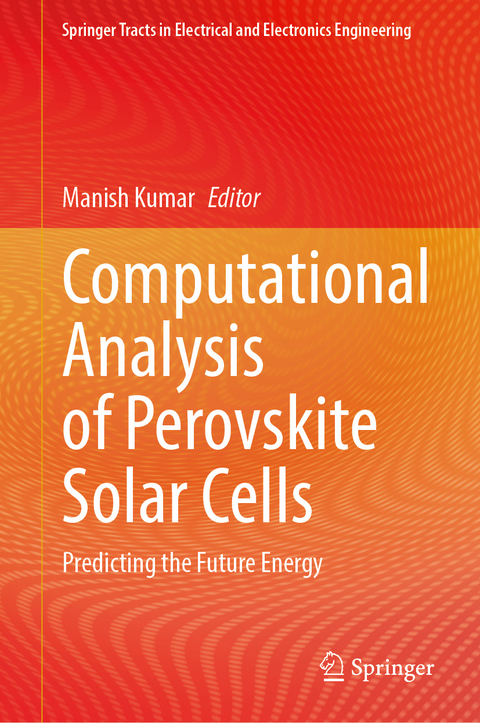
Computational Analysis of Perovskite Solar Cells
Springer Verlag, Singapore
978-981-95-6520-7 (ISBN)
- Titel nicht im Sortiment
- Artikel merken
Dr. Manish Kumar obtained his M.Tech. degree in Ceramic Engineering from IIT(BHU), Varanasi, and Ph.D. degree in Physics from Institute of Science, Department of Physics, Banaras Hindu University, Varanasi, India. At present, he is serving as Assistant Professor at Department of Physics, ARSD College, University of Delhi, New Delhi, India, since last more than 12 years. His research area focuses on environmental friendly multifunctional materials for energy and memory devices, materials for green energy solutions, multiferroics, magnetoelectrics, composites, perovskite materials for photovoltaic applications, supercapacitors, white light-emitting materials, solar simulation via different software, and DFT calculation. He has delivered the talks in a number of national and international conferences. He is also Member of various research committees of different universities. He has completed two national research projects and received the best research award from his institute. He is guiding/guided number of Ph.D., M.Tech./M.Sc., and B.Sc./B.Tech. students as Supervisor and Co-Supervisor.
Introduction of perovskite solar cells on computational analysis.- Generation of defects in perovskite absorber.- Structural analysis and modification of perovskite absorber through the density functional theory studies (DFT).- Assessment of physical parameters of perovskite solar cells through computational studies.- Multi-physics studies of perovskite solar cells.- Theoretical study of all inorganic and organic-Inorganic mixed halide perovskite solar cells.- Computational studies of tandem solar cells.- Computational investigations on stability of perovskite solar cell.- Computational investigations on the impact of organic molecule layer in between the heterostructures of the perovskite solar cells.- Interfacial engineering in perovskite solar cells by the simulation approaches.- Bandgap tuning strategy in perovskite solar cells using the solar cell simulations.- Role of machine learning in the perovskite solar cell investigations.- Role of defect density and doping concentration in perovskite solar cell.- Summary and future outlook.
| Erscheint lt. Verlag | 14.7.2026 |
|---|---|
| Reihe/Serie | Springer Tracts in Electrical and Electronics Engineering |
| Zusatzinfo | Approx. 400 p. |
| Verlagsort | Singapore |
| Sprache | englisch |
| Maße | 155 x 235 mm |
| Themenwelt | Naturwissenschaften ► Chemie |
| Technik ► Elektrotechnik / Energietechnik | |
| Technik ► Maschinenbau | |
| Technik ► Umwelttechnik / Biotechnologie | |
| Schlagworte | Bandgap Tuning Strategy in Perovskite Solar Cells • Computational Simulation • Defect Density in Perovskite • Defects in Perovskite Absorber • Density Functional Theory (DFT) • Doping Concentration in Perovskite • Green Energy Conversion • Inorganic-Organic Perovskite Materials • Mixed Halide Perovskite Solar Cell Materials • Photovoltaics • power conversion efficiency • Renewable Energy with Perovskite Solar Cells • Solar Cells Power Efficiency • Tunable Optoelectronic Properties |
| ISBN-10 | 981-95-6520-0 / 9819565200 |
| ISBN-13 | 978-981-95-6520-7 / 9789819565207 |
| Zustand | Neuware |
| Informationen gemäß Produktsicherheitsverordnung (GPSR) | |
| Haben Sie eine Frage zum Produkt? |
aus dem Bereich