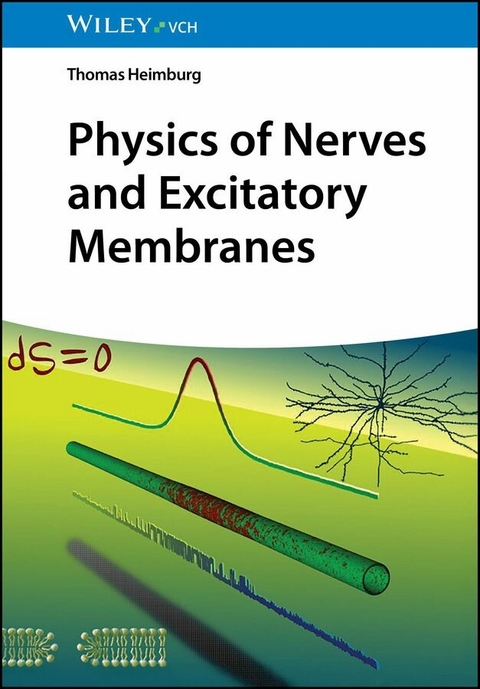
Physics of Nerves and Excitatory Membranes (eBook)
960 Seiten
Wiley-Blackwell (Verlag)
978-3-527-69061-9 (ISBN)
Ground-breaking reference explaining the biological properties of nerve cell membranes from a unifying physical perspective
Without neglecting the known theories of nerve impulse propagation, Physics of Nerves and Excitatory Membranes focuses on the less known features of nerve cell membranes, such as their mechanical, caloric and optical properties. Based on these properties, the author then develops an electromechanical theory of pulse propagation, offering the most plausible explanation yet for some unresolved questions regarding the effects observed during general anesthesia.
Physics of Nerves and Excitatory Membranes is didactically written and includes information on:
- The structure and electrical properties of nerves, dimensions and mechanical properties of the nerve pulse, and optical changes during the action potential
- Cable theory, voltage gating, the Hodgkin-Huxley model, and protein ion channels
- Membrane structure and melting, phase behavior, domains, and rafts, and the influence of pressure, voltage, drugs, proteins, pH, and ionic strength
- Heat capacity, sound propagation, relaxation timescales, and capacitance and capacitive susceptibility
- The emergence of solitary nerve pulses in a biological membrane under physiological conditions
- Voltage-gated and mechanosensitive lipid channels, temperature sensing, and selectivity of lipid channels
Physics of Nerves and Excitatory Membranes is of prime interest for biophysicists studying biomembranes as well as for neurobiologists and clinical researchers studying anesthesia. Its accessible style makes it very well suited for teaching the subjects that it covers.
Thomas Heimburg is Professor for Biophysics at the Niels Bohr Institute of the University of Copenhagen (Denmark), where he is the head of the Membrane Biophysics Group. His research focuses on theoretical and experimental thermodynamics of biological systems, including biomembranes, artificial lipid membranes, and proteins. He is the author of the book Thermal Biophysics of Membranes (Wiley-VCH, 2007).
Preface
The first scientist to study the thermodynamics and the velocity of nerve impulses was Hermann von Helmholtz around 1850. Helmholtz made numerous contributions not only to important problems in physiology but also to theoretical physics. He also wrote a popular book, On the Sensations of Tone as a Physiological Basis for the Theory of Music [1] – seemingly unrelated to nerves. It expresses a fascination with the effect that music has on us and attempts to relate it to the physical construction of the ear. The question of how the ear is connected to the perception of sound in the brain is still not well understood. It may be that sound is only perceived in the ear and then converted into signals of a different nature. However, many people use analogies to music to describe brain function and perception: “good vibrations,” “ringing a bell,” “being in harmony,” “in tune,” and “being on the same wavelength” [2] – or a “cognitive dissonance.” “That sounds good” expresses something that makes sense.
How is it that the brain can recognize the doubling of a frequency (an octave) and reconstruct the 12 tones of the musical scale by the circle of fifths? Why does the brain experience “harmony” when listening to music? In neural models based on electrical phenomena, there is no good reason why this should be so. Are the aforementioned terms just useful analogies? Then why can mechanical changes be measured during the nerve pulse, why is the nerve mechanically excitable, why is the pulse velocity close to the speed of sound in membranes, and why can the brain be stimulated by ultrasound?
In this book, I will present a new concept of the function of excitatory membranes, nerves, and the brain that is based on thermodynamics and the theory of adiabatic processes, of which sound is one aspect. It has important early proponents such as Hermann von Helmholtz, Archibald V. Hill, J.V. Howarth, J.M. Ritchie, and most importantly, I. Tasaki of the NIH. In a thermodynamic treatment of nerves, all variables must be considered if one wishes to understand the properties of cell membranes.
For this reason, a nerve impulse has electrical as well as mechanical, thermal, and chemical components. A thermodynamic view of excitatory membranes differs significantly from the electrophysiological description of nerves as developed by Julius Bernstein, Alan V. Hodgkin, Andrew F. Huxley, Bernard Katz, Erwin Neher, and Bert Sakmann, among others. The latter concepts are based exclusively on electrochemistry and have no explicit mechanical or thermal aspects, except for the idea that there may be macromolecules that are sensitive to these variables, such as mechanoreceptors, which influence the electrical properties. The electrophysiological approach is best represented by the Hodgkin–Huxley model of 1952, which won the Nobel Prize in 1963. It is described in Part IV of this book. The Hodgkin–Huxley model is inherently based on dissipative phenomena that increase entropy.
In contrast, the thermodynamic soliton theory at the heart of this book is based on adiabatic phenomena, i.e., on processes that conserve entropy. The two approaches are therefore mutually exclusive.
I have been thinking about the thermodynamics of excitable membranes for more than two decades. My interest actually goes back even further, to my PhD training at the Max Planck Institute, where I grew up in a field of tension between physical chemists and molecular biologists, who did not seem to understand each other very well. The very different approaches of the two fields were embodied by two Nobel laureates. The first is Manfred Eigen, a physicist with a deep interest in biology. He won his prize for the experimental and theoretical description of fast reaction kinetics and went on to develop a thermodynamic theory of biological evolution. The other scientist is Erwin Neher, who was honored with Bert Sakmann for developing the patch-clamp technique to study the function of protein ion channels. In their field, thinking tends to focus on the function of individual molecules. Whereas physicists tend to seek beauty in finding simple explanations for seemingly complicated processes, molecular biologists marvel at the complexity of biological systems, which they see as the result of 4 billion years of evolution. There are compelling arguments to be made for both approaches.
Because of my physics training, I tend to take a physics or physical chemistry approach to biology. The term physiology was coined by Emil du Bois Raymond in the first half of the nineteenth century to describe a physical approach to biology. I have great sympathy with Erwin Schrödinger’s influential book What Is Life? [3]. Schrödinger believed that biology was based solely on physical and especially thermodynamic processes. I believe that many processes only seem complicated because one has not yet found the most appropriate physical level of description for a particular problem.
In particular, many problems turn out to be much simpler if you try to understand them not as the sum of the properties of individual molecules (as is typically done in molecular biology), but rather at the level of properties that emerge at larger scales. This approach is common in physics and can lead to simple laws even when the atomic or molecular structure of the matter under consideration is complex. An example is the emergence of waves in continuous matter, which depend on elastic moduli.
Waves can be understood using a simple differential equation that requires no knowledge of the molecular structure of the medium. This is because the wavelength is typically many orders of magnitude larger than atoms and molecules. Waves cannot be understood at the level of the elementary components of a system (e.g., atoms or molecules), with the possible exception of crystals. This means that the concept of waves cannot be deduced from the structure of molecules. Waves in biology are outside the scope of molecular biology. We will show here that such considerations apply to nerves.
My own expertise is in the field of membrane thermodynamics. In this book, I will show that phenomena, such as the nerve impulse, can be convincingly understood by applying a thermodynamic formalism to nerves and excitatory membranes. The propagation of the pulse, its temporal length, the occurrence of ion channel-like events in nerve membranes, and the action of anesthetics are all rooted in thermodynamic couplings and are contained in one of the deepest thermodynamic concepts: the fluctuation-dissipation theorem. It originated in a seminal paper on thermodynamics by Albert Einstein in 1910 dealing with the phenomenon of critical opalescence [4] – one of Einstein’s many important works that defined a whole new field. This theorem describes the couplings between the fluctuations of thermodynamic variables, the susceptibilities, and the time scales of processes. The emergence of lipid channels in melting transitions, as described in Part VIII, is reminiscent of critical opalescence.
Thermodynamics in itself is not really a theory for any particular problem because it is absolutely generic. It works at the atomic level as well as at astrophysical scales, in solids as well as in soft or biological matter. Thermodynamics is more like the language of physics. It has words and a grammar. Terms such as energy, temperature, pressure, and entropy form the words, and the laws of thermodynamics form the grammar of this language. There are strong couplings between different variables, expressed by Maxwell’s relations. For example, relates the pressure dependence of entropy and the volume expansion coefficient, a coupling that is not immediately intuitive.
As Albert Einstein noted [5]:
“Therefore the deep impression which classical thermodynamics made upon me. It is the only physical theory of universal content concerning which I am convinced that, within the framework of the applicability of its basic concepts, it will never be overthrown.”
Any violation of a thermodynamic principle falsifies a theory, regardless of its field of application. A correct description of biological processes can never be in conflict with any thermodynamic law. I hope that the power of a thermodynamic approach to biology will be evident in the description of nerves and excitatory membranes presented in this book.
There are also other important aspects of scientific investigation. In his 1637 essay “Discourse on the Method,” René Descartes described his scientific method and formulated four steps:
- “The first was never to accept anything for true which I did not clearly know to be such; that is to say, carefully to avoid precipitancy and prejudice, and to comprise nothing more in my judgment than what was presented to my mind so clearly and distinctly as to exclude all ground of doubt.
- The second, to divide each of the difficulties under examination into as many parts as possible, and as might be necessary for its adequate solution.
- The third, to conduct my thoughts in such order that, by commencing with objects the simplest and easiest to know, I might ascend by little and little, and, as it were, step by step, to the knowledge of the more complex; assigning in thought a certain order even to those objects which in their own nature do not stand in a relation of antecedence and sequence.
- At the last, in every case to make enumerations so complete, and reviews so general, that I might be assured that nothing...
| Erscheint lt. Verlag | 28.11.2025 |
|---|---|
| Sprache | englisch |
| Themenwelt | Naturwissenschaften ► Biologie |
| Schlagworte | Anesthetics • Biological membranes • Cable theory • fluctuation-dissipation theorem • lipid channels • Lipid membranes • nerve cells • nerve membranes • nerve pulse • nerve temporal length • neuronal properties • thermodynamic couplings |
| ISBN-10 | 3-527-69061-1 / 3527690611 |
| ISBN-13 | 978-3-527-69061-9 / 9783527690619 |
| Informationen gemäß Produktsicherheitsverordnung (GPSR) | |
| Haben Sie eine Frage zum Produkt? |
 EPUB (Adobe DRM)
Kopierschutz: Adobe-DRM
Adobe-DRM ist ein Kopierschutz, der das eBook vor Mißbrauch schützen soll. Dabei wird das eBook bereits beim Download auf Ihre persönliche Adobe-ID autorisiert. Lesen können Sie das eBook dann nur auf den Geräten, welche ebenfalls auf Ihre Adobe-ID registriert sind.
Details zum Adobe-DRM
Dateiformat: EPUB (Electronic Publication)
EPUB ist ein offener Standard für eBooks und eignet sich besonders zur Darstellung von Belletristik und Sachbüchern. Der Fließtext wird dynamisch an die Display- und Schriftgröße angepasst. Auch für mobile Lesegeräte ist EPUB daher gut geeignet.
Systemvoraussetzungen:
PC/Mac: Mit einem PC oder Mac können Sie dieses eBook lesen. Sie benötigen eine
eReader: Dieses eBook kann mit (fast) allen eBook-Readern gelesen werden. Mit dem amazon-Kindle ist es aber nicht kompatibel.
Smartphone/Tablet: Egal ob Apple oder Android, dieses eBook können Sie lesen. Sie benötigen eine
Geräteliste und zusätzliche Hinweise
Buying eBooks from abroad
For tax law reasons we can sell eBooks just within Germany and Switzerland. Regrettably we cannot fulfill eBook-orders from other countries.
aus dem Bereich