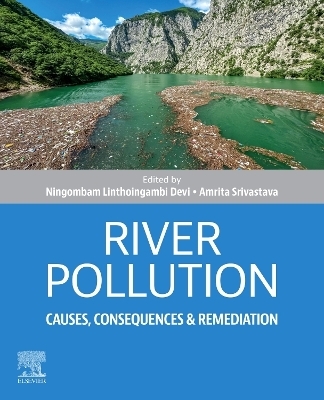
River Pollution: Causes, Consequences and Remediation
Elsevier - Health Sciences Division (Verlag)
978-0-443-45024-2 (ISBN)
- Noch nicht erschienen (ca. Juli 2026)
- Versandkostenfrei
- Auch auf Rechnung
- Artikel merken
Dr. N.L. Devi is an Assistant Professor at the department of Environmental Science at Central University of South Bihar. For thirteen years she has researched persistent organic pollutants (POPs) in various environmental matrices and their ecological risk assessment. Her research experience also inclines towards atmospheric aerosols in Indo-Gangetic regions and heavy metal contaminations, and removal of emerging pollutants in sustainable ways. During her research career, she has able to publish 50 peer-reviewed research papers in International and National Journals. She is the authored 3 of books and more than 5 book chapters. In the past, she has also received projects funded by SERB-DST, and UGC. Dr. Amrita Srivastava is currently and Assistant Pro in the Department of Life Sciences at the Central University of South Bihar, Gaya, India. She has a PhD in BioScience and over 11 years of teaching and research experience. She works in the field of microbial secondary metabolites, and her research focus lies in the extraction and purification of microbial secondary metabolite siderophore and its application. Her work includes establishment of antimicrobial and anticancer properties of secondary metabolites by elucidating the mechanism of their effect on plants, microbes, and cell lines. She has published 26 research and review articles in journals of international repute, edited 2 books and authored over 15 book chapters.
I. River Pollutants and their sources
1. Natural and Anthropogenic Sources of River Pollution
2. Harmful Algal Blooms
3. River deterioration due to indiscriminate use of pesticides, pharmaceutical and personal care products
4. Pollution induced alterations in natural hydrogeological cycle
5. Micro/Neoplastic Pollution
6. Atmospheric wet Deposition based Pollution
7. Emerging pollutants pollution
8. Industries as source of river pollution
9. Heavy Metal pollution
II. Impact of pollution
10. Changing Microbial Diversity
11. Effect on aquatic flora and fauna
12. Histopathological changes in fishes
13. Gangetic pollution
14. Land use change and change in meandering pattern
15. Change in river chemistry 16. River salinization
17. Human health ailments due to polluted waters
18. Disturbance in Food chain
19. Socio-Economic impacts of river pollution
III. Assessment of pollution and remedial measures
20. Water quality assessment using sophisticated instruments
21. Wastewater treatment
22. Physical, chemical and BioRemedial measures
23. Remediation by using novel techniques
| Erscheint lt. Verlag | 1.7.2026 |
|---|---|
| Verlagsort | Philadelphia |
| Sprache | englisch |
| Maße | 191 x 235 mm |
| Gewicht | 450 g |
| Themenwelt | Naturwissenschaften ► Biologie ► Ökologie / Naturschutz |
| ISBN-10 | 0-443-45024-2 / 0443450242 |
| ISBN-13 | 978-0-443-45024-2 / 9780443450242 |
| Zustand | Neuware |
| Informationen gemäß Produktsicherheitsverordnung (GPSR) | |
| Haben Sie eine Frage zum Produkt? |
aus dem Bereich