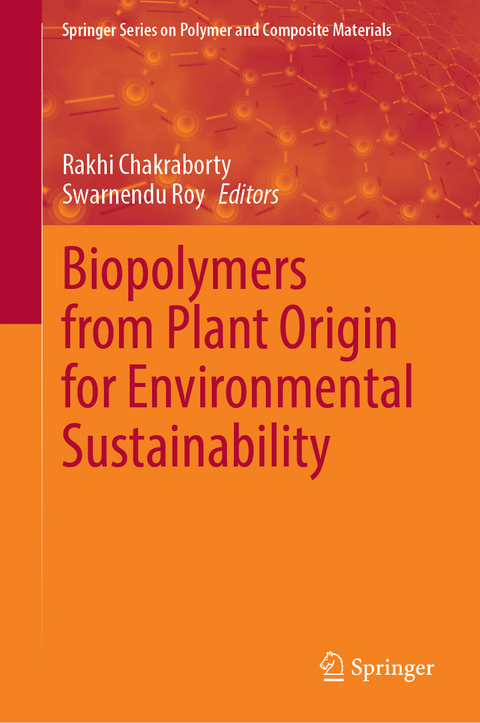
Biopolymers from Plant Origin for Environmental Sustainability
Springer International Publishing (Verlag)
978-3-032-16033-1 (ISBN)
- Noch nicht erschienen - erscheint am 01.03.2026
- Versandkostenfrei
- Auch auf Rechnung
- Artikel merken
The book aims to present a detailed overview regarding the extraction, characterization, modifications, and applications of plant-based biopolymers in different commercial sectors by pinpointing their advantages over conventional synthetic polymers. In this connection, an insight into the unconventional or underutilized plant sources will be explored. In addition, the book will also throw light on the physicochemical, biochemical, mechanical, and extraordinary properties of such biopolymers. Furthermore, the findings of recent research in this field that will help understand the existing limitations of biopolymers, the advanced strategies for overcoming these constraints, and the prospect of their large-scale production is included. Moreover, the significant contributions of other disciplines like biotechnology, nanotechnology, polymer science, and engineering will be discussed. An important section of this book will highlight the present global status of the commercialization, overall acceptance, and prospects of plant-based biopolymers. The post-graduate students, research scholars, faculties, and scientists working in the fields of food science and technology, pharmaceutical technology, biomedical science, environmental science, agricultural science and allied disciplines will benefit from this book.
Dr. Rakhi Chakraborty presently works as an Assistant Professor in the Department of Botany, Acharya Prafulla Chandra Roy Government College, Siliguri, India, for the last 10 years. She has done her Ph.D. on medicinal plants specifically characterizing the antidiabetic and antihyperlipidemic properties of Litsea cubeba fruits traditionally used to cure hyperglycemia and hypertension by the ethnic communities of Darjeeling Himalayas, India. She also has a keen interest in the study of nutraceutical properties of underutilized food plants and the food biochemistry of bakery products. She has also published Research and Review articles in journals of international repute. She has recently co-edited two books published by Springer. She has also presented her research work in several Seminars and Conferences and has also been awarded the Best Oral Presentation at the West Bengal State Regional Science Congress, at a National seminar organized by the University of North Bengal, India, and at an International Conference organized by the Banaras Hindu University, India.
Dr. Swarnendu Roy works as an Assistant Professor at the University of North Bengal, Siliguri, India. He has more than 15 years of teaching experience. He has received the University Gold Medal for securing the first position at B.Sc. and the University Silver medal for securing the second position at M.Sc. level. He received the Post-Graduate Merit Scholarship for University Rank Holder, which was awarded by the Ministry of HRD and UGC (2006 2008), Government of India. He also received the CSIR Junior Research Fellowship, which was awarded by CSIR-UGC (2008). He is actively engaged in research topics encompassing plant stress management by engineered nanoparticles and the synthesis of starch-based biofilms and edible coatings. He has published more than 50 articles with high-impact factors in reputed journals, such as Water Research and Scientific Reports, among many others. He has recently edited two books published by Springer and has also published several book chapters in edited volumes to date. He is a life member of prestigious societies like The Indian Science Congress Association ; Association of Food Scientists and Technologists (India) and Society of Plant Research (India) .
Chapter 1 Wild plant sources for the extraction and processing of biopolymers.- Chapter 2 Plant-Based Polymers in Food Packaging Industry Application.- Chapter 3 Advancing Sustainable Food Packaging with Plant-Based Polymers.- Chapter 4 From Plants to Plates: The Role of Biopolymers in Edible Coatings.- Chapter 5 Plant-derived biopolymers as edible films and coatings.- Chapter 6 Plant-based Biopolymers in the Pharmaceutical Sector.- Chapter 7 Application of plant-derived and agricultural waste-based biopolymers in separation technologies.- Chapter 8 Starch-derived Cyclodextrins: Cyclical Oligomers with Potential Multifaceted Applications in Agriculture, Pharmaceutical and Environmental Avenues.- Chapter 9 Systematic Utilization of Plant Derived Cellulose and its Derivatives: A Step Towards Sustainable 3D Bioprinting Techniques.- Chapter 10 Unraveling the Potentiality of Alginates, Agar, and Carrageenan in the Food Industry.- Chapter 11 Biofunctional Applications of Chitin, Chitosan, and Their Derivatives.- Chapter 12 Agricultural Application of Chitin, Chitosan and their Derivatives.- Chapter 13 Chemical Modification of Chitosan for Enhanced Environmental Applications.- Chapter 14 A Sustainable Approach to Extraction, Purification and Applications of Hemicellulose and its Derivatives from Plant Resources.- Chapter 15 Extraction and Functional Applications of Hemicellulose from Wheat Straw.- Chapter 16 Advanced Processing Techniques and Simulation-Driven Design of Hemicellulose-Based Products.- Chapter 17 Diverse applications and environmental sustainability of Galactomannans.- Chapter 18 Plant-derived Mucilage: From plant origins to Biopolymer applications.- Chapter 19 Synthesis and Application of Polylactic Acid: Recent Advances and Future Implications.- Chapter 20 Fabrication of Plant-Based Biopolymer-Reinforced Fibres: Advances, Functional Performance, and Future Prospects.- Chapter 21 Fortification of Biopolymers for Enhanced Antimicrobial Activity.- Chapter 22 Emerging trends in functional biopolymers with special reference to their antimicrobial and antioxidant properties.- Chapter 23 Plant Protein-based Bioplastics for Sustainable Packaging.- Chapter 24 Exploration and utilization of nanotechnology in the modifications and sustainable utilizations of plant-based biopolymers.- Chapter 25 Gut Microbiome Diversity in Plastic Degrading Insects and Environmental Persistence of Different Polymeric Materials.- Chapter 26Smart Biopolymers: Commercial Applications, Innovations, and Market Integration.- Chapter 27 Comprehensive Toxicity and Environmental Impact Assessment of Biodegradable Polymers: Pathways, Trade-Offs, and Safe-by-Design Strategies.
| Erscheint lt. Verlag | 1.3.2026 |
|---|---|
| Reihe/Serie | Springer Series on Polymer and Composite Materials |
| Zusatzinfo | X, 634 p. 99 illus., 86 illus. in color. |
| Verlagsort | Cham |
| Sprache | englisch |
| Maße | 155 x 235 mm |
| Themenwelt | Naturwissenschaften ► Chemie ► Organische Chemie |
| Technik ► Maschinenbau | |
| Schlagworte | Biodegradability • biopolymers • Environment • packaging materials • sustainability |
| ISBN-10 | 3-032-16033-2 / 3032160332 |
| ISBN-13 | 978-3-032-16033-1 / 9783032160331 |
| Zustand | Neuware |
| Informationen gemäß Produktsicherheitsverordnung (GPSR) | |
| Haben Sie eine Frage zum Produkt? |
aus dem Bereich