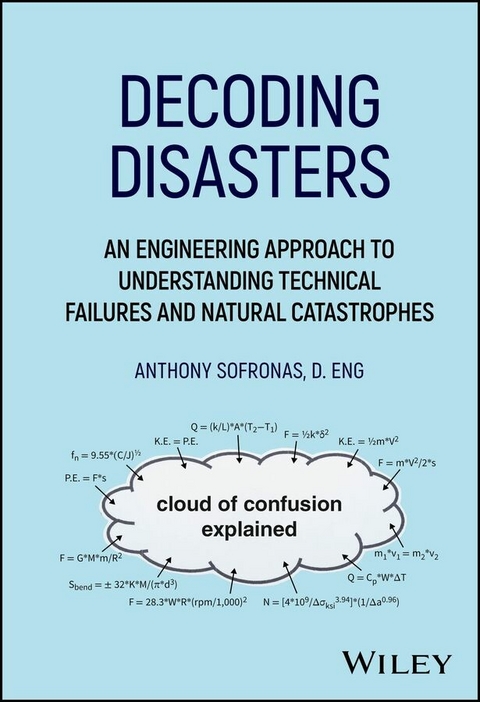
Decoding Disasters (eBook)
406 Seiten
Wiley (Verlag)
978-1-394-31951-0 (ISBN)
Understanding failures and disasters using case studies and simple engineering techniques
Decoding Disasters provides illustrated failure case histories on a multitude of technologies and shows how engineering analysis can explain and help professionals understand them. For each case, the analysis technique is included so that the reader can adapt and apply it to their own situation. Different techniques are developed to show how the methods can be applied in various disciplines. This book guides readers to determine what likely occurred in each case with a minimum amount of data and without speculating.
Each example in this book states the problem, theorizes a conceptual cause, verifies the cause by analysis (i.e. a mathematical model) and actual data, shows the use of the various engineering equations, and documents a solution.
In this comprehensive guide, readers will learn about:
- Viewing disasters not solely as a matter of emergency response, but also more holistically as social constructs between natural extremes, human populations, and the built environment
- Economic, environmental, and human impacts of disasters
- How growth calculations can evaluate the past and present and be applied to likely future events
- Disasters stemming from shortcuts in the design process to meet the demands and needs of society
This book is an excellent learning resource not only for practicing engineers, but also government and regulatory officials who can enact changes to prevent future repeat failures.
Dr. Anthony Sofronas is the former Worldwide Lead Mechanical Engineer for ExxonMobil. He was involved with machinery troubleshooting for 50 years with over 130 publications and presented over 30 industry seminars worldwide on machinery troubleshooting. Sofronas served as owner of Engineered Products (engineering consulting and seminars) for 16 years. He was Contributing Editor for Hydrocarbon Processing Magazine for 16 years on machinery and pressure vessel troubleshooting (110 articles). He has written multiple books published by Wiley.
Understanding failures and disasters using case studies and simple engineering techniques Decoding Disasters provides illustrated failure case histories on a multitude of technologies and shows how engineering analysis can explain and help professionals understand them. For each case, the analysis technique is included so that the reader can adapt and apply it to their own situation. Different techniques are developed to show how the methods can be applied in various disciplines. This book guides readers to determine what likely occurred in each case with a minimum amount of data and without speculating. Each example in this book states the problem, theorizes a conceptual cause, verifies the cause by analysis (i.e. a mathematical model) and actual data, shows the use of the various engineering equations, and documents a solution. In this comprehensive guide, readers will learn about: Viewing disasters not solely as a matter of emergency response, but also more holistically as social constructs between natural extremes, human populations, and the built environmentEconomic, environmental, and human impacts of disastersHow growth calculations can evaluate the past and present and be applied to likely future eventsDisasters stemming from shortcuts in the design process to meet the demands and needs of society This book is an excellent learning resource not only for practicing engineers, but also government and regulatory officials who can enact changes to prevent future repeat failures.
Chapter 1
Methods for Analyzing Failures:
“Hypothesize, Quantify, Verify, Rectify, Utilize”
In engineering and other sciences, decisions have to be made when failures occur. The mechanical engineering field I was in was concerned with machinery systems, pressure vessels, structures, and the various catastrophic failures that occurred. It was important to find the source of the failures quickly and implement a safe and cost-effective repair. This was not the time for guessing or using past experiences on similar failures. Each failure can be quite different. When the cause can’t be identified, it can’t be rectified. An example of this was when a high-speed coupling failed on a large centrifugal compressor system. A new coupling was installed without determining the cause. It failed again in 2 days. This was a dangerous situation as coupling debris flew everywhere. Luckily, no one was injured.
Many of the failures used in this book aren’t of the typical type that have obvious solutions. These failures are classified as being catastrophic, meaning they either produced a dangerous situation, had legal implications, were costly because of lost production or repair costs or all of the above.
Some of the examples were done just out of curiosity about something I had witnessed, read about, or was questioned about. It was a way to sharpen my analytical skills and techniques to see if my analysis agreed with actual observed data.
My primary contribution to a failure investigation team was to develop a mathematical model that could represent the system which failed. In this way, failures could be examined on the computer to see if they made sense with the data recovered from the failed system.
This information was provided to the investigation team so they could concentrate on areas of importance. The model could also be used to see how worthwhile a proposed modification might be.
This approach certainly enhanced my career and greatly reduced the risk of a failure on a re-start-up [1]. The personal stress involved in a start-up was greatly reduced.
While this approach made me many managerial friends by eliminating repeat failures and allowing safe start-ups at their plant, it also caused problems. Sometimes, management was not agreeable with the expensive downtime necessary for the investigation and repairs recommended and didn’t want to implement them. They just wanted to replace parts and start back up. There’s always the respected uninformed person who will tell them there’s no problem in doing this. My approach was to let them know it was their unit and their decision, but I was obligated to write up the team’s safety concerns along with my supporting calculations. With the do-nothing approach and luck, the unit might start-up and run fine. However, the team had used a scientific approach that was documented and defendable. Another catastrophic failure could bring legal action, especially if a fatality were involved. That would not fare well in a court of law. The court would want to know why the recommended modifications weren’t implemented. Cost and timing would be a weak defense.
This scientific approach has worked well during a 50-year career and has resulted in no-repeat start-up catastrophes for investigations I was involved with.
Some caution should be noted. This approach is recommended only for senior-level engineers with considerable experience and no history of bad decisions. For new engineers, do the calculations, provide your input but don’t confront management directly without support from a chief engineer or someone of a similar status who agrees with your calculations, reasoning, and logic.
1.1 Mathematical Modeling
Mathematical modeling is a scientific technique of producing the workings of a machine, structure, or any phenomena such as explosions in the form of equations. The wonderful part of this type of modeling is that these equations are like a time machine and can be used to predict the past, present, and future state of equipment.
The equations can be simple or complex. For example, the force required to accelerate an automobile to a given speed could be done with the simple equation, , where is the force required, the mass of the automobile, and the acceleration. A practical use for this would be to determine the strength of various structural components.
With development of mathematical models to analyze the cause of actual failures in industry, the results were sometimes surprising. They might not have been quite what was expected from observations of historical failures. When this happens, this just means we don’t understand something well enough, have the wrong model or data or not enough data.
Most of us may not be scientific geniuses, but we can do our own thought experiments. In my simplistic way I realized I used these creative images in my mind when building mathematical models to solve problems. Figure 1.1.1 is one envisioned when analyzing how far an attached gage on a vessel would fly if a poor weld holding it failed during high-pressure pneumatic testing. This was important because the plant safety officer was only going to restrict a pneumatic pressure test safety distance of 100 ft. The spring represents the pressure energy behind the piece of flying debris and was related to the pressure in the vessel.
Figure 1.1.1 Modeling a pressure explosion.
Certainly not any monumental discovery and not a highly accurate model, but it did address and solve an industrial safety concern quickly. The analysis indicated that depending on the fragment size, the fragment could travel up to 1,000 ft. The conclusion was to place blast blankets on the critical testing locations. It seems the 100-ft restriction code compliance clearance was only for the pressure shock wave and not for flying fragments.
Richard Feynman (theoretical physicist 1918–1988), known for his brilliant research into quantum mechanics, once stated in a physics classroom, to paraphrase him, “If a mathematical model, even if it is elegant and from a well-known scientist, doesn’t agree with good experimental data, it’s wrong.” I certainly agree with this, but wrong doesn’t mean not useful. In engineering much analysis work that doesn’t come out with the correct magnitude is still useful. For example, with the pneumatic testing model, when verifying the equation with data from a similar incident, the distance was found to be closer to 1,500 ft away, not the 1,000-ft distance predicted. The analysis still was useful for the engineering decision made. Next time used, the calculation method will be modified and will be more accurate.
Reference
- 1 Sofronas, A., Unique Engineering Methods for Analyzing Failures and Catastrophic Events: A Practical Guide for Engineers, Wiley, 2022.
1.2 Methods for Solving Problems
A valuable trait someone can have is good problem-solving skills. This is because there are all types of problems that have to be solved in everyday life. Some allow others to solve their problems by using those who have more experience in a particular area. Consultants, doctors, or using the advice of others are some that come to mind.
Most of us are capable of being good problem solvers. You might say, “But I’m not a doctor so how can I solve my health problems?” The answer is by doing some research and finding out what others have done who have had a similar problem and finding a good solution for yourself. You can then see your doctor and use their experience and education to address your concerns. You can ask questions based on your limited knowledge.
This section isn’t about personal problems but engineering ones. It’s about solving problems like those presented in this book. Both complex and fairly straightforward analysis methods are shown to help illustrate the versatility of these methods.
1.2.1 The Scientific Method
Arriving at the scene of a devastating type of failure such as a machine, structure, or explosion can be confusing. Everything is scattered about and no cause is evident. I call it “The Fog Of Confusion” because that’s how all the uncertainty feels to me. The following method helps eliminate this uncertainty in engineering.
One of the most used methods for problem-solving in engineering is the scientific method. In its simplest form it consists of the following:
- Stating the problem you are trying to solve.
- Developing a hypothesis, meaning what’s your best guess on what the problem cause might be.
- Testing this guess by gathering data, interviewing personal, researching similar failures, performing calculation on analytical models, or running experimental tests. Since you can never really determine if you have found the exact solution, it’s valuable to see if your guess was wrong. Many times it is, and you need to state another best guess based on the data and test it in a similar way.
- Asking your trusted associates to prove the hypothesis wrong you have developed.
- Implementing a solution to the problem and documenting it.
- Following up to ensure it solved the problem. Similar problems tend to reappear elsewhere, and this is good data to have.
The method isn’t only for scientific problems, and with a little imagination it can be used for solving many of life’s problems.
1.3 The Crack Growth Equation
In Section 2.5 an equation will be used...
| Erscheint lt. Verlag | 25.11.2025 |
|---|---|
| Sprache | englisch |
| Themenwelt | Naturwissenschaften ► Chemie |
| Schlagworte | Crack Growth • Design • eliminate speculation • Engineering Calculations • engine failure • evaluating failures • recent catastrophic events • structural failure • submersible failure • troubleshooting failures • unique failures |
| ISBN-10 | 1-394-31951-7 / 1394319517 |
| ISBN-13 | 978-1-394-31951-0 / 9781394319510 |
| Informationen gemäß Produktsicherheitsverordnung (GPSR) | |
| Haben Sie eine Frage zum Produkt? |
 EPUB (Adobe DRM)
Kopierschutz: Adobe-DRM
Adobe-DRM ist ein Kopierschutz, der das eBook vor Mißbrauch schützen soll. Dabei wird das eBook bereits beim Download auf Ihre persönliche Adobe-ID autorisiert. Lesen können Sie das eBook dann nur auf den Geräten, welche ebenfalls auf Ihre Adobe-ID registriert sind.
Details zum Adobe-DRM
Dateiformat: EPUB (Electronic Publication)
EPUB ist ein offener Standard für eBooks und eignet sich besonders zur Darstellung von Belletristik und Sachbüchern. Der Fließtext wird dynamisch an die Display- und Schriftgröße angepasst. Auch für mobile Lesegeräte ist EPUB daher gut geeignet.
Systemvoraussetzungen:
PC/Mac: Mit einem PC oder Mac können Sie dieses eBook lesen. Sie benötigen eine
eReader: Dieses eBook kann mit (fast) allen eBook-Readern gelesen werden. Mit dem amazon-Kindle ist es aber nicht kompatibel.
Smartphone/Tablet: Egal ob Apple oder Android, dieses eBook können Sie lesen. Sie benötigen eine
Geräteliste und zusätzliche Hinweise
Buying eBooks from abroad
For tax law reasons we can sell eBooks just within Germany and Switzerland. Regrettably we cannot fulfill eBook-orders from other countries.
aus dem Bereich