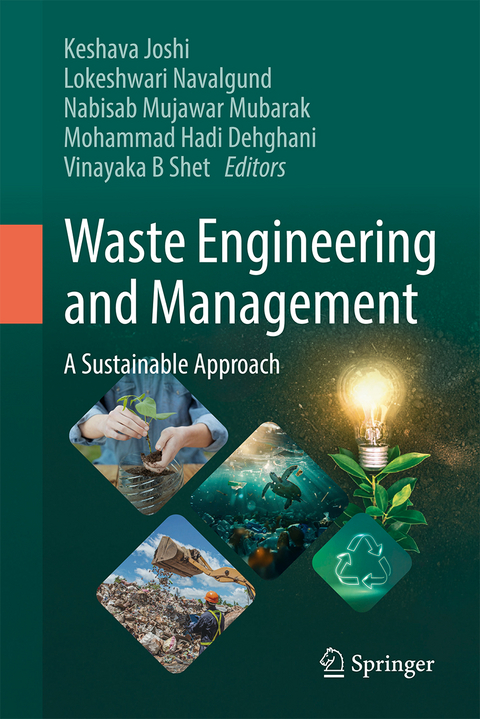
Waste Engineering and Management
Springer International Publishing (Verlag)
978-3-032-15914-4 (ISBN)
- Noch nicht erschienen (ca. Mai 2026)
- Versandkostenfrei
- Auch auf Rechnung
- Artikel merken
Dr. Keshava Joshi is the Dean (Administration) and an Associate Professor in the Department of Chemical Engineering at SDM College of Engineering and Technology, Dharwad, Karnataka, India. He obtained his Ph.D. in Chemical Engineering from the National Institute of Technology Karnataka (NITK), Surathkal, specializing in Denitrification in a Spouted Bed Reactor. With over 22 years of academic experience and a decade of active research, his areas of expertise include environmental biotechnology, advanced wastewater treatment, process modelling, and nanotechnology. He has successfully executed a Vision Group of Science and Technology (VGST), Bangalore-sponsored research project (Rs. 20 lakh) as Principal Investigator on Denitrification of Municipal Wastewater using a Spouted Bed Reactor. Additionally, he serves as Co-Principal Investigator for two other VGST-funded projects worth Rs.20 lakh each, focusing on air quality modelling and nanotechnology applications. He has published more than 40 research papers and book chapters in reputed scopus-indexed international journals. He has presented his work at numerous national and international conferences, earning several Best Paper Awards. He also serves as a peer reviewer for many leading scientific journals, contributing actively to the academic and research community. Dr. Lokeshwari Navalgund is an Associate Professor in the Department of Chemical Engineering at SDM College of Engineering and Technology, Dharwad, Karnataka, India. She obtained her Ph.D. from the National Institute of Technology Karnataka (NITK), Surathkal, specializing in Air Quality Modelling using Remote Sensing (RS) and Geographic Information Systems (GIS). With over 22 years of academic experience and a decade of dedicated research, Dr. Navalgund s research interests encompass air and water quality modelling, adsorption, advanced wastewater treatment, and nanotechnology. She has published more than 40 research papers and book chapters in reputed scopus-indexed journals. She has actively participated in numerous national and international conferences and has received several Best Paper Awards for her research contributions. Dr. Navalgund has also successfully completed a Vision Group of Science and Technology, Bangalore sponsored research project worth Rs.20 lakh, titled Source Apportionment Studies for Hubli-Dharwad City. She serves as a peer reviewer for several leading journals in the domains of chemical, environmental, and nanotechnology research. Dr. Nabisab Mujawar Mubarak is an Associate Professor in the Department of Chemical Engineering, College of Engineering, Imam Mohammad Ibn Saud Islamic University (IMSIU), Riyadh 11432, Saudi Arabia. He is a scientific reviewer for numerous journals in Chemical Engineering and Nanotechnology. In research, Dr. Mubarak has published over 460 journal papers and 40 conference proceedings, authored 85 book chapters, and has an H-index of 88. His areas of interest include the synthesis of carbon nanomaterials, the production of magnetic biochar via microwave heating, and wastewater treatment using advanced materials. He received the Curtin Malaysia Most Productive Research Award, the Outstanding Faculty of Chemical Engineering Award, the Best Scientific Research Award in London, and the Exceptional Scientist Award in publication and citation by i-Proclaim, Malaysia. Since 2020, he has also been listed among the top 2% of the world's most influential scientists in the fields of chemistry and energy. The List of the Top 2% of Scientists in the World, compiled and published by Stanford University, is based on international scientific publications, the number of scientific citations for research, and participation in the review and editing of scientific research. Dr. Mubarak is a Fellow Member of the Institution of Engineers Australia, a Chartered Pro
Chapter 1: Introduction to Waste Engineering and Sustainability Development Goals.- Chapter 2: Sustainable Healthcare and Biomedical Waste Management.- Chapter 3: Pathways In Construction To Deliver Sdgs 11, 12, And 13 Waste Management For The Built Environment: Unlocking The Circular Economy.- Chapter 4: Sustainable Agricultural and Food Waste Management.- Chapter 5: Sustainable Management and Valorization of Electronic Waste.- Chapter 6: Integrating Microalgae Into Circular Bioeconomy: From Wastewater Remediation To High-Value Bio-Products.- Chapter 7: Wastewater And Sludge Valorisation For Resource Recovery.- Chapter 8: From Organic Waste To Agricultural Wealth: Circular Economy Pathways For The Fertiliser Market.- Chapter 9: Sustainable Strategies for Industrial Wastewater Management.- Chapter 10: Smart Wastewater Management and Resource Recovery.- Chapter 11: Microbiology Approach For Valorization of Waste.- Chapter 12: Industrial Waste Valorisation and Zero-Waste Strategies.- Chapter 13: Agro-Industrial Waste Potential Towards A Circular Bioeconomy of Orange Peel.- Chapter 14: Circular Economy And Waste Valorization: Pathways To Sustainable Technology And Wealth Creation.- Chapter 15: Waste To Worth: Extraction of Chitosan From Marine Waste And Its Biomedical Applications.- Chapter 16: Waste To Resource: Degradation of Air Pollutants Using Solid Catalysts.- Chapter 17: Policy Frameworks, Regulations, and Governance In Waste Management.- Chapter 18: Economic, Social, and Environmental Impact of Waste Management.- Chapter 19: Advances In Digital Technologies For Real-Time Monitoring And Optimization of Solid Waste-To-Biofuel Conversion Processes.- Chapter 20: Circular Economy and Green Policy Integration.- Chapter 21: The Future of Waste Engineering and Technological Innovations.- Chapter 22: Biotechnology Innovations In Waste Engineering: A Sustainable Future.- Chapter 23: Circular Waste Management: Integrating Engineering Practices With Environmental Responsibility.- Chapter 24: Sustainable Wastewater Management In The Age Of Plastics: Strategies For Mitigation And Removal.
| Erscheint lt. Verlag | 28.5.2026 |
|---|---|
| Zusatzinfo | XII, 701 p. 73 illus., 69 illus. in color. |
| Verlagsort | Cham |
| Sprache | englisch |
| Maße | 155 x 235 mm |
| Themenwelt | Naturwissenschaften ► Biologie ► Ökologie / Naturschutz |
| Technik | |
| Schlagworte | Biomedical waste • circular economy • Environmental Engineering • Industrial Waste • Waste engineering • Waste Valorization |
| ISBN-10 | 3-032-15914-8 / 3032159148 |
| ISBN-13 | 978-3-032-15914-4 / 9783032159144 |
| Zustand | Neuware |
| Informationen gemäß Produktsicherheitsverordnung (GPSR) | |
| Haben Sie eine Frage zum Produkt? |
aus dem Bereich