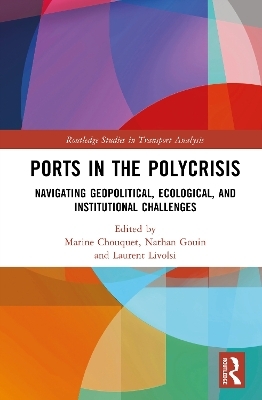
Ports in the Polycrisis
Routledge (Verlag)
978-1-041-06880-8 (ISBN)
- Noch nicht erschienen (ca. Mai 2026)
- Versandkostenfrei
- Auch auf Rechnung
- Artikel merken
This book examines how seaports, once emblematic drivers of globalization and growth, are being transformed by a convergence of geopolitical, environmental and societal crises. Rather than analysing each disruption separately, it adopts the lens of polycrisis, highlighting the interconnections between supply chain fragility, climate transition, shifting economic models, and social tensions.
Contributors from geography, law and management provide a multidisciplinary overview of port mutations, focusing on geopolitical reconfigurations, ecological constraints and institutional change. The book explores issues such as reshoring and national security, the decline of fossil-fuel-based port economies, conflicts over land use and infrastructure, climate resilience, and the redefinition of port–city relations. By offering an integrated understanding of current transitions, the book provides readers with analytical tools to grasp how crises reinforce each other and reshape ports’ functions, governance and spatial dynamics. It invites new ways of thinking about ports not only as infrastructures of exchange, but as strategic, political and ecological actors in a world of accelerating change.
The primary readership includes academics and researchers in transport geography, port studies, maritime economics, political geography, environmental policy and public law. It will also interest professionals in port authorities, logistics, maritime industries, and policymakers involved in transport, territorial planning and the green transition.
Marine Chouquet is an assistant professor of public law at Le Havre Normandy University, France. Nathan Gouin is a postdoctoral researcher in political and economic geography at Le Havre Normandy University, France. Laurent Livolsi is Professor in management sciences at Aix Marseille University, France.
Introduction: Rethinking Port Strategies in the Age of Polycrisis First section – Geopolitical and Strategic Transitions 1. Port Reorganization in the Baltic Sea: Logistical Growth and Geopolitical Contractions 2. Impact of geopolitical factors on Ukrainian seaports during the ongoing Russian-Ukrainian war 3. Chinese FDI in African Ports 4. New European Ports Strategies and Policies in the Globalisation Crisis 5. From the Japanese Perspective: A century of Ports Development 6. Looking Back at the Strategic Trajectory of Spanish Ports: Key Factors and Development Potential Second section – Ecological, Economic, and Social Transitions 7. City, port and Mediterranean cruises: conflicts and spatial restructuring in Venice, Marseille and Barcelona 8. Sustainable Reindustrialisation and the Future of Ports 9. The City-Port Relationship and Digitalisation: Towards Enhanced Competitiveness as Part of the Morocco Digital 2030 Strategy 10. The Changing Role of the Port of Laem Chabang, Thailand, in the Automotive Supply Chain Third section –Transitions of Institutions and Governance 11. The trajectory of French decentralized ports towards corporatization 12. The Law of Major Seaports Facing the Ecological Emergency. Janus or Jupiter? 13. The Privatisation of French Ports: an Unfinished Process? 14. Support for Port Transitions by Local Authorities 15. Cambodia’s Seaports in the Context of International Competitiveness
| Erscheint lt. Verlag | 25.5.2026 |
|---|---|
| Reihe/Serie | Routledge Studies in Transport Analysis |
| Zusatzinfo | 16 Tables, black and white; 32 Line drawings, black and white; 1 Halftones, black and white; 33 Illustrations, black and white |
| Verlagsort | London |
| Sprache | englisch |
| Maße | 156 x 234 mm |
| Themenwelt | Naturwissenschaften ► Geowissenschaften ► Geografie / Kartografie |
| Technik | |
| ISBN-10 | 1-041-06880-8 / 1041068808 |
| ISBN-13 | 978-1-041-06880-8 / 9781041068808 |
| Zustand | Neuware |
| Informationen gemäß Produktsicherheitsverordnung (GPSR) | |
| Haben Sie eine Frage zum Produkt? |
aus dem Bereich