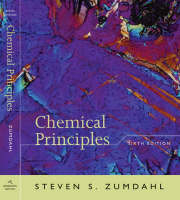
Chemical Principles
Brooks/Cole (Verlag)
978-0-618-94690-7 (ISBN)
- Titel erscheint in neuer Auflage
- Artikel merken
Steve Zumdahl is the author of market-leading textbooks in introductory chemistry, general chemistry, honors-level chemistry, and high school chemistry. Recently retired from his long-time position as Director of Undergraduate Programs at the University of Illinois, he has received numerous awards for his contributions to chemical education. These include the National Catalyst Award in recognition of his contribution to chemical education, the University of Illinois Teaching Award, the UIUC Liberal Arts and Sciences Advising Award, and the School of Chemical Sciences Teaching Award (five times). He earned his B.S. in Chemistry from Wheaton College (IL), and his Ph.D. from the University of Illinois.
Note: Each chapter concludes with Exercises.
1. Chemists and Chemistry
1.1 Thinking Like a Chemist
1.2 A Real-World Chemistry Problem
1.3 The Scientific Method
1.4 Industrial Chemistry
1.5 Polyvinyl Chloride (PVC): Real-World Chemistry
2. Atoms, Molecules, and Ions
2.1 The Early History of Chemistry
2.2 Fundamental Chemical Laws
2.3 Dalton's Atomic Theory
2.4 Cannizzaro's Interpretation
2.5 Early Experiments to Characterize the Atom
2.6 The Modern View of Atomic Structure: An Introduction
2.7 Molecules and Ions
2.8 An Introduction to the Periodic Table
2.9 Naming Simple Compounds
3. Stoichiometry
3.1 Atomic Masses
3.2 The Mole
3.3 Molar Mass
3.4 Percent Composition of Compounds
3.5 Determining the Formula of a Compound
3.6 Chemical Equations
3.7 Balancing Chemical Equations
3.8 Stoichiometric Calculations: Amounts of Reactants and Products
3.9 Calculations Involving a Limiting Reactant
4. Types of Chemical Reactions and Solution Stoichiometry
4.1 Water, the Common Solvent
4.2 The Nature of Aqueous Solutions: Strong and Weak Electrolytes
4.3 The Composition of Solutions
4.4 Types of Chemical Reactions
4.5 Precipitation Reactions
4.6 Describing Reactions in Solution
4.7 Selective Precipitation
4.8 Stoichiometry of Precipitation Reactions
4.9 Acid-Base Reactions
4.10 Oxidation-Reduction Reactions
4.11 Balancing Oxidation-Reduction Equations
4.12 Simple Oxidation-Reduction Titrations
5. Gases
5.1 Early Experiments
5.2 The Gas Laws of Boyle, Charles, and Avogadro
5.3 The Ideal Gas Law
5.4 Gas Stoichiometry
5.5 Dalton's Law of Partial Pressures
5.6 The Kinetic Molecular Theory of Gases
5.7 Effusion and Diffusion
5.8 Collisions of Gas Particles with the Container Walls
5.9 Intermolecular Collisions
5.10 Real Gases
5.11 Characteristics of Several Real Gases
5.12 Chemistry in the Atmosphere
6. Chemical Equilibrium
6.1 The Equilibrium Condition
6.2 The Equilibrium Constant
6.3 Equilibrium Expressions Involving Pressures
6.4 The Concept of Activity
6.5 Heterogeneous Equilibria
6.6 Applications of the Equilibrium Constant
6.7 Solving Equilibrium Problems
6.8 Le Châtelier's Principle
6.9 Equilibria Involving Real Gases
7. Acids and Bases
7.1 The Nature of Acids and Bases
7.2 Acid Strength
7.3 The pH Scale
7.4 Calculating the pH of Strong Acid Solutions
7.5 Calculating the pH of Weak Acid Solutions
7.6 Bases
7.7 Polyprotic Acids
7.8 Acid-Base Properties of Salts
7.9 Acid Solutions in Which Water Contributes to the H+ Concentration
7.10 Strong Acid Solutions in Which Water Contributes to the H+ Concentration
7.11 Strategy for Solving Acid-Base Problems: A Summary
8. Applications of Aqueous Equilibria
8.1 Solutions of Acids or Bases Containing a Common Ion
8.2 Buffered Solutions
8.3 Exact Treatment of Buffered Solutions
8.4 Buffer Capacity
8.5 Titrations and pH Curves
8.6 Acid-Base Indicators
8.7 Titration of Polyprotic Acids
8.8 Solubility Equilibria and the Solubility Product
8.9 Precipitation and Qualitative Analysis
8.10 Complex Ion Equilibria
9. Energy, Enthalpy, and Thermochemistry
9.1 The Nature of Energy
9.2 Enthalpy
9.3 Thermodynamics of Ideal Gases
9.4 Calorimetry
9.5 Hess's Law
9.6 Standard Enthalpies of Formation
9.7 Present Sources of Energy
9.8 New Energy Sources
10. Spontaneity, Entropy, and Free Energy
10.1 Spontaneous Processes and Entropy
10.2 The Isothermal Expansion and Compression of an Ideal Gas
10.3 The Definition of Entropy
10.4 Entropy and Physical Changes
10.5 Entropy and the Second Law of Thermodynamics
10.6 The Effect of Temperature on Spontaneity
10.7 Free Energy
10.8 Entropy Changes in Chemical Reactions
10.9 Free Energy and Chemical Reactions
10.10 The Dependence of Free Energy on Pressure
10.11 Free Energy and Equilibrium
10.12 Free Energy and Work
10.13 Reversible and Irreversible Processes: A Summary
10.14 Adiabatic Processes
11. Electrochemistry
11.1 Galvanic Cells
11.2 Standard Reduction Potentials
11.3 Cell Potential, Electrical Work, and Free Energy
11.4 Dependence of the Cell Potential on Concentration
1
| Verlagsort | CA |
|---|---|
| Sprache | englisch |
| Maße | 205 x 43 mm |
| Gewicht | 2177 g |
| Themenwelt | Naturwissenschaften ► Chemie |
| ISBN-10 | 0-618-94690-X / 061894690X |
| ISBN-13 | 978-0-618-94690-7 / 9780618946907 |
| Zustand | Neuware |
| Informationen gemäß Produktsicherheitsverordnung (GPSR) | |
| Haben Sie eine Frage zum Produkt? |
aus dem Bereich