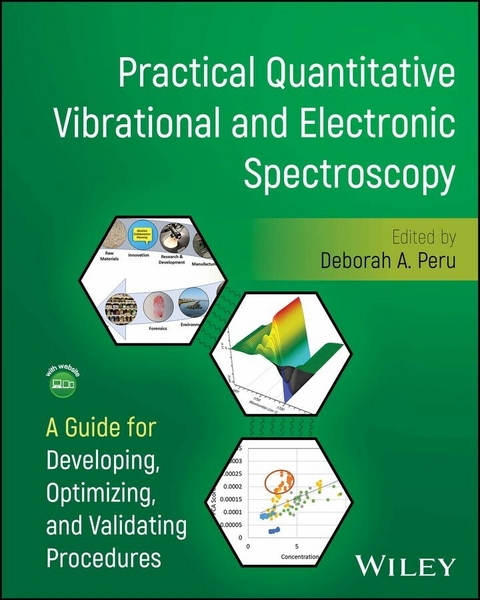
Practical Quantitative Vibrational and Electronic Spectroscopy (eBook)
872 Seiten
Wiley (Verlag)
978-1-394-22724-2 (ISBN)
An expert collection of case studies, real-world examples, and up-to-date info about quantitative spectroscopic methods
In Practical Quantitative Vibrational and Electronic Spectroscopy: A Guide For Developing, Optimizing, and Validating Procedures, experienced spectroscopist Deborah Peru and an expert team of contributors deliver an up-to-date discussion of the development of the quantitative spectroscopic methods used for measuring samples in the ultraviolet, visible, near IR, and mid IR regions of the spectrum.
The book presents and reviews statistical considerations, method development, and standard quantitative techniques involving regression and other approaches. This coverage explores many of the techniques used in industry and academia for extracting quantitative information from spectra. You'll discover how to develop and implement spectroscopic methods for analysis in products using commercial instruments and software.
Readers will also find:
- A thorough introduction to real-world issues in spectroscopy, including expeditious development timelines and procedure lifecycle management
- Comprehensive explorations of the fundamentals of quantitative spectroscopy
- Practical discussions of quantitative applications and statistical analysis of spectral data
- Select examples of the real-world implementation of spectroscopic technologies
Perfect for scientists, process engineers, and managers supervising the development and use of spectroscopic instruments, Practical Quantitative Vibrational and Electronic Spectroscopy will also benefit students interested in this rapidly developing collection of technologies.
Deborah A. Peru is the owner and President of DP Spectroscopy and Training LLC. She has over 40 years' experience in industrial research and development, and process analytical technology in the petrochemical, specialty chemical, consumer products, and pharmaceutical industries.
1
An Introduction to Quantitative Spectroscopy
Deborah A. Peru
DP Spectroscopy and Training LLC, Lebanon, NJ, USA
1.1 Introduction
The fundamental purpose of quantitative spectroscopy is to determine the concentration of an analyte, molecule, ingredient, or property of interest in an unknown sample using the spectral signals obtained when samples interact with light. A method can be developed using the entire spectrum, one or more specific regions, or with one or several wavelengths or frequencies. Many spectroscopic methods that determine concentration utilize light energy to measure absorbance, reflectance, excitation, or emission of specific molecules in all forms of matter (solid, liquid, and gas). In this book, we will limit our discussions to liquid and solid forms of matter, although the principles and techniques apply to the measurement of gas-phase molecules.
Applications using mid-infrared and other spectroscopy techniques have seen a rapid increase since the computer revolution began in the early 1980s. With the advent of more affordable computers and improved computational speeds, real-time processing of the data collected became a reality [1]. This led to applying chemometric algorithms to extract more useful information from the spectral fingerprint. The potential for using these techniques is no longer limited to the chemical, petrochemical, agricultural, and pharmaceutical industries [2], but found everywhere. In the last decade, quantitative applications have been applied more broadly in many diverse areas, including nutraceuticals, biomedical, environmental, forensics, biologicals, and clinical for testing and quality analysis.
As depicted in Figure 1.1, applications of spectroscopy are being applied in all stages of the manufacturing supply chain from early research through quality control testing and for problem solving. During the early stages of development and innovation, quantitative procedures can provide insight to enhance the chemical understanding and quality of a product and process for improved performance. For example, when raw materials arrive at a manufacturing plant, quantitative analysis provides a safeguard against contaminants entering the plant and for checking purity levels.
During research and development and scale-up, methods can be applied to optimize new products or processes in the laboratory and pilot plant. In manufacturing, quantitative methods provide information for making critical business decisions, quality assurance, and quality control. Spectroscopy is routinely used in forensic investigations and to solve performance problems even after the products and materials reach the consumer. Often, these problems are solved using a variety of instrumental analysis techniques in combination with spectroscopy, which typically begins the investigation because of the ability to measure samples “as is.”
Figure 1.1 Stages in product lifecycle when spectroscopy procedures can be used.
Source: Deborah A. Peru.
What is driving the use of spectroscopy in industry? Companies invest time and resources in developing spectroscopic-based applications because this approach often requires little or no sample preparation. Analysis time is quick, and results are available within minutes. With proper knowledge, experience, and training in method development, quantitative methods can be designed to be as reliable and sometimes more reliable than compendial methods because errors introduced from sample preparation, solvent interactions, and analyst errors are often reduced.
In addition, spectroscopy eliminates the analyte recovery problem associated with extraction methods. These methods can be classified as green technology [3]. It reduces the need for harsh solvents and thus is safer for operators. It also reduces disposal costs, solvent waste, and contamination of the environment [4]. With all these benefits, why are not all analytical procedures developed using spectroscopy techniques? Well, the short answer is the fact that many molecules absorb or emit light at similar frequencies, and thus, developing methods that are highly specific for the molecular or ingredient of interest requires a good understanding of the mathematical tools available to extract that specific information desired, particularly when measuring complex samples and formulations containing many components. Additionally, compendial and primary methods are essential in developing spectroscopy methods. The concentrations assigned to calibration standards are often obtained using primary methods such as high-performance liquid chromatography (HPLC), gas chromatography, Karl Fischer moisture determination, and various wet chemical methods. These methods must be accurate, reliable, and validated before spectroscopy methods can be implemented with full confidence that the information is reliable. Yet, as you will see in this book, there are other ways of using spectral information for quantitative analysis that may not always involve using a primary method or developing a calibration regression model.
The first principle in quantitative spectroscopy began in 1729 when Pierre Bouguer found that the intensity transmitted by light through a solution diminishes logarithmically as the depth of the solution or pathlength increased [5]. Unfortunately, this work was not discovered until much later in history, and his name is often not mentioned. In 1760, Johann Heinrich Lambert created a mathematical expression Eq. (1.1) related to this finding, known as the Lambert law [6].
where
- ε – intrinsic ability of the solution (or molecule) to absorb light at a particular frequency or wavelength
- l – pathlength of the light through the solution
- I – intensity after passing through a finite thickness of matter
- Io – intensity of incident radiation.
In 1852, the German scientist August Beer conducted an experiment to determine the absorption of red light in colored liquids. Based on the measurement of transmitted light, he proposed a law relating transmittance to concentration [7]. Most quantitative spectroscopy techniques are based on these two laws. Molecules absorb energy from a light source at specific wavelengths. The transmission of light through a liquid exponentially declines as the sample pathlength thickens (at constant concentration) and as the concentration increases at constant pathlength (Figure 1.2).
Absorbance is related to the logarithmic ratio of the transmittance through a material and is linearly proportional to concentration at constant pathlength as shown in Figure 1.3.
The relationship in Eq. (1.2) is known as the Beer–Lambert law. The absorptivity constant (ε) is an intrinsic property of each molecule and defines the amount of light energy absorbed at each wavelength. Other names are used for ε, such as “molar absorption coefficient,” “absorbancy index,” and “attenuation coefficient” [8]. Strongly absorbing molecules will have a high absorptivity, and weak absorbers will have a much lower absorptivity constant.
If the instrument measures transmittance as a percentage, conversion to absorbance (Abs) is 2-log % T. Most instrumental software automatically converts the spectral data from T or % T into absorbance and vice versa. The only unit that changes is related to the Y axis of the spectrum. The wavelength or wavenumber positions remain the same. For quantitative applications, it is often more convenient to convert the spectral data into absorbance units because the relationship between absorbance and concentration is linear, whereas the relationship between transmittance and concentration is logarithmic and requires complex mathematical solutions to be developed. The Beer–Lambert law of absorption states that the amount of light absorbed by the molecule is directly proportional to concentration. This is fundamental for building a linear calibration model to predict the concentration of unknown samples.
Figure 1.2 Relationship between transmittance of light through matter as concentration increases at a constant pathlength.
Source: Deborah A. Peru.
Figure 1.3 Generalized relationship between absorbance of light and concentration.
Source: Deborah A. Peru.
The principle that electromagnetic energy is absorbed by molecules at specific frequencies forms the basis for ultraviolet, visible, near-infrared, and mid-infrared spectroscopy. The absorbed energy from the light source can cause the molecule to undergo an electronic, vibrational, rotational, and/or translational transition. When measured with appropriate instrumentation, these molecular transitions yield a unique spectral fingerprint providing molecular structure and concentration information.
The ultraviolet and visible frequencies are located on the blue end of the electromagnetic spectrum as shown in Figure 1.4. Light absorption in this region generally excites electronic transitions within the molecule. Light radiation in this region is characterized as having a higher frequency, higher energy, and shorter wavelengths. The mid-infrared and Raman vibrational frequencies are located on the red end of the electromagnetic spectrum. This...
| Erscheint lt. Verlag | 19.11.2025 |
|---|---|
| Sprache | englisch |
| Themenwelt | Naturwissenschaften ► Chemie ► Analytische Chemie |
| Schlagworte | Fluorescence spectroscopy • Quantitative spectroscopy • Raman spectroscopy • spectral preprocessing • spectroscopic validation • spectroscopy applications • spectroscopy book • spectroscopy method development • Ultraviolet-Visible Spectroscopy • vibrational spectroscopy |
| ISBN-10 | 1-394-22724-8 / 1394227248 |
| ISBN-13 | 978-1-394-22724-2 / 9781394227242 |
| Informationen gemäß Produktsicherheitsverordnung (GPSR) | |
| Haben Sie eine Frage zum Produkt? |
 EPUB (Adobe DRM)
Kopierschutz: Adobe-DRM
Adobe-DRM ist ein Kopierschutz, der das eBook vor Mißbrauch schützen soll. Dabei wird das eBook bereits beim Download auf Ihre persönliche Adobe-ID autorisiert. Lesen können Sie das eBook dann nur auf den Geräten, welche ebenfalls auf Ihre Adobe-ID registriert sind.
Details zum Adobe-DRM
Dateiformat: EPUB (Electronic Publication)
EPUB ist ein offener Standard für eBooks und eignet sich besonders zur Darstellung von Belletristik und Sachbüchern. Der Fließtext wird dynamisch an die Display- und Schriftgröße angepasst. Auch für mobile Lesegeräte ist EPUB daher gut geeignet.
Systemvoraussetzungen:
PC/Mac: Mit einem PC oder Mac können Sie dieses eBook lesen. Sie benötigen eine
eReader: Dieses eBook kann mit (fast) allen eBook-Readern gelesen werden. Mit dem amazon-Kindle ist es aber nicht kompatibel.
Smartphone/Tablet: Egal ob Apple oder Android, dieses eBook können Sie lesen. Sie benötigen eine
Geräteliste und zusätzliche Hinweise
Buying eBooks from abroad
For tax law reasons we can sell eBooks just within Germany and Switzerland. Regrettably we cannot fulfill eBook-orders from other countries.
aus dem Bereich