Climate-Resilient Structures and Infrastructures
CRC Press (Verlag)
978-1-032-93601-7 (ISBN)
- Noch nicht erschienen (ca. Juli 2026)
- Versandkostenfrei
- Auch auf Rechnung
- Artikel merken
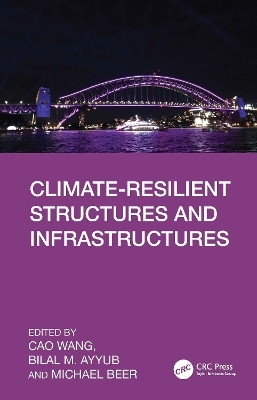
The safety and serviceability of in-service structures and infrastructure systems are often threatened by natural hazards. Owners and decision makers are especially concerned about the resilience of an asset (structure or infrastructure), namely its ability to be in readiness for, to absorb, recover from, and adapt to disruptive events. Climate change is increasingly producing nonstationary natural hazards such as wind hazards, and concurrent multiple hazards may result in especially severe performance reduction. This book focuses on hazard modelling and resilience methods, and their application in engineering cases. It presents the state of the art of the theory, methodology, and applications related to infrastructure resilience, and offers practical approaches to enhancing resilience for engineers, policy makers, and researchers.
Cao Wang is a Lecturer & ARC DECRA Fellow at University of Technology Sydney, Australia. He is a member of the Committee on Probability and Statistics in the Physical Sciences (C(PS)2), Bernoulli Society for Mathematical Statistics and Probability. Bilal Ayyub is Professor and Director of the Center for Technology and Systems Management at the University of Maryland, USA. He is a distinguished member of ASCE and honorary member of ASME, and co-chair of the ASCE-NOAA Task Force of Climate Resilience in Engineering Practice, and has chaired the ASCE Committee on Adaptation to a Changing Climate. Michael Beer is Professor and Head of the Institute for Risk and Reliability, Leibniz Universität Hannover, Germany. He is also part time Professor at the University of Liverpool and guest Professor at Tongji University and Tsinghua University, China. He is the Chairman of the European Safety and Reliability Association (ESRA) and serves on the Executive Board of the International Safety and Reliability Association (IASSAR), on the Executive Board of the European Association of Structural Dynamics (EASD), and on the Board of Directors of the International Association for Probabilistic Safety Assessment and Management (IAPSAM). He is a Fellow of the Alexander von Humboldt-Foundation.
Chapter 1 Introduction
Chapter 2 Sustainable Climate Resilience for Critical Energy Infrastructure in Developing Countries: Needs and Challenges
Chapter 3 Climate-resilient structures and infrastructures: hazards, methods, and applications
Chapter 4 Navigating new waters: ensuring cyber and climate resilience in industrial water systems
Chapter 5 Unpacking The ‘BLACK Box’ of Enabling Infrastructure Resilience to Climate Change: Time to Address the ‘Soft’ Elements of Organisations for Ensuring Better Decisions
Chapter 6 Adapting Infrastructure to a Changing Climate with Extreme Event Attribution Assessments
Chapter 7 Hazard and Risk Assessment in Nonstationary Environments for Engineering Applications
Chapter 8 Climate Impact Analytics for the US Freight Rail Network: Extreme Temperatures as a Case Study
Chapter 9 Disaster Recovery Modeling for Residential Buildings and Its Policy Implications
Chapter 10 Fragility Assessment of Building Portfolios under Natural Hazards Using Machine Learning and Poisson Binomial Distribution
Chapter 11 Predictive modelling of hail impact damage on toughened glazing panels
Chapter 12 Performance modelling of aluminium building cladding under hail hazards
Chapter 13 The Impact of Climate Change on Maritime Transport and Port Infrastructure Resilience
Chapter 14 Machine Learning-Driven Resilience Assessment: Integrating Dynamic Bayesian Networks and Machine Learning for Predicting Critical Infrastructure Resilience Against Disasters
Chapter 15 Optimizing Hurricane Evacuation Decisions Under Climate Change
Chapter 16 Adoption of Green Building Strategies: A Case of Enhancing Infrastructure and Superstructure Resilience in Zimbabwe
| Erscheint lt. Verlag | 1.7.2026 |
|---|---|
| Zusatzinfo | 59 Tables, black and white; 88 Line drawings, color; 43 Line drawings, black and white; 18 Halftones, color; 106 Illustrations, color; 43 Illustrations, black and white |
| Verlagsort | London |
| Sprache | englisch |
| Maße | 156 x 234 mm |
| Themenwelt | Naturwissenschaften ► Biologie ► Ökologie / Naturschutz |
| Technik ► Bauwesen | |
| ISBN-10 | 1-032-93601-0 / 1032936010 |
| ISBN-13 | 978-1-032-93601-7 / 9781032936017 |
| Zustand | Neuware |
| Informationen gemäß Produktsicherheitsverordnung (GPSR) | |
| Haben Sie eine Frage zum Produkt? |
aus dem Bereich