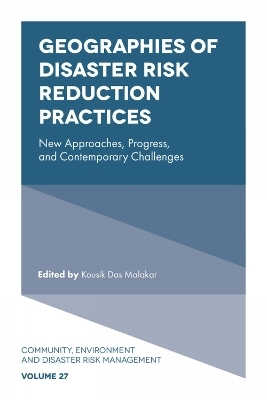
Geographies of Disaster Risk Reduction Practices
Emerald Publishing Limited (Verlag)
978-1-83662-011-2 (ISBN)
- Noch nicht erschienen (ca. Mai 2026)
- Versandkostenfrei
- Auch auf Rechnung
- Artikel merken
In the intricate web of socio-environmental crises across diverse geographical landscapes, grasping the intricacies of geographies and socio-spatial ecologies in disaster risk reduction practices is indispensable for global socio-ecological sustainability. In response to this imperative, this volume pioneers the development of disaster risk reduction understanding within the disaster research domain.
This authored volume is structured into two parts. The initial part extensively explores the fundamentals of geographies in disaster risk reduction practices, encompassing concepts, methodologies, and challenges in disaster management, disaster preparedness, response, relief operations, resource allocation, disaster medicine, information dissemination, recovery, rehabilitation, and reconstruction. It also delves into various applications and emerging trends, management techniques, applied practices through contemporary case studies, socio-ecological challenges in disaster risk reduction, and sustainability considerations in management practices.
The latter part focuses on real-world case studies within geographies and socio-spatial ecologies to examine scenarios of disaster risks, management practices, and community challenges specific to coastal regions. These case studies encompass topics such as mangrove vegetation health risks and stress, climate change adaptation strategies at the local level, shoreline change and vulnerability assessments, geographies of coastal hazards, societal vulnerability during the COVID-19 pandemic, as well as analyses of natural hazards and disaster risks, among others. This work enriches the scientific and practical understanding of mitigating disaster risks, and advocating for stakeholder integration in disaster policy planning among planners, scientists, researchers, professionals, government officials, students, and anyone else engaged in disaster research globally.
Kousik Das Malakar is a socio-ecological geographer, GIS analyst, and researcher specializing in climate change and policy. He is currently an Assistant Professor in the Department of Geography at GDC Memorial College, India. Dr. Malakar earned his Ph.D. from the Central University of Haryana, India. He holds a master’s degree in social science geography from Jawaharlal Nehru University (JNU), New Delhi, and a bachelor’s degree in the same discipline from Vidyasagar University, Medinipur. His research interests include the climate crisis, socio-ecological systems, coastal environments, sustainability, disaster studies, participatory policy planning, and geospatial technologies.
Foreword; S. K. Sinha
Part I. Geographies of Disaster Risk Reduction Practices: Fundamentals
Chapter 1. Introduction to Geographies of Disaster Management
Chapter 2. Approaches and Progress of Disaster Preparedness
Chapter 3. Disaster Response, Relief Operations, Resource Management, and Society
Chapter 4. Disaster Medicine: Approaches and Practices
Chapter 5. Reporting Information, Disaster Recovery, Rehabilitation, and Reconstruction in Disaster Risk Management
Chapter 6. Geospatial Technologies in Disaster Risk Reduction: Applications and Emerging Trends
Chapter 7. Contemporary Cases of Hazard/Disaster: Causes, Management Methods, and Applied Practices
Chapter 8. Socio-ecological Challenges in Disaster Risk Reduction Practices: Towards Sustainable Solutions
Part II. Geographies of Disaster Risk Reduction Practices: Real-World Case Studies in the Context of Coastal Geographies and Socio-Spatial Ecologies
Chapter 9. Modelling and Monitoring of Mangrove Vegetation Health Risks and Stress using LANDSAT Satellite Data
Chapter 10. Examining Climate Change/Variability and Local Adaptation Strategy in the Traditional Marine Fishing Community of Coastal Bengal, India
Chapter 11. Reviewing Modelling Approaches for Climate Crisis Adaptation: A Comprehensive Analysis of Multi-Risk Assessment in Coastal Regions
Chapter 12. Monitoring and Modelling of Coastal Shoreline Change and Vulnerability Using Geospatial Technologies: The Case of Coastal 24 Parganas, India
Chapter 13. Role and Mandate of the NDRF in Coastal Disaster Risk Reduction in India: An Analytical Assessment
Chapter 14. The COVID-19 Pandemic, Societal Vulnerability, and Management Practices of Traditional Marine Fishermen: A Village-level Correlates of Coastal Bengal, India
Chapter 15. Researching Natural Hazards and Disaster Risk: Addressing Scientific Challenges
| Erscheint lt. Verlag | 18.5.2026 |
|---|---|
| Reihe/Serie | Community, Environment and Disaster Risk Management |
| Verlagsort | Bingley |
| Sprache | englisch |
| Maße | 152 x 229 mm |
| Themenwelt | Naturwissenschaften ► Biologie ► Ökologie / Naturschutz |
| ISBN-10 | 1-83662-011-X / 183662011X |
| ISBN-13 | 978-1-83662-011-2 / 9781836620112 |
| Zustand | Neuware |
| Informationen gemäß Produktsicherheitsverordnung (GPSR) | |
| Haben Sie eine Frage zum Produkt? |
aus dem Bereich