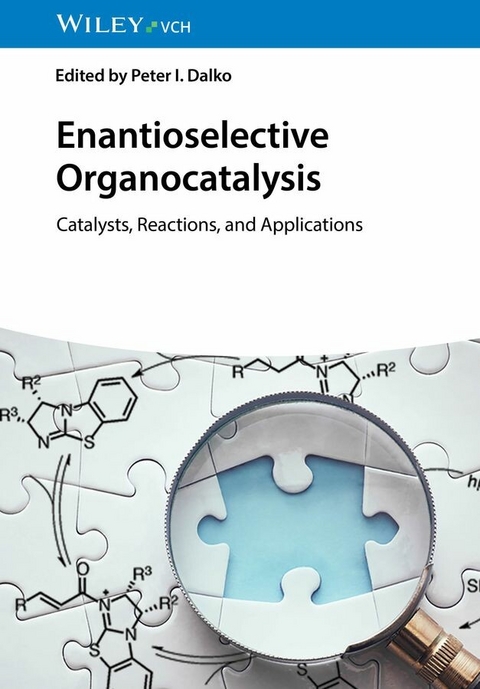
Enantioselective Organocatalysis (eBook)
3137 Seiten
Wiley-VCH (Verlag)
978-3-527-84554-5 (ISBN)
Updated reference on the field of organocatalysis explaining the many advances made in the past 10 years
Enantioselective Organocatalysis III presents easily accessible, summarized information on organocatalysis, from computational aspects to non-conventional strategies, with complete coverage of the main advances in the field in the past 10 years. The book is the continuation of Comprehensive Enantioselective Organocatalysis, retaining the main features of its predecessor but with a larger number of concise chapters. Experimental procedures are not presented in this edition as most of them are similar to those already discussed in the previous edition.
Edited by a highly qualified researcher and contributed to by experts in the field, Enantioselective Organocatalysis III includes information on:
- Aminocatalysis-3 selected examples of aminocatalytic direct alpha-heteroatom functionalization and direct alpha-alkylation
- Organocatalytic dynamic kinetic resolution and organocatalysis in carbohydrate synthesis and polymer science
- Light-controlled organocatalysis by bifunctional single-catalyst systems and dual photo/organocatalytic strategies in asymmetric synthesis
- Strategies towards asymmetric organocatalysis at parts-per-million loadings and emerging organocatalyst classes from renewable sources
- Activation modes in asymmetric anion-binding catalysis and transformations with chiral phase-transfer catalysts
Appealing to a broad readership, Enantioselective Organocatalysis III is an essential reference for chemists and other researchers seeking to stay on top this rapidly developing field.
Peter I. Dalko completed his graduate studies at the Technical University of Budapest (BME) and earned his PhD at Paris XI, France. He currently works at the Paris Cité University, France, (CNRS). His group focuses on the development of enantiocatalytic reactions for organic synthesis, the design and application of light-sensitive molecular probes allowing accurate four-dimensional control of biological events in complex tissues, and on the preparation of remotely controllable drug delivery systems with imaging ability.
1
Privileged Catalyst Structures in Organocatalytic Reactions
Xiao Xiao1, Xinyi Ren1, Baoguo Zhao1,2, and Kuiling Ding2
1The Education Ministry Key Lab of Resource Chemistry, the Shanghai Key Laboratory of Rare Earth Functional Materials, and the Shanghai Frontiers Science Center of Biomimetic Catalysis, No. 100 Guilin Rd., Shanghai Normal University, Shanghai 200234, China
2The State Key Laboratory of Synergistic Chem‐Bio Synthesis and the School of Chemistry and Chemical Engineering, Shanghai Jiao Tong University, No. 800 Dongchuan Rd., Shanghai, 200240, China
1.1 Introduction
Enantioselective organocatalysis employs chiral small organic molecules as catalysts to drive asymmetric reactions [1]. This approach has recently evolved into a versatile platform for the synthesis of a wide array of chiral molecules [2]. To a certain degree, organocatalysis inherits several advantageous features from enzymatic catalysis, notably high stereocontrol and mild reaction conditions [3]. Furthermore, it showcases the benefits of chemical catalysts, such as easy modification, high stability, and low molecular weight. The catalysts are the key to enantioselective organocatalysis, and their structures exhibit a rich diversity. They can range from the simplicity of molecules like proline to the intricate designs of synthetic polypeptides. The elegance of organocatalysts lies in their versatility and adaptability. They can be designed to incorporate multiple functional groups, enabling them to engage in various interactions with substrates. This flexibility allows for the precise adjustment of catalytic processes, facilitating high reactivity and selectivity under mild conditions. While multiple interactions can be introduced, the catalytic process is primarily governed by the structure and reactivity of the core catalytic group within the organocatalyst. Organocatalysis can be categorized into several types based on the interactions between catalysts and substrates (Scheme 1.1) [1]. Enamine catalysis [4], iminium catalysis [5], and singly occupied molecular orbital (SOMO) catalysis [6] are developed for asymmetric transformations of aldehydes, ketones, and their α,β‐unsaturated derivatives using chiral amines as the catalysts, relying on imine/iminium intermediates formed between primary/secondary amine catalysts and aldehydes/ketones (Scheme 1.1a) [7]. Carbonyl catalysis, reverse to the process of enamine catalysis, also involves imine intermediates, utilizing chiral aldehydes/ketones as catalysts to promote asymmetric α‐C—H transformations of primary amines (Scheme 1.1a) [8]. Brønsted acid–base interactions relate to Brønsted acid catalysis [9], hydrogen‐bonding catalysis [10], Brønsted base catalysis [11], and peptide catalysis [12], enabling asymmetric reactions of proton‐acceptor‐containing electrophiles and proton‐donor‐containing nucleophiles (Scheme 1.1b). Enantioselective organocatalysis involving Lewis acid–base interactions includes carbene catalysis [13], Lewis base catalysis [14], Lewis acid catalysis [15], and halogen/chalcogen catalysis (Scheme 1.1c) [16]. They activate substrates containing blank orbitals or electron pairs through Lewis acid–base interactions, facilitating a wide array of asymmetric transformations. Although carbene catalysis also falls under Lewis base catalysis, it is treated separately due to its unique and versatile catalytic power and the resulting numerous transformations. Chiral cation–anion catalysis involves phase‐transfer catalysis and counteranion catalysis (Scheme 1.1d). Phase‐transfer catalysis provides an efficient strategy to facilitate asymmetric heterogeneous reactions [17]. Chiral counteranion catalysis utilizes chiral anions to create a chiral environment that influences the enantioselectivity [18]. Asymmetric epoxidation employs chiral ketones as catalysts to convert oxidants such as oxone into active dioxirane species, which enantioselectively transfer the electrophilic oxygen onto olefins (Scheme 1.1e) [19].
Scheme 1.1 Representative organocatalytic modes.
Along with the development of organocatalysis, a diverse range of chiral organic small molecule catalysts with privileged structural frameworks have emerged, facilitating numerous significant catalytic reactions and demonstrating limitless applications in chiral synthesis. This chapter will briefly discuss these representative organocatalysts, their activation modes, and the reactions they enable.
1.2 Catalysts for Organocatalysis Based on Imine/Iminium Intermediates
1.2.1 Chiral Amine Catalysts
The essence of amine‐based asymmetric catalysis draws inspiration from biological enzymes, wherein the amino groups on the amino acid residues of enzymes serve as active sites for numerous biological reactions or as intramolecular bases for cooperative catalysis [3, 20]. Reports of amine catalysis can date back to the 1930s [21], but it was not until the year 2000s [22] that amine catalysis began to flourish [4, 5, 23]. Many privileged chiral amine catalysts have been developed. Proline (1) and its derivatives represent one of the most classic amine catalysts (Scheme 1.2a) [4, 22a, 24]. Despite a large number of substituted chiral prolines, the core structures involve prolinamide 2 [25], diarylprolinol/silicon‐protected diarylprolinol 3 [26], proline tetrazole 4 [27], proline thiourea 5 [28], and spiro‐pyrrolidine 6 [29]. The five‐membered secondary amines tend to form a relatively stable enamine or a highly activated iminium species with a carbonyl compound, assisted by an intramolecular carboxylic acid group or a hydrogen‐bonding donor moiety or by an additional Brønsted acid co‐catalyst. Acyclic amino acid‐based chiral amine catalysts chiefly involve imidazolidinones and amino acids (salts) (Scheme 1.2b). Chiral imidazolidine‐4‐ones 7 and 8, commonly referred to as Macmillan catalysts, can be readily prepared from phenylalanine. These catalysts possess the ability to catalyze the Diels–Alder cycloaddition reaction through an iminium activation mechanism [5, 22b, 30]. Phenyl glycine salt 9 [31] and threonine‐derived compound 10 [32] could be used directly as catalysts [33]. Chiral amines with diamine moieties such as morpholine derivative 11 [34], diaminocyclohexanes 12 [35], and aliphatic diamine 13 [3, 23b, 36] have been recognized as valuable amine catalysts for many asymmetric transformations (Scheme 1.2c). Cinchona alkaloid derivatives 14 [37] and 15 [38] are a type of highly effective primary amine catalysts (Scheme 1.2d). The biaryl amines16 [39], 17 [40, 41], and 18 [41] could demonstrate a distinctive catalytic proficiency due to the strategic placement of functional groups at the 2, 3, or 3,3′ positions on the biaryl framework (Scheme 1.2e).
Scheme 1.2 Representative chiral amine catalysts with privileged core structures.
Despite a wide array of chiral amine catalysts available, their principal activation mechanisms remain enamine and iminium catalysis [4, 5]. The structural diversity of these catalysts enables the creation of tailored chiral environments for specific reactions, which is essential for the production of significant enantioenriched compounds [4, 5, 23]. In the enamine activation mode (Scheme 1.3a), the principal reaction types include aldol reactions, Mannich reactions, Michael addition, and addition to other electrophiles [4, 5, 22a, 23]. On the other hand, in the iminium activation mode (Scheme 1.3b), reactions such as the Diels–Alder reaction, epoxidation, reduction, Friedel–Crafts reactions, conjugate addition, and nucleophilic addition to α,β‐unsaturated or simple carbonyl compounds are typically studied [4, 5, 22b, 23]. Cascade, one‐pot, and multicomponent reactions that proceed via the enamine or iminium activation mechanisms offer straightforward and efficient routes to synthesize chiral polycyclic and heterocyclic compounds [23c]. The selective one‐electron oxidation of the enamine intermediate results in a 3π‐electron SOMO‐activated intermediates (Scheme 1.3c). This intermediate is capable of facilitating diverse α‐functionalization reactions of carbonyl compounds [42].
Scheme 1.3 The enamine, iminium, and SOMO catalysis cycles.
1.2.2 Carbonyl Catalysts
With the continuous development in recent years, carbonyl catalysis [43] has become a powerful strategy to access chiral α‐substituted amines via catalytic enantioselective α‐functionalization of primary amines. As a reverse strategy of enamine catalysis, carbonyl catalysis employs an appropriate aldehyde or ketone to...
| Erscheint lt. Verlag | 13.11.2025 |
|---|---|
| Sprache | englisch |
| Themenwelt | Naturwissenschaften ► Chemie |
| Schlagworte | anion-binding catalysis • asymmetric organocatalysis at parts-per-million loadings • Light-controlled organocatalysis • organocatalysis carbohydrate synthesis • organocatalyst classes • Organocatalytic dynamic kinetic resolution |
| ISBN-10 | 3-527-84554-2 / 3527845542 |
| ISBN-13 | 978-3-527-84554-5 / 9783527845545 |
| Informationen gemäß Produktsicherheitsverordnung (GPSR) | |
| Haben Sie eine Frage zum Produkt? |
 EPUB (Adobe DRM)
Kopierschutz: Adobe-DRM
Adobe-DRM ist ein Kopierschutz, der das eBook vor Mißbrauch schützen soll. Dabei wird das eBook bereits beim Download auf Ihre persönliche Adobe-ID autorisiert. Lesen können Sie das eBook dann nur auf den Geräten, welche ebenfalls auf Ihre Adobe-ID registriert sind.
Details zum Adobe-DRM
Dateiformat: EPUB (Electronic Publication)
EPUB ist ein offener Standard für eBooks und eignet sich besonders zur Darstellung von Belletristik und Sachbüchern. Der Fließtext wird dynamisch an die Display- und Schriftgröße angepasst. Auch für mobile Lesegeräte ist EPUB daher gut geeignet.
Systemvoraussetzungen:
PC/Mac: Mit einem PC oder Mac können Sie dieses eBook lesen. Sie benötigen eine
eReader: Dieses eBook kann mit (fast) allen eBook-Readern gelesen werden. Mit dem amazon-Kindle ist es aber nicht kompatibel.
Smartphone/Tablet: Egal ob Apple oder Android, dieses eBook können Sie lesen. Sie benötigen eine
Geräteliste und zusätzliche Hinweise
Buying eBooks from abroad
For tax law reasons we can sell eBooks just within Germany and Switzerland. Regrettably we cannot fulfill eBook-orders from other countries.
aus dem Bereich