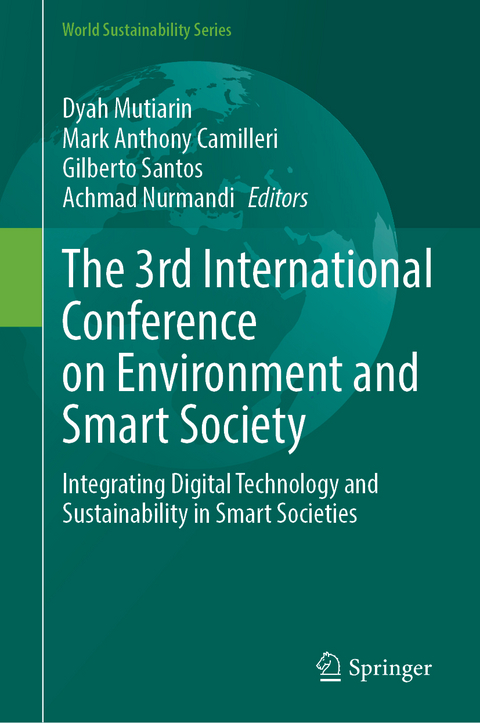
The 3rd International Conference on Environment and Smart Society
Springer International Publishing (Verlag)
978-3-032-14846-9 (ISBN)
- Noch nicht erschienen - erscheint am 07.03.2026
- Versandkostenfrei
- Auch auf Rechnung
- Artikel merken
Dyah Mutiarin is a Professor of Governmental Science and Vice Rector at Universitas Muhammadiyah Yogyakarta, specializing in public policy, governance reform, and digital innovation.
Mark Anthony Camilleri is Associate Professor at the University of Malta and globally recognized top 2% scientist, noted for research in business, sustainability, and education.
Gilberto Santos is Researcher at INEGI-LAETA, Editor-in-Chief of QIP, and founder of the ICQIS conference, with extensive contributions to quality, innovation, and sustainability research.
Achmad Nurmandi is a Professor of Government Science at UMY and former Rector, with research focused on public governance, urban systems, and digital government innovation.
Chapter 1. Advancing Global Sustainability through Innovation, Education, Community Em-powerment, and Green Governance.- Chapter 2. IoT Use Cases for Environmental Monitoring to Support Sustainability Development Goals.- Chapter 3. Mapping out Sustainable Agriculture Through the Lens of Artificial Intelligence: A Scientometric Analysis.- Chapter 4. Mathematical Analysis and Forecasting of Development of the Agro-Industrial Sector of the Regions.- Chapter 5. Assessment of Heavy Metal Contamination in Al-Sadeer Stream Water and Its Suitability for Various Uses.- Chapter 6. Challenges in Overcoming Environmental Pollution from Nickel Mining to Achieve Sustainable Development Goals 2030 in Southeast Sulawesi.- Chapter 7. Design of an Efficient Induction Converter for Supporting Household Energy Transition A Preliminary Study.- Chapter 8. Environmental Risk Analysis for Sustainable Dengue Prevention in Yogyakarta City.- chapter 9. Enhancing Digital Information Systems for Sustainable Institutional Performance: A Case Study of PDM Sleman.- Chapter 10. Smart Education: Utilizing Support Vector Machines for Final Project Topic Selection.- Chapter 11. Empowering Smart Sustainable Education Filipino Teachers Integration of QR Codes in Classrooms.- Chapter 12. From Chalkboard to ChatbotExploring Sustainable Pedagogical Practices in English Writing through ChatGPT and Traditional Approaches.- Chapter 13. Meaningful Learning and Smart Multimodality for Sustainable Digital Learning.- Chapter 14. Language for a Sustainable Future Curriculum Innovations in Vocational Higher Education.- Chapter 15. Integrating Digital Literacies for Environmental Awareness Outcome-Based English Curriculum Models.- Chapter 16. Transforming EFL Grammar Learning through Artificial Intelligence Tools, Trends, and Challenges in Promoting Environmental Awareness and Sustainability Education.- Chapter 17. Toward Sustainable and Effective Instruction Smart Grammar Teaching with WordWall.- Chapter 18. Sustainability in EFL Learning Extending the Benefits of Children s Storybooks for Adolescents Reading Motivation.- Chapter 19. Code-Switching and Code-Mixing in Sustainability Education Language Practices for Environmental Awareness in SDG-Oriented Workplaces.- Chapter 20. Integrating Eco-Themed Film Distribution into Smart City Education A Study of Sustainability Communication in Indonesia and Malaysia.- Chapter 21. Mapping Sustainable Smart Education A Bibliometric Study on Religious Coping and Adolescent Mental Health.- Chapter 22. Environment and Quranic Interpretation Building Ecological Awareness Towards Golden Indonesia 2045.- Chapter 23. Digital Frames for Environmental Advocacy An Analysis Of @Aksikitaindonesia Campaign Strategies in Building Public Awareness Through Sustainable Innovation on Instagram.- Chapter 24. Framing Environmental Injustice Tempo.co s Green Campaign on Nickel Mining in Morowali.- Chapter 25. Journalists Dilemma in Aligning Sustainable Innovation with Digital Work Security Frame of SindoNews and Detik.com.- Chapter 26. Sustainable Environmental Development Through Technology and Community Empowerment.- Chapter 27. The Mediating Role of Customer Demand in Fostering Green Innovation and Sustainable Small and Medium Enterprises.- Chapter 28. Go Green Movement Promoting Sustainable Consumer Behavior in Semarang s Small and Medium Enterprises.- Chapter 29. Understanding Green Audiences as Sustainable Brand Partnerships in the Cosmetics Industry.- Chapter 30. Green Digital Communication for Sustainability Ecotourism Branding of Maron Beach.- Chapter 31. Millennials Sustainable Lifestyle Role of Knowledge, Attitudes, and Digital Platforms.- Chapter 32. Toward Sustainable Sheep Farming in Yogyakarta Integrating Tradition and Innovation.- Chapter 33. Evaluating Sustainable Cultural Education through Instagram A Comparative Analysis of @mangkunegaran and @info.mn.- Chapter 34. Greening Instagram: Greenpeace
| Erscheint lt. Verlag | 7.3.2026 |
|---|---|
| Reihe/Serie | World Sustainability Series |
| Zusatzinfo | X, 190 p. 54 illus., 52 illus. in color. |
| Verlagsort | Cham |
| Sprache | englisch |
| Maße | 155 x 235 mm |
| Themenwelt | Naturwissenschaften ► Biologie ► Ökologie / Naturschutz |
| Naturwissenschaften ► Geowissenschaften | |
| Schlagworte | AI applications in smart urban planning • Big data for environmental monitoring • Climate action through digital transformation • Digital technology for climate resilience • Environment and smart society research • Green governance in Southeast Asia • Integrating technology and sustainability • Policy innovation for sustainable cities • Smart city strategies for sustainable development • Smart governance and e-government solutions • Smart solutions for resilient communities • Smart technologies for environmental protection • Sustainable city development in Indonesia • Sustainable innovation in public policy • Urban innovation in developing countries |
| ISBN-10 | 3-032-14846-4 / 3032148464 |
| ISBN-13 | 978-3-032-14846-9 / 9783032148469 |
| Zustand | Neuware |
| Informationen gemäß Produktsicherheitsverordnung (GPSR) | |
| Haben Sie eine Frage zum Produkt? |
aus dem Bereich