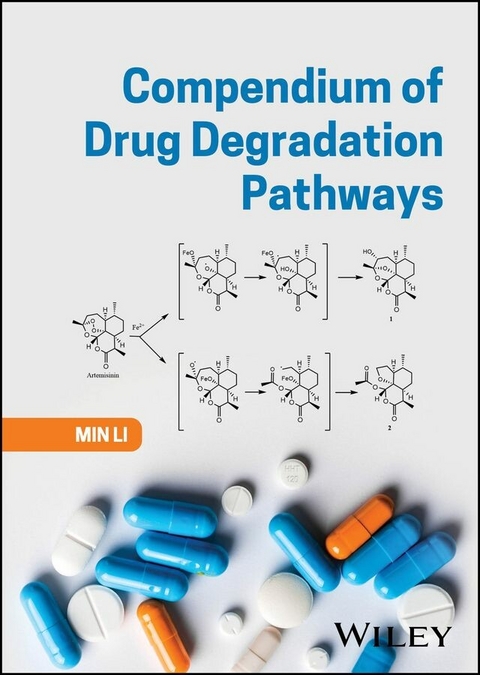
Compendium of Drug Degradation Pathways (eBook)
989 Seiten
Wiley (Verlag)
978-1-118-83310-0 (ISBN)
Provides accurate and current information on drug degradation pathways
Understanding the degradation chemistry of pharmaceuticals is essential for drug formulation, stability testing, and regulatory compliance. Compendium of Drug Degradation Pathways presents a detailed analysis of the degradation pathways of approximately 350 widely used prescription and over-the-counter drugs, making it an indispensable reference for formulation and analytical scientists.
Drug stability and impurity characterization play a critical role in pharmaceutical research and development, as degradation can impact efficacy, safety, and regulatory approval. Structured alphabetically, this compendium organizes degradation data into concise monographs, each summarizing a drug's chemical structure, degradation pathways, and stability considerations. By collating information from regulatory guidelines, scientific literature, and real-world drug formulations, Dr. Min Lin provides formulation chemists, regulatory scientists, and medicinal chemists with a clear understanding of degradation mechanisms under practical storage conditions.
- Provides guidance on real-world drug degradation under long-term stability conditions
- Summarizes critical stability data for formulation and analytical scientists working in drug development and manufacturing
- Offers valuable insights into drug metabolism and in vivo degradation linked to potential toxicities
- Uses a systematic and organized approach, grouping drugs by therapeutic categories and structural similarities
- Includes a dedicated introduction on regulatory perspectives, impurity characterization, and stress testing methodologies
With increasing regulatory scrutiny on drug quality and safety, Compendium of Drug Degradation Pathways is a critical reference for professionals in pharmaceutical sciences, intellectual property law, and regulatory agencies reviewing Chemistry, Manufacturing, and Controls (CMC) sections of NDAs and ANDAs.
Min Li is currently the Chief Scientist of Huahai Pharmaceutical, Co., Ltd. responsible for analytical research and development. He received his PhD in Organic Chemistry from The Johns Hopkins University in 1991. Following a postdoctoral research in medicinal chemistry, he has worked for several multinational pharmaceutical companies with increasing responsibilities, including Roche, Merck & Co., Inc., and Schering-Plough. Dr Li has led technical teams of senior-level scientists for various analytical and pharmaceutical manufacturing process investigations and troubleshooting, impurity research and qualification, study of drug degradation chemistry, analytical development, and support for new drug filing (NDA).
Provides accurate and current information on drug degradation pathways Understanding the degradation chemistry of pharmaceuticals is essential for drug formulation, stability testing, and regulatory compliance. Compendium of Drug Degradation Pathways presents a detailed analysis of the degradation pathways of approximately 350 widely used prescription and over-the-counter drugs, making it an indispensable reference for formulation and analytical scientists. Drug stability and impurity characterization play a critical role in pharmaceutical research and development, as degradation can impact efficacy, safety, and regulatory approval. Structured alphabetically, this compendium organizes degradation data into concise monographs, each summarizing a drug s chemical structure, degradation pathways, and stability considerations. By collating information from regulatory guidelines, scientific literature, and real-world drug formulations, Dr. Min Lin provides formulation chemists, regulatory scientists, and medicinal chemists with a clear understanding of degradation mechanisms under practical storage conditions. Provides guidance on real-world drug degradation under long-term stability conditionsSummarizes critical stability data for formulation and analytical scientists working in drug development and manufacturingOffers valuable insights into drug metabolism and in vivo degradation linked to potential toxicitiesUses a systematic and organized approach, grouping drugs by therapeutic categories and structural similaritiesIncludes a dedicated introduction on regulatory perspectives, impurity characterization, and stress testing methodologies With increasing regulatory scrutiny on drug quality and safety, Compendium of Drug Degradation Pathways is a critical reference for professionals in pharmaceutical sciences, intellectual property law, and regulatory agencies reviewing Chemistry, Manufacturing, and Controls (CMC) sections of NDAs and ANDAs.
Preface
My first book, Organic Chemistry of Drug Degradation, was published in September 2012, and it was intended to be a systematic summary of drug degradation chemistry based on the types of degradation pathways such as hydrolytic, oxidative, and photochemical degradation. Each type of drug degradation discussed in a particular chapter of that book is substantiated by examples of the specific degradation pathway(s) of a drug or drugs related to the subject of the chapter. Hence, for the drug molecules discussed in those examples, there are no summary or compilation of all of their known or reported degradation pathways. In other words, the degradation chemistry of a particular drug was not intended to be presented in its entirety in that book. Although Organic Chemistry of Drug Degradation can be used as a textbook for graduate students majoring in pharmaceutical sciences or anyone who is interested in a systematic study of drug degradation chemistry, it has occurred to me that in many occasions the practicing scientists, particularly those working in the pharmaceutical industry, would also like to have a convenient reference book in which the degradation chemistry of many commonly prescribed drugs can be readily found. Hence, for the past 10 years or so, it has been my goal to try to fulfill that need by summarizing the known or reported degradation pathways of representative small molecule drugs in another book, as such a book would be complementary to Organic Chemistry of Drug Degradation from a different perspective. Furthermore, such a book might also be supplementary to official pharmacopeias, where the degradation chemistry of drugs is usually not included, despite the fact that the supplementation would be quite limited.
During the course of pondering the contents of such a book, I decided to choose approximately 300+ representative small molecule drugs and then to summarize their degradation pathways in respective monographs that are organized in alphabetical order of the generic names of these drugs. The selection of these representative drugs in the book was based upon the following several factors: the numbers of their prescription, sales status, and inclusion in WHO List of Essential Medicines (the ones that “satisfy the priority health care needs of the population” per World Health Organization’s definition). Many drugs in the same therapeutic categories share the same or similar core structures and functional groups and thus would have the same or similar degradation pathways. For this reason, these drugs are typically covered in the same respective monographs, with the best known or most widely used drugs as the main entries of the monographs. Such examples include, but not limited to, the monograph for benzodiazepines, the monograph for omeprazole and related azoles, the monograph for opioids, and the monograph for penicillins.
Preceding the monographs, the main body of the current book Compendium of Drug Degradation Pathways, a general chapter entitled “Introduction” is included, in which a brief overview of the regulatory perspective on drug stability and impurities, as well as an overview of drug degradation chemistry is provided. In addition, the role and limitation of stress testing, often referred to as forced degradation study as well, is also discussed. In the ensuing monographs, each one is started with the structure(s) of the drug molecule(s), and compilation of their key information, including chemical names, brand names, formulas, protonated monoisotopic mass‐over‐charge ratios, average molecular weights, and CAS numbers, as applicable. The above information is mostly derived from the following publicly accessible resources: Pubchem (pubchem.ncbi.nlm.nih.gov), Wikipedia (wikipedia.org), Drugbank online (go.drugbank.com), BMRB (Biological Magnetic Resonance Data Bank, https://bmrb.io/metabolomics/mol_mass.php), and Chemspider (chemspider.com). In the main body of each monograph, the known or reported degradation chemistry of a drug or drugs is summarized in text, which is followed by schematic presentation of the drug degradation pathway(s). Quite often, the reported degradation chemistry of a drug was based upon stress or forced degradation studies of the drug. As it is discussed in Introduction of this book, the degradation chemistry predicted from the forced degradation studies may not necessarily represent the one under real‐life scenario, i.e., the degradation chemistry observed under the long‐term storage conditions as represented by the stability conditions recommended by the International Council on Harmonisation of Technical Requirements for Registration of Pharmaceuticals for Human Use (ICH) and the World Health Organization (WHO). The quality for the prediction of real‐life degradation chemistry relies upon a clear understanding of the principles of drug degradation chemistry, so that the forced degradation study would be conducted under the conditions that are relevant to the drug degradation in real‐life scenarios. The degradation pathways obtained by utilizing these conditions, sometimes referred to as purposefully designed conditions or mechanism‐based conditions, would most likely to contain the real‐life degradation profiles. In other words, the real‐life degradation pathways of a drug would more likely be a subset of its degradation pathways obtained under the forced degradation conditions purposefully designed by taking into consideration of the perceived degradation mechanisms and kinetics. To borrow the terms from the quality‐by‐design paradigm, the degradation pathways of a drug obtained under the purposefully designed forced degradation conditions would be the design space, while the real‐life degradation pathways would be the control space, a subset of the design space. Due to the limitation that many forced degradation studies reported in the literature were not necessarily performed under purposefully designed conditions, readers are cautioned in places where artificial degradation may occur in these forced degradation studies.
To facilitate organization of the book contents, the alphabetically arranged monographs are further sequentially grouped into eight sections, following Section 1, Dedication and Preface, and Section 2, Introduction.
It has been quite a long time since my initiation for the writing of this book, which far exceeds the originally proposed timeline for the completion; this is primarily due to the change of my career path and increasing responsibilities, particularly during the last 10 years at Huahai Pharmaceutical Co., Ltd. For this reason, I sincerely apologize for the delay, while being very grateful for the patience of the editors of Wiley. Meantime, I am also very appreciative for the opportunities provided by Huahai that allowed me to create Center of Excellence for Modern Analytical Technologies (CEMAT), the analytical core group within Huahai that is dedicated to investigating and solving the most technically challenging problems occurring in the stages of pharmaceutical research and development, scale up, regulatory filing, and commercial production. CEMAT was modeled after my former organizations at Merck & Co., Inc. (Department of Regulatory and Analytical Sciences–Analytical, or RAS‐A), Schering‐Plough Corp. (Department of Global Quality Services–Analytical Sciences, or GQS‐AS), and Merck again (Analytical Chemistry in Development and Supply–Supply Analytical Sciences, or ACDS‐SAS). CEMAT was formally established in early 2016, and it currently has a staff of approximately 150 scientists and is equipped with state‐of‐art analytical instrument and equipment. Over the years, members of CEMAT have performed thousands of investigations, many of which are related to elucidating drug degradation pathways and mechanisms. The results obtained from these investigations have further expanded my own knowledge in drug degradation chemistry. Among the many young and energetic scientists who have made significant contributions toward the establishment, operation, and continuous improvement of CEMAT, I would like to extend my special gratitude to Mr. Wenquan Zhu, who helped me from the very beginning for the establishment, organization, daily operation, as well as future expansion of CEMAT. My appreciation also goes to the following CEMAT members, some of whom have moved on to other career opportunities: Mr. Wenbin Chen, Dr. Jinsheng Lin, Mr. Jian Ye, Mr. Jianyang Jin, Dr. Lewei Zheng, Ms. Dan Li, Dr. Jichao Wang, Dr. Jian Ma, Mr. Wenping Hu, Ms. Qianqian Lv, Mr. Zijian Kuang, Mr. Shaolan Wang, Mr. Zijian Wang, Mr. Qiang Zhou, Ms. Hong Cai, and Ms. Qiaohong Guo.
Between June 2020 and May 2023, I was also responsible for managing Shanghai Synergy Pharmaceutical Sciences, the Huahai subsidiary dedicated to small molecule innovative drug research. During that three‐year tenure, my team advanced two novel drug candidates into clinical stage and developed several preclinical drug candidates. Toward these achievements, I am very much indebted to the following team members at Shanghai Synergy: Dr. Yu Huang, Dr. Jia Chen, Dr. Chengjun Deng, Dr. Xin Xu, Dr. Zhan Cai, and Dr. Zhezhou Yang. Over the past 10 years or so, I also have had the opportunities to work with many capable and hard‐working colleagues at different functional areas of Huahai and its subsidiaries. Their expertise, contributions, and friendship have made my journey of the last 10 years more fruitful and enjoyable. Among them, the most notable ones are Mr. Jun Du, Ms. Linda (Lihong) Lin, Dr. Xiaodi Guo, and Mr. Jay (Jie) Wang. Jun was...
| Erscheint lt. Verlag | 12.11.2025 |
|---|---|
| Sprache | englisch |
| Themenwelt | Naturwissenschaften ► Chemie |
| Schlagworte | drug degradation monographs • drug degradation pathways • drug degradation reference • drug formulation reference • drug stability testing • formulation chemistry reference • pharmaceutical regulatory compliance • pharmaceutical stability reference |
| ISBN-10 | 1-118-83310-4 / 1118833104 |
| ISBN-13 | 978-1-118-83310-0 / 9781118833100 |
| Informationen gemäß Produktsicherheitsverordnung (GPSR) | |
| Haben Sie eine Frage zum Produkt? |
 EPUB (Adobe DRM)
Kopierschutz: Adobe-DRM
Adobe-DRM ist ein Kopierschutz, der das eBook vor Mißbrauch schützen soll. Dabei wird das eBook bereits beim Download auf Ihre persönliche Adobe-ID autorisiert. Lesen können Sie das eBook dann nur auf den Geräten, welche ebenfalls auf Ihre Adobe-ID registriert sind.
Details zum Adobe-DRM
Dateiformat: EPUB (Electronic Publication)
EPUB ist ein offener Standard für eBooks und eignet sich besonders zur Darstellung von Belletristik und Sachbüchern. Der Fließtext wird dynamisch an die Display- und Schriftgröße angepasst. Auch für mobile Lesegeräte ist EPUB daher gut geeignet.
Systemvoraussetzungen:
PC/Mac: Mit einem PC oder Mac können Sie dieses eBook lesen. Sie benötigen eine
eReader: Dieses eBook kann mit (fast) allen eBook-Readern gelesen werden. Mit dem amazon-Kindle ist es aber nicht kompatibel.
Smartphone/Tablet: Egal ob Apple oder Android, dieses eBook können Sie lesen. Sie benötigen eine
Geräteliste und zusätzliche Hinweise
Buying eBooks from abroad
For tax law reasons we can sell eBooks just within Germany and Switzerland. Regrettably we cannot fulfill eBook-orders from other countries.
aus dem Bereich