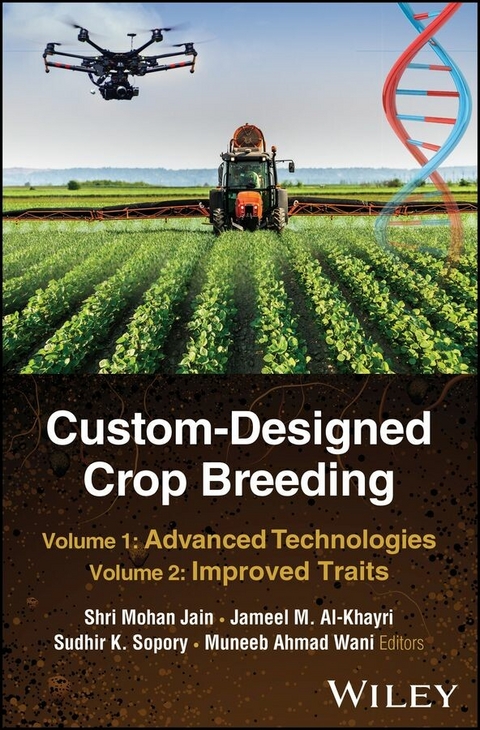
Custom-Designed Crop Breeding (eBook)
1653 Seiten
Wiley (Verlag)
978-1-394-19258-8 (ISBN)
Discover strategies to develop crop plants with specific traits needed to meet the specific challenges.
Climate change poses an existential threat to global food supplies, with even modest increases in global temperature potentially spelling disaster for crop productivity. Plant breeders have applied traditional methods and developed new crop varieties to maintain productivity under specific conditions, but there is an urgent need to go much further. We must harness the broadest possible range of genomic data and crop breeding practices to create the next generation of resilient food crops.
Custom-Designed Crop Breeding highlights the use of omics-based knowledge, precision genetics, and molecular techniques to breed new climate-resistant crops. Beginning with an overview of both present and future scenarios in which functional genomics is applied to crops, it moves through crop breeding techniques, design of crops for stress tolerance, and more. The result is an essential tool in the fight for a sustainable food supply.
Custom-Designed Crop Breeding: Volume 1 - Advanced Technologies offers a comprehensive exploration of cutting-edge advancements driving modern crop improvement. This volume highlights innovative methodologies in genomics, climate-resilient breeding strategies, and the transformative role of artificial intelligence (AI) and machine learning (ML) in precision agriculture. Spanning diverse topics, including genomic tools, high-throughput phenotyping, bioinformatics integration, and next-gen AI-driven predictions, this book serves as an essential resource for researchers, breeders, and professionals seeking to revolutionize agricultural practices for sustainability and productivity.
Custom-Designed Crop Breeding: Volume 2 - Improved Traits delves into innovative strategies for engineering crops with enhanced traits to address global agricultural challenges. This volume is structured around three critical themes: abiotic stress tolerance, biotic stress resistance, and improved nutritional and pharmaceutical quality. Edited by leading experts, it offers a thorough exploration of advanced techniques like haplotype-based breeding, genomic selection, and root system optimization, along with the development of designer crops for resilience, sustainability, and functional applications.
Custom-Designed Crop Breeding readers will also find:
- Designer crop solutions for abiotic and biotic stresses, including drought, salinity, insects, and fungal diseases.
- Highlights on the development of crops tailored for functional foods, herbal, and aromatic applications.
- Presents the latest methodologies, such as haplotype-based breeding, genomic selection, and root architecture optimization for improved yield and resilience.
Custom-Designed Crop Breeding is ideal for professionals and researchers interested in genetic improvements of crop plants based on innovative breeding technologies.
Shri Mohan Jain, is a Professor in the Department of Agricultural Sciences, University of Helsinki, Helsinki, Finland.
Jameel M. Al-Khayri, is a Professor in the Department of Agricultural Biotechnology, College of Agriculture and Food Sciences, King Faisal University, Al-Ahsa, Saudi Arabia.
Sudhir K. Sopory, is a Professor and SERB (Government of India) Distinguished Fellow and Senior Emeritus Scientist at the International Centre for genetic Engineering and Biotechnology, New Delhi, India.
Muneeb Ahmad Wani, is an Assistant Professor cum Junior Scientist in the Department of Floriculture & Landscape Architecture, Sher-e-Kashmir University of Agricultural Sciences & Technology of Kashmir, Srinagar, India
Discover strategies to develop crop plants with specific traits needed to meet the specific challenges. Climate change poses an existential threat to global food supplies, with even modest increases in global temperature potentially spelling disaster for crop productivity. Plant breeders have applied traditional methods and developed new crop varieties to maintain productivity under specific conditions, but there is an urgent need to go much further. We must harness the broadest possible range of genomic data and crop breeding practices to create the next generation of resilient food crops. Custom-Designed Crop Breeding highlights the use of omics-based knowledge, precision genetics, and molecular techniques to breed new climate-resistant crops. Beginning with an overview of both present and future scenarios in which functional genomics is applied to crops, it moves through crop breeding techniques, design of crops for stress tolerance, and more. The result is an essential tool in the fight for a sustainable food supply. Custom-Designed Crop Breeding: Volume 1 Advanced Technologies offers a comprehensive exploration of cutting-edge advancements driving modern crop improvement. This volume highlights innovative methodologies in genomics, climate-resilient breeding strategies, and the transformative role of artificial intelligence (AI) and machine learning (ML) in precision agriculture. Spanning diverse topics, including genomic tools, high-throughput phenotyping, bioinformatics integration, and next-gen AI-driven predictions, this book serves as an essential resource for researchers, breeders, and professionals seeking to revolutionize agricultural practices for sustainability and productivity. Custom-Designed Crop Breeding: Volume 2 Improved Traits delves into innovative strategies for engineering crops with enhanced traits to address global agricultural challenges. This volume is structured around three critical themes: abiotic stress tolerance, biotic stress resistance, and improved nutritional and pharmaceutical quality. Edited by leading experts, it offers a thorough exploration of advanced techniques like haplotype-based breeding, genomic selection, and root system optimization, along with the development of designer crops for resilience, sustainability, and functional applications. Custom-Designed Crop Breeding readers will also find: Designer crop solutions for abiotic and biotic stresses, including drought, salinity, insects, and fungal diseases. Highlights on the development of crops tailored for functional foods, herbal, and aromatic applications. Presents the latest methodologies, such as haplotype-based breeding, genomic selection, and root architecture optimization for improved yield and resilience. Custom-Designed Crop Breeding is ideal for professionals and researchers interested in genetic improvements of crop plants based on innovative breeding technologies.
Contributors
Mohmed A. Abdein
Seed Development Department
El-Nada Misr Scientific Research and Development Projects
Mansoura
Egypt
Hala M. Abdelmigid
Botany Department
Faculty of Science
Mansoura University
Mansoura
Egypt
Biotechnology Department
Faculty of Science
Taif University
Taif
Saudi Arabia
Sumaiyah Abdullah
Department of Plant Protection
Faculty of Agriculture
Universiti Putra Malaysia, Serdang
Malaysia
Ishtiaq Ahmad
Department of Horticultural Sciences
Faculty of Agriculture and Environment
The Islamia University of Bahawalpur
Bahawalpur
Pakistan
Hafiz Ghulam Muhu-Din Ahmed
Department of Plant Breeding and Genetics
Faculty of Agriculture and Environment
The Islamia University of Bahawalpur
Bahawalpur
Pakistan
Beena Alam
State Key Laboratory of Cotton Biology
Key Laboratory of Biological and Genetic Breeding of Cotton
The Ministry of Agriculture
Institute of Cotton Research
Chinese Academy of Agricultural Sciences
Anyang
China
Muhammad Fraz Ali
College of Agronomy
Northwest A & F University
Yangling
Shaanxi
China
Khalid H. Alobaidi
Department of Plant Biotechnology
College of Biotechnology
Al-Nahrain University
Baghdad
Iraq
Department of Plant Protection
Faculty of Agriculture
Universiti Putra Malaysia
Serdang
Malaysia
Jameel R. Al-Obaidi
Department of Biology
Faculty of Science and Mathematics
Universiti Pendidikan Sultan Idris
Tanjong Malim
Malaysia
Muhammad Tanveer Altaf
Faculty of Agricultural Sciences and Technology
Sivas University of Science and Technology
Sivas
Turkey
Faheem Shehzad Baloch
Department of Biotechnology
Faculty of Science
Mersin University
Yenişehir
Türkiye
Celaleddin Barutçular
Department of Field Crops
Faculty of Agriculture
Institute of Natural and Applied Sciences
Çukurova University
Adana
Turkey
Min-Hui Bi
State Key Laboratory of Grassland
Agro-Ecosystems
College of Ecology
Lanzhou University
Lanzhou
China
Shantanu Y. Chavan
Sant Dnyaneshwar Mahavidyalaya
Soegaon
India
Rukoo Chawla
Department of Genetics and Plant
Breeding
MPUAT
Udaipur
India
Bharadwaj Chellapilla
School of Agriculture and Environment
The University of Western Australia
Perth
Australia
Mukesh Choudhary
ICAR-Indian Institute of Maize Research
Ludhiana
India
Mihaiela Cornea-Cipcigan
Department of Horticulture and Landscaping
Faculty of Horticulture and Business in Rural Development
University of Agricultural Sciences and Veterinary Medicine Cluj-Napoca
Cluj-Napoca
Romania
Mohamed Nejib El Melki
Higher School of Engineers of Medjezel Bab
Department of Mechanical and AgroIndustrial Engineering
University of Jandouba
Jendouba
Tunisia
Irsa Ejaz
Department of Crop Science
Division of Agronomy
University of Göttingen
Göttingen
Germany
Karima Mohamed El-Absy
Biology Department
University College of Tayma
University of Tabuk
Tabuk
Saudi Arabia
Eco-physiology Unit
Plant Ecology and Ranges Department
Desert Research Center
Cairo
Egypt
Mohamed El-Absy
Eco-physiology Unit
Plant Ecology and Ranges Department
Desert Research Center
Cairo
Egypt
Essam Fathy El-Hashash
Department of Agronomy
Faculty of Agriculture
Al-Azhar University
Cairo
Egypt
Tehreem Fatima
Department of Plant Breeding and Genetics
Faculty of Agriculture and Environment
The Islamia University of Bahawalpur
Bahawalpur
Pakistan
Firoz Hossain
ICAR-Indian Agricultural Research Institute
New Delhi
India
Siti Nahdatul Isnaini Said Hussin
Agro-Biotechnology Institute Malaysia (ABI)
National Institutes of Biotechnology Malaysia (NIBM)
Serdang
Malaysia
Jaweria Iqbal
Department of Plant Breeding and Genetics
Faculty of Agricultural Sciences and Technology
Bahauddin Zakariya University
Multan
Pakistan
Amna Jamil
Department of Horticulture
MNS University of Agriculture
Multan
Pakistan
Muhammad Faheem Jan
College of Agriculture
Northeast Agricultural University
Harbin
China
Kishore Pundlik Jeughale
Crop Improvement Division
ICAR-National Rice Research Institute
Cuttack
India
Rohit Joshi
Division of Biotechnology
CSIR-Institute of Himalayan Bioresource Technology
Palampur
India
Nimra Khaliq
Department of Plant Breeding and Genetics
Faculty of Agriculture and Environment
The Islamia University of Bahawalpur
Bahawalpur
Pakistan
Mueen Alam Khan
Department of Plant Breeding and Genetics
Faculty of Agriculture and Environment
The Islamia University of Bahawalpur
Bahawalpur
Pakistan
Sudhir Kumar
ICAR—Indian Agricultural Research Institute
New Delhi
India
Waqas Liaqat
Department of Field Crops
Faculty of Agriculture
Institute of Natural and Applied Sciences
Çukurova University
Adana
Turkey
Thomas Lübberstedt
Department of Agronomy
Iowa State University
Ames
USA
Lijuan Ma
College of Agronomy
Northwest A & F University
Yangling
China
Rodica Mărgăoan
Department of Animal Production and Food Safety
Faculty of Veterinary Medicine
University of Agricultural Sciences and Veterinary Medicine
Cluj-Napoca
Romania
Muhammad Ahtasham Mushtaq
Department of Plant Breeding and Genetics
Faculty of Agriculture and Environment
The Islamia University of Bahawalpur
Bahawalpur
Pakistan
Vignesh Muthusamy
ICAR-Indian Agricultural Research Institute
New Delhi
India
Muhammad Azhar Nadeem
Faculty of Agricultural Sciences and Technology
Sivas University of Science and Technology
Sivas
Turkey
Naresh
Department of Genetics and Plant Breeding
CCS Haryana Agricultural University
Hisar
India
Sneha-Priya Pappula-Reddy
The UWA Institute of Agriculture
The University of Western Australia
Perth
Australia
Fatimah Azzahra Ahmad Rashid
Department of Biology
Faculty of Science and Mathematics
Universiti Pendidikan Sultan Idris
Tanjong Malim
Malaysia
Ravikiran K.T
ICAR-Central Soil Salinity Research Institute
Regional Research Station
Lucknow
India
Raj Kishore Sahoo
Crop Improvement Division
ICAR-National Rice Research Institute
Cuttack
India
Kajal Samantara
Institute of Technology
University of Tartu
Tartu
Estonia
Abhishek Kumar Shrivastav
Mayo Clinic
Scottsdale
USA
Kadambot H.M. Siddique
The UWA Institute of...
| Erscheint lt. Verlag | 11.11.2025 |
|---|---|
| Sprache | englisch |
| Themenwelt | Naturwissenschaften ► Biologie ► Genetik / Molekularbiologie |
| Schlagworte | AI • Crop design • Crop improvement • electronic plant • Gene Mining • genetic variation of plant • Gene Transformation • Genome editing • marker assisted breeding • Plant Breeding • plant breeding technology • plant improvement tool • plant mutation • Robotics |
| ISBN-10 | 1-394-19258-4 / 1394192584 |
| ISBN-13 | 978-1-394-19258-8 / 9781394192588 |
| Informationen gemäß Produktsicherheitsverordnung (GPSR) | |
| Haben Sie eine Frage zum Produkt? |
 EPUB (Adobe DRM)
Kopierschutz: Adobe-DRM
Adobe-DRM ist ein Kopierschutz, der das eBook vor Mißbrauch schützen soll. Dabei wird das eBook bereits beim Download auf Ihre persönliche Adobe-ID autorisiert. Lesen können Sie das eBook dann nur auf den Geräten, welche ebenfalls auf Ihre Adobe-ID registriert sind.
Details zum Adobe-DRM
Dateiformat: EPUB (Electronic Publication)
EPUB ist ein offener Standard für eBooks und eignet sich besonders zur Darstellung von Belletristik und Sachbüchern. Der Fließtext wird dynamisch an die Display- und Schriftgröße angepasst. Auch für mobile Lesegeräte ist EPUB daher gut geeignet.
Systemvoraussetzungen:
PC/Mac: Mit einem PC oder Mac können Sie dieses eBook lesen. Sie benötigen eine
eReader: Dieses eBook kann mit (fast) allen eBook-Readern gelesen werden. Mit dem amazon-Kindle ist es aber nicht kompatibel.
Smartphone/Tablet: Egal ob Apple oder Android, dieses eBook können Sie lesen. Sie benötigen eine
Geräteliste und zusätzliche Hinweise
Buying eBooks from abroad
For tax law reasons we can sell eBooks just within Germany and Switzerland. Regrettably we cannot fulfill eBook-orders from other countries.
aus dem Bereich